
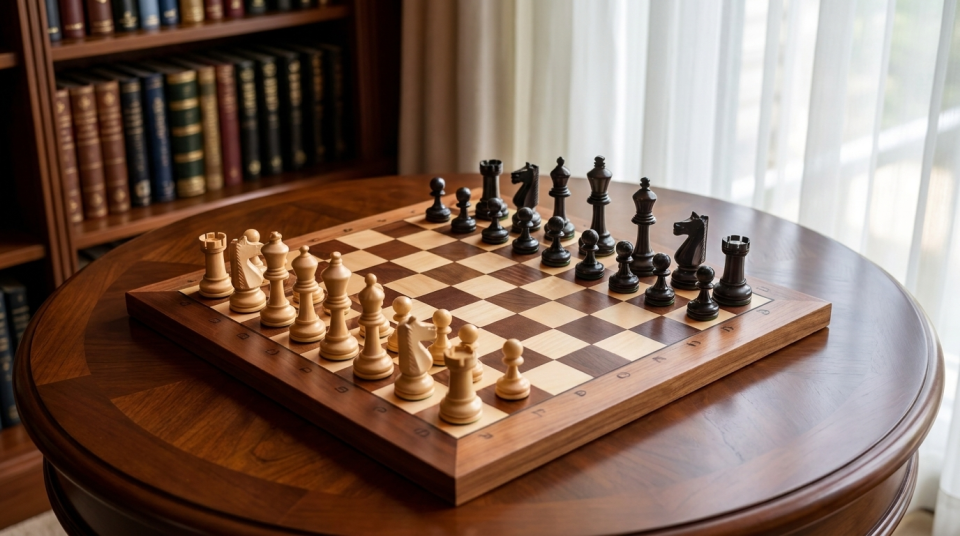
You solve anagrams for fun. You spot the Wordle in three guesses and feel a quiet satisfaction that carries you through the morning. You untangle Connections groups that were designed to trick you, and you do it before your coffee gets cold.
So why does chess feel like a completely different universe?
Here’s the thing: it isn’t. Not really. The skills you’ve been sharpening through word games and daily puzzles are the exact same skills that separate a good chess player from someone who stares at the board and panics.
You’ve just never thought about it that way.
Pattern Recognition Is the Whole Game
Every time you look at a jumble of letters and see a word hiding inside them, you’re doing something your brain has trained itself to do through repetition: recognizing patterns in apparent chaos.
]Chess works the same way. A strong player doesn’t calculate every possible move from scratch. They look at the board and see patterns they’ve encountered before. A fork (where one piece attacks two at once). A pin (where a piece is stuck because moving it would expose something more valuable behind it). A back-rank weakness that’s about to become a checkmate.
If you’ve ever played Connections and instantly spotted the grouping that links four seemingly unrelated words, you already know what pattern recognition feels like. The difference is that in chess, the patterns are spatial instead of linguistic. The underlying cognitive skill is identical.
What’s more, research backs this up. Studies on expert chess players consistently show that their advantage isn’t raw calculation power. It’s the ability to chunk information into recognizable patterns, then recall the right response. Sound familiar? That’s exactly what you do when you see “AELRT” and your brain instantly finds “ALTER,” “LATER,” and “ALERT.”
You Already Think in Constraints
Word games train you to work within rules. Five letters. One guess per row. No repeated letters. These constraints aren’t limitations. They’re the structure that makes the puzzle solvable.
Chess is all constraints. The bishop only moves diagonally. The knight makes that weird L-shape. Pawns can only capture forward-diagonally but move forward in a straight line (and yes, en passant is a real rule, not a myth your friend made up to win an argument).
Players who are comfortable thinking inside tight constraints, rather than being paralyzed by them, adapt to chess faster than people who come in expecting total freedom. Word game players are already wired this way. You don’t resent that Wordle only gives you six guesses. You use each one with intention. That same discipline is exactly what chess demands.
Strategic Thinking vs. Tactical Thinking (You Do Both)
In word games, there’s a constant tension between two modes of thought. There’s the strategic layer: “I should guess a word with common vowels first to narrow things down.” And there’s the tactical layer: “Wait, if the E is in position three and I know there’s no A, then the word has to be…”
Chess has the same split. Strategy is the big picture: control the center, develop your pieces, keep your king safe. Tactics are the sharp, concrete sequences: “If I move my knight here, it forks the queen and the rook, and there’s nothing they can do about it.”
Most beginners only think tactically. They react to what’s right in front of them. Players who come from a puzzle background tend to hold both layers at once, because that’s what daily games have trained them to do. You’ve been toggling between “what’s my overall approach” and “what’s the specific move right now” for years. In chess, that toggle is everything.
Process of Elimination Is Your Superpower
One of the most underrated skills in chess is knowing what not to do. Beginners look at a position and see 30 possible moves. Strong players immediately eliminate 25 of them based on pattern recognition and basic principles, then focus their energy on the remaining five.
This is how you already solve puzzles. When you’re working through an anagram and you see a Q without a U, you know certain letter combinations are off the table. When you’re guessing in Wordle and a letter goes grey, you don’t waste another guess on it. You narrow the field, efficiently, almost automatically.
In chess, this translates directly. “That move hangs my queen, so no. That move weakens my king’s position, so no. That move doesn’t develop a piece, so it’s probably not the best use of my turn.” The elimination happens fast because the principles are clear. Puzzle players already have the muscle memory for this kind of structured narrowing. They just need the chess-specific principles to apply it to (and those are learnable in an afternoon).
Short Sessions, High Focus, Daily Repetition
There’s a reason daily games work. The format, one puzzle per day, five minutes of focused attention, is perfectly designed for building skill over time without burnout.
Chess training works exactly the same way. The players who improve fastest aren’t the ones who play five-hour marathon games. They’re the ones who spend 10 to 15 minutes a day on tactical puzzles, study one opening for a few minutes, and play a quick game or two. Short, focused, daily.
If your morning routine already includes a Wordle, a Connections, and maybe an anagram puzzle, adding a few chess puzzles to the rotation is a natural fit. Same structure. Same satisfaction. Different board.
The Crossover Is Real
I’m not suggesting you’ll become a grandmaster because you’re good at Spelling Bee. Chess has its own deep complexity, and getting genuinely strong takes real study and practice.
But the gap between “I’ve never played chess” and “I’m a competent, improving player who actually understands what’s happening” is much smaller than most people think. Especially if you already spend time each day solving puzzles, recognizing patterns, and thinking inside constraints.
The skills transfer. The mindset transfers. The daily habit transfers. You’re closer to being a chess player than you realize.
Curious? Chess411 is built for exactly this: daily challenges, opening guides, tactical training, and puzzles designed to help you improve. It’s like having a word solver for your chess game, except the solver is your own brain getting sharper.
