
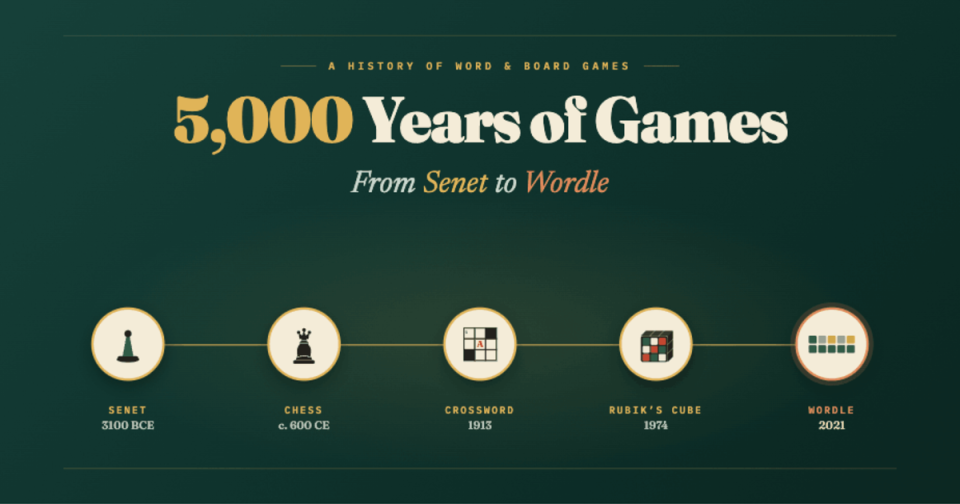
Every morning, millions of people open a phone, tap out a five-letter guess, and share a small grid of coloured squares. You might assume this is a strictly modern routine, but in reality, this daily habit has been with us for millennia.
The human drive to tackle a daily brain-teaser spans more than five thousand years, ever since Egyptians pushed pieces across a Senet board. The desire to play is timeless; only the canvas has changed. We have always adapted our games to the materials of the day, moving from carved stone and newspaper grids to plastic cubes, desktop computers, and modern mobile apps. It is a continuous, unbroken line stretching from the tombs of Egypt straight to today’s Wordle.
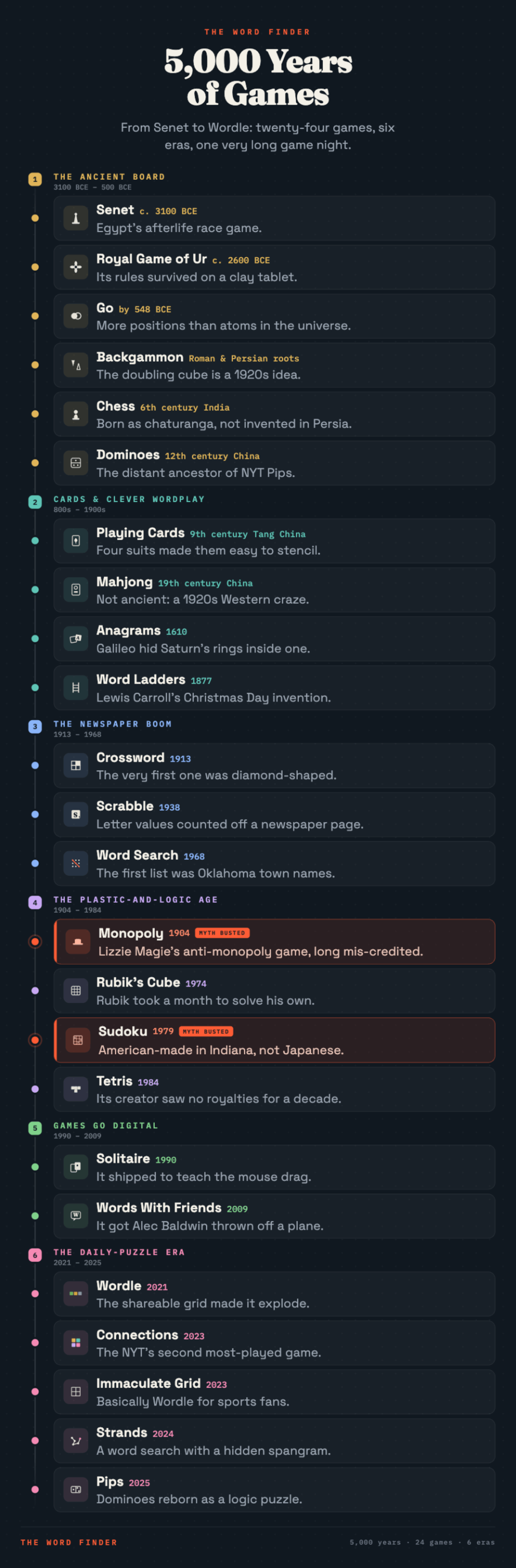
Here is the whole journey, from the oldest games we can still name to the daily puzzles we cannot put down.
The ancient board: 3000 BCE onward
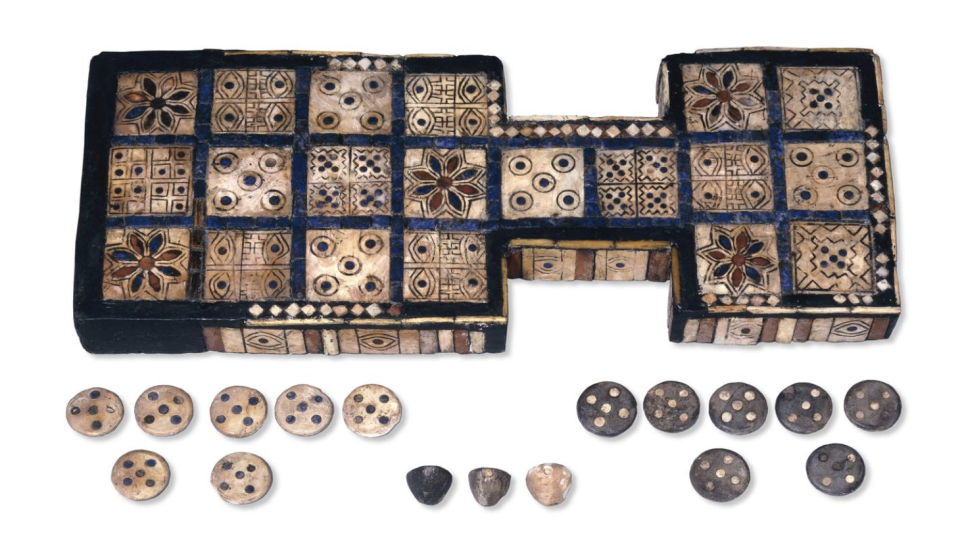
The first games we know by name were played on boards, because a board was the technology available. Around 3100 BCE, Egyptians were playing Senet, a race game so beloved that it became a symbol of the journey through the afterlife, with the dead shown playing it against an unseen opponent. A few centuries later in Mesopotamia came the Royal Game of Ur, and we know how to play it only because a Babylonian scribe wrote the rules on a clay tablet in 177 BCE, which British Museum curator Irving Finkel later decoded. We cover these in full in our guide to the world’s oldest board game.
Strategy games arrived next and have never left. Go emerged in China more than 2,500 years ago and holds more possible board positions than there are atoms in the observable universe, which is why no computer could beat a top human at it until 2016. Chess grew out of the Indian game chaturanga by the 6th century, its piece types modelled on the divisions of an army. It was not invented in Persia, a common mix-up that traces to the word checkmate, which comes from the Persian shah mat. Persia passed the game along, but it was India who built it.
Two of these ancient games still shape what we make today. Backgammon’s race mechanic runs back through Roman and Persian versions for two thousand years, and dominoes began in 12th-century China. That domino line runs straight to the New York Times’ 2025 puzzle Pips, which our NYT Pips solver helps you crack. The chess thread runs to our own chess site, Chess411, and to Takes, a solitaire-chess game.
Cards and clever wordplay: 9th to 19th century
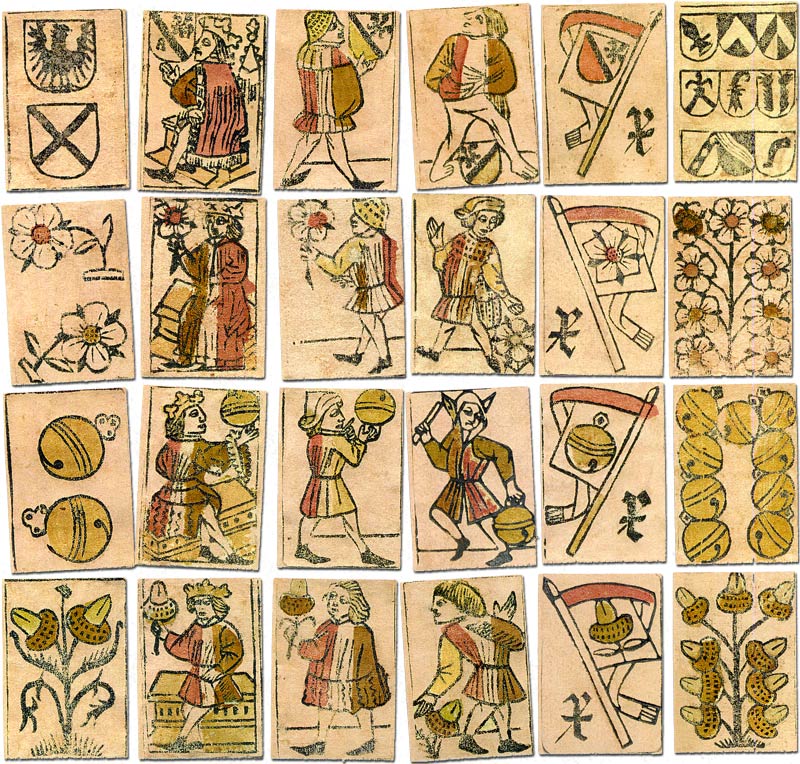
Paper changed everything. Once China had cheap printing in the Tang dynasty around the 9th century, the playing card was born, reaching Europe by the 1370s and settling into four suits because they were simple to stencil. Mahjong, despite its ancient reputation, is a 19th-century Chinese invention that became a Western craze only in the 1920s, after an American businessman sold a simplified rulebook through Abercrombie and Fitch.
Words became a game too, and in some surprising hands. Long before scientific journals, scholars used anagrams to stake a claim on a discovery without giving it away. In 1610 Galileo announced the rings of Saturn as the jumble smaismrmilmepoetaleumibunenugttauiras, and hid the phases of Venus the same way. Robert Hooke published his law of elasticity as ceiiinosssttuv, which unscrambled to ut tensio sic vis, “as the extension, so the force.” Our Anagram Solver does in a second what those men managed with careful secrecy, and we cover the by-hand method in our guide to anagram solving strategies. The author Lewis Carroll turned wordplay into a proper game on Christmas Day 1877, when he invented Doublets, changing one word into another a single letter at a time. That is the same game you can play today as Flipple in the CleverGoat collection.
The newspaper puzzle boom: 1913 to 1968
The newspaper gave games their next home, and one puzzle proved a good one could sell papers. On 21 December 1913, the journalist Arthur Wynne published a diamond-shaped grid in the New York World that he called a word-cross. A typesetter flipped the words a few weeks later, cross-word stuck, and by 1924 a young firm called Simon and Schuster launched its very first book, a collection of them, into a national craze. The daily crossword was the Wordle of its day, and today our crossword solvers and CleverGoat’s mini crossword, Crossherd, keep it alive.
Two more word games arrived in this stretch. In the 1930s an out-of-work architect named Alfred Butts built Scrabble, and he set the letter values by counting how often each letter appeared on the front page of the New York Times, which is why E is common and Q and Z are worth ten. We dug into that same maths in our piece on the most common letters in English, and our Scrabble Word Finder puts it to work. Then in 1968, in Norman, Oklahoma, a man named Norman Gibat printed the first English word search in a free classified-ads sheet, using Oklahoma town names, and local schoolteachers wrote in begging for copies. You can build your own with our Word Search Maker.
Some games were secretly lessons
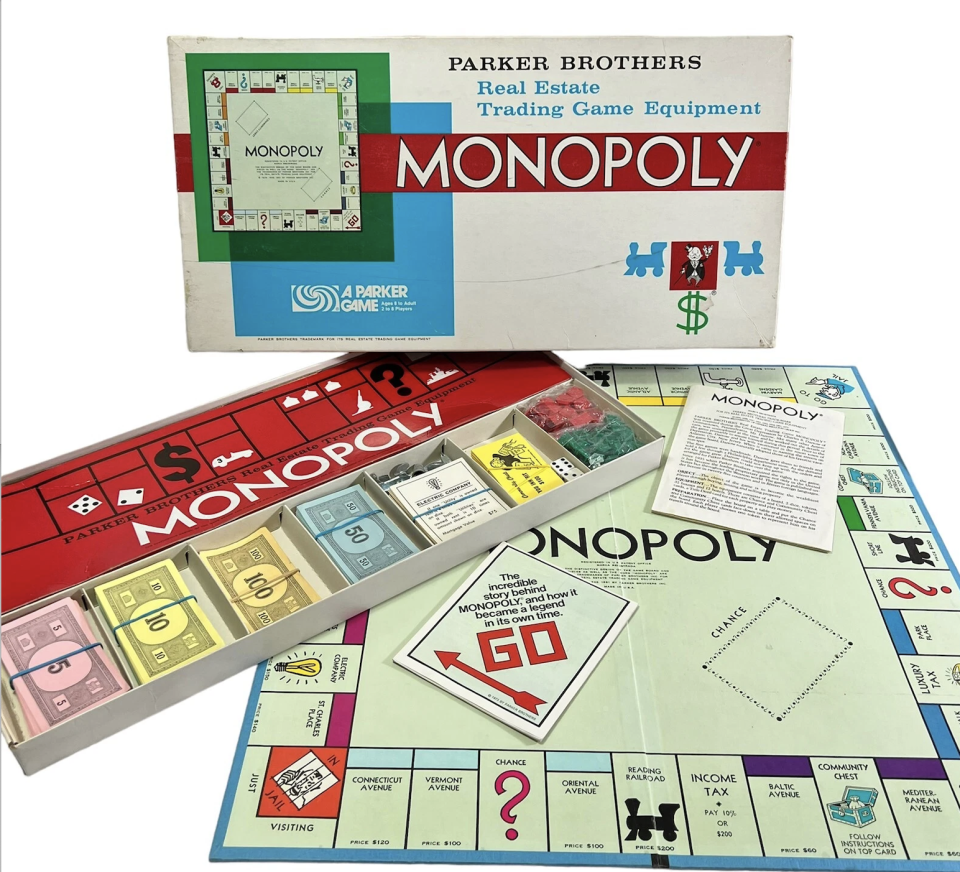
Not every game was built for fun. In 1904 Lizzie Magie patented The Landlord’s Game to show how landlords bleed tenants dry, a warning about the dangers of monopolies. Thirty years later Parker Brothers sold almost the same game as Monopoly, credited a man named Charles Darrow, and wrote Magie out of the story. She had sold her patent for 500 dollars. The lesson she built into the board was the opposite of the one most players take from it.
The plastic-and-logic age: 1970s and 80s
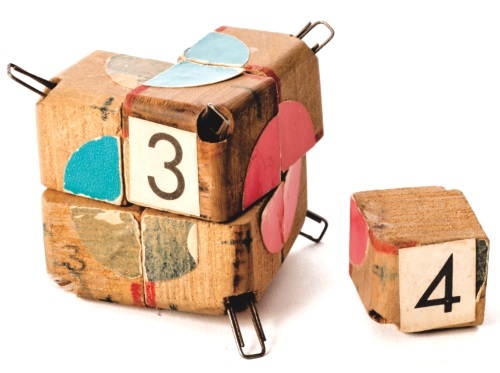
Cheap moulded plastic, and soon the home computer, produced a run of puzzles that still dominate. In 1974 a Hungarian architecture professor, Ernő Rubik, built the Rubik’s Cube as a teaching aid and then needed more than a month to solve his own creation. Here is a myth worth busting: Sudoku is not Japanese. It was created by an American, Howard Garns, in 1979 under the name Number Place, then named and popularised in Japan years later. Garns died in 1989 without ever knowing what his puzzle became. You can play it, and get unstuck, with our Sudoku game and Sudoku Solver. The decade closed with Tetris, built in 1984 by Alexey Pajitnov inside a Soviet computer lab, work that meant he saw no royalties for roughly ten years while the world played his falling blocks.
Games go digital: 1990 to 2010
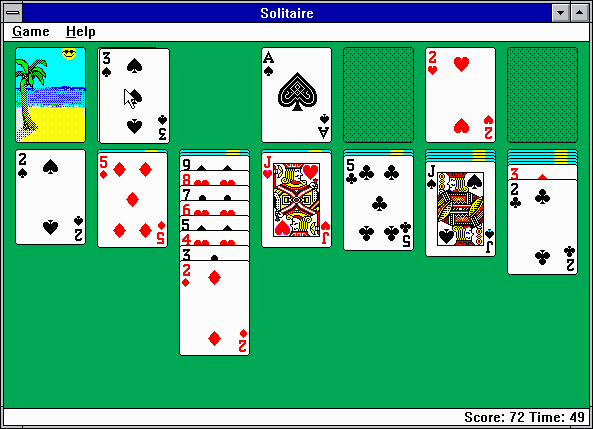
When games moved onto the screen, the most-played of them all arrived by stealth. Microsoft added Solitaire to Windows in 1990 not as a toy but as a lesson, a way to teach nervous new users how to drag and drop with a mouse. It worked so well that people are still playing it. Then the smartphone made games social. Words With Friends launched in 2009 and made play-at-your-own-pace mobile gaming normal, so much so that the actor Alec Baldwin was removed from a plane in 2011 for refusing to stop a game. Our word-game finder helps you spot the play from an awkward rack.
The daily-puzzle era: 2021 to now
Which brings us back to the phone. In 2021 a software engineer named Josh Wardle built a word game for his partner and named it, as a small pun, Wordle. The feature that made it explode was not the game but the spoiler-free grid of coloured squares, which he added later. Players went from around ninety to millions within weeks, and the New York Times bought it in early 2022. It was never an NYT invention. Our Wordle Solver runs on the letter-frequency logic those first guesses rely on, and if five letters feels tight, our own game Lingle plays it with six.
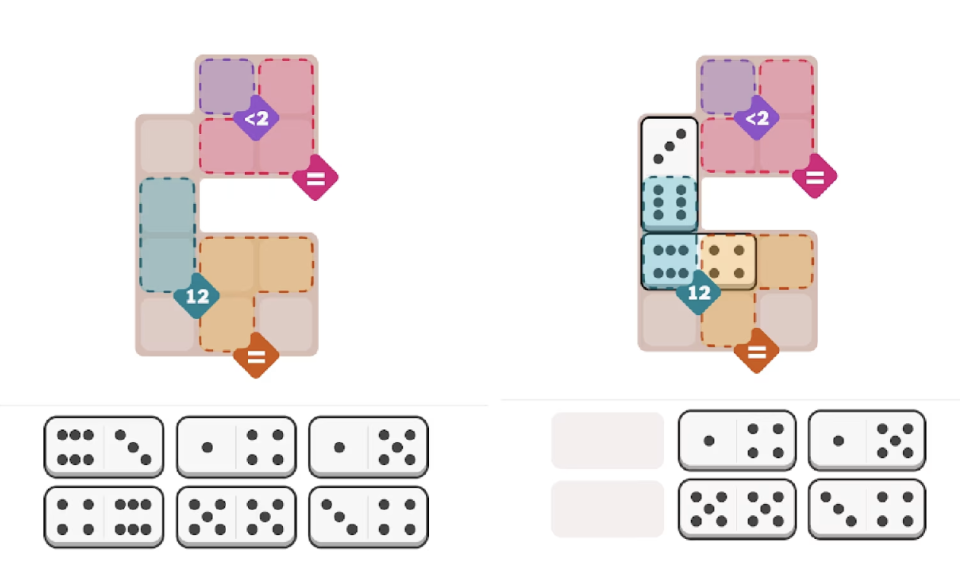
The daily habit spread fast. The NYT’s Connections arrived in 2023 and is now its second most-played game, a grouping puzzle you can get a nudge on from our Connections hints. The same year, an independent developer built Immaculate Grid, a sports-trivia grid one writer called Wordle for sports fans, and we run the same format across HoopGrids, GridIron Grids and MLB Grids. In 2024 the NYT added Strands, a word search with a twist, which our Strands solver untangles, and in 2025 came Pips, a domino logic puzzle that closes a five-thousand-year loop back to those first game pieces, and which our Pips solver will crack for you.
Which of these games do we still search for most?
The old games did not die when the new ones arrived. They made room. Using current monthly US search data, here is how the appetite looks today. Wordle is in a league of its own at around 46 million searches a month, a four-year-old game outdrawing everything before it. The classics endure: Sudoku pulls about 1.7 million, chess about 1.2 million, and the crossword close to half a million, all of them centuries or millennia old. The newest arrivals already rank among them, with Connections near 750,000 and Strands around 600,000. And the game that opened this story, the roughly 4,600-year-old Royal Game of Ur, still gets about 2,200 searches a month from people who want to know where it all began.
| Game | Origin | Global search volume |
|---|---|---|
| Wordle | 2021 | 82,320,000 |
| Solitaire | 1990 (Windows) | 17,440,000 |
| Sudoku | 1979 | 6,640,000 |
| Chess | c. 600 CE (India) | 5,320,000 |
| Mahjong | 19th century (China) | 2,780,000 |
| Tetris | 1984 | 1,790,000 |
| Connections | 2023 | 1,570,000 |
| Scrabble | 1938 | 490,000 |
| Backgammon | Ancient (Roman/Persian roots) | 426,000 |
| Rubik’s Cube | 1974 | 265,000 |
| Pips | 2025 | 186,000 |
| Go | c. 548 BCE (China) | 31,000 |
Five thousand years on, we are still doing what the Egyptians did: sitting down each day to a small, solvable contest, whether it is carved in stone or tapped out in coloured squares.
Frequently asked questions
What is the oldest game in the world?
The oldest games we can name are ancient board games. Senet was played in Egypt by around 3100 BCE, and the Royal Game of Ur in Mesopotamia by about 2600 BCE. The Royal Game of Ur is often called the oldest game we can still actually play, because its rules survived on a clay tablet.
Is Sudoku Japanese?
No. Sudoku was created by an American, Howard Garns, in 1979 under the name Number Place. It was later named Sudoku and popularised in Japan, then went global in 2005, which is why many people assume it is Japanese.
Who invented Monopoly?
Lizzie Magie, who patented The Landlord’s Game in 1904 to criticise land monopolies. Parker Brothers later sold a near-identical game as Monopoly and credited Charles Darrow, writing Magie out of the popular story for decades.
Who invented the crossword?
Arthur Wynne, a journalist who published the first one in the New York World on 21 December 1913. He called it a word-cross; a printer’s error flipped it to cross-word.
What is the oldest word game?
Wordplay games like anagrams are ancient, going back to Greek and Roman times. As printed puzzles, the crossword (1913) is the modern ancestor of most word games, and the word search followed in 1968.
When was Wordle invented?
Josh Wardle built Wordle in 2021 and released it publicly that October. It went viral in December 2021, and the New York Times bought it in January 2022.
