
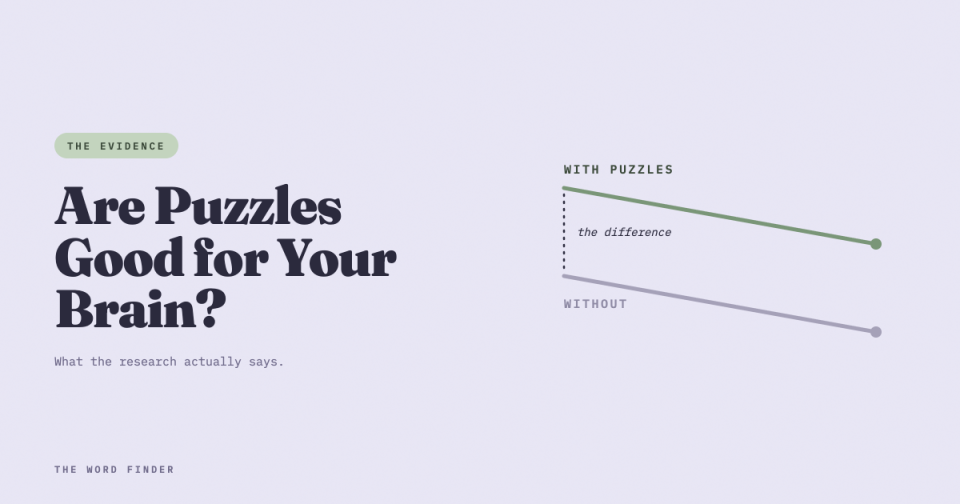
Short answer: yes, but not in the way the headlines promise. Puzzles are linked to sharper thinking, and there is decent trial evidence that crosswords beat commercial brain-training apps. What they almost certainly do not do is stop your brain ageing. That gap between what the research shows and what gets sold is the whole story, so it is worth walking through properly.
What the strongest evidence actually shows
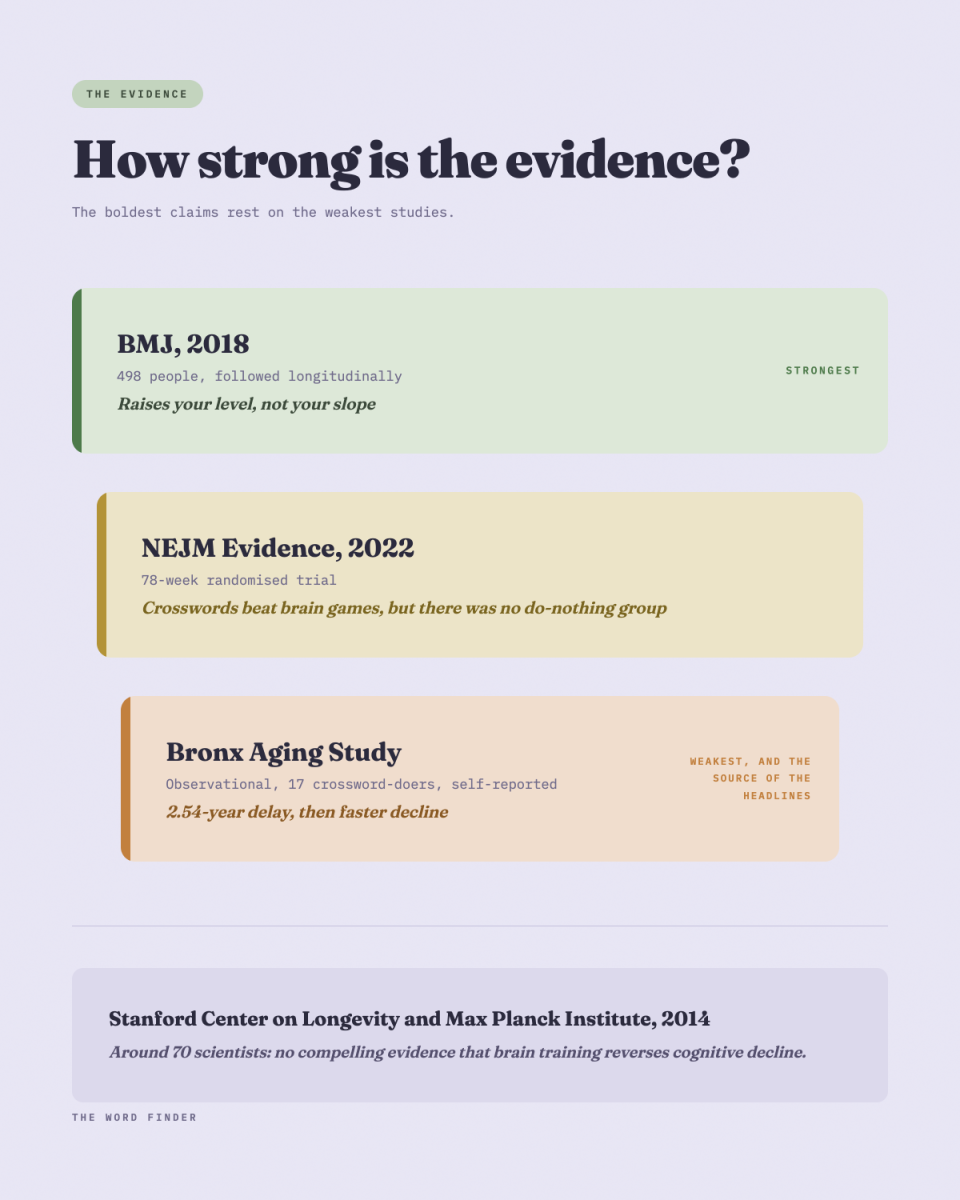
The most useful study on this ran in northeast Scotland and was published in the BMJ in 2018. Researchers followed 498 people, all born in 1936, and asked whether staying intellectually engaged changes how the mind ages.
The finding was split. Intellectual engagement was significantly associated with the level of cognitive performance in later life. It did not influence the trajectory of decline.
Put plainly, puzzles do not flatten the curve. They start you higher up the hill. You still slide at the same gradient, you just slide from further up. That is not nothing, and it is worth being clear about why. Starting higher means it takes longer before decline shows up in your actual daily life. But it is a different promise from the one on the box.
The crossword trial everyone misreads
In 2022, teams at Columbia and Duke published a 78-week randomised trial in NEJM Evidence. People with mild cognitive impairment were assigned either web-based crosswords or intensive computerised brain-training games. Crosswords won. On the main cognitive measure, the early-MCI group got worse on the games and better on the crosswords.
That result is real and it matters. But notice what it does not contain: a do-nothing arm. The trial shows crosswords beat brain games. It does not show crosswords beat not doing crosswords, and the participants were a clinical population, not healthy adults keeping sharp. “Crosswords proven to fight dementia” is not what the paper says.
The dementia claim, told honestly
The finding behind most of those headlines comes from the Bronx Aging Study. A 2011 follow-up reported that people who did crosswords and later developed dementia hit the point of accelerated memory decline about 2.54 years later than those who did not.
Now the part that rarely survives the retelling. Once decline began, it ran faster in the crossword group, by roughly 3.31 points a year. That is precisely what cognitive reserve theory predicts. Reserve masks the damage for longer, so when the mask finally slips, more has already accumulated underneath. The crosswords did not slow the disease. They hid it, and then it arrived at speed.
The caveats are heavy too. Seventeen crossword-doers. Self-reported activity. Observational, which leaves reverse causation wide open, since people whose thinking is already slipping may quietly stop doing puzzles in the first place.
Meanwhile, in 2014, around 70 cognitive psychologists and neuroscientists signed a consensus statement from the Stanford Center on Longevity and the Max Planck Institute. Their verdict: no compelling evidence that brain training reduces or reverses cognitive decline, and claims that say otherwise “exploit the anxiety of adults facing old age for commercial purposes.”
So the defensible claim is this. Puzzles are associated with a higher cognitive baseline. Not that puzzles protect your brain.
Then why do they feel so good?
This is the better question, and here the science is genuinely lovely.
The aha moment is real, and visible
In 2004, Mark Jung-Beeman and John Kounios published work in PLoS Biology showing that when people crack a word problem by sudden insight rather than by grinding through it, there is a burst of high-frequency gamma activity over the right anterior superior temporal gyrus, roughly above and in front of your right ear. It lands almost exactly when the answer becomes conscious. Solve the same problem analytically and the burst is simply absent.
The detail I love comes just before it. Alpha activity rises over the visual cortex a moment earlier, which looks like the brain briefly dimming incoming vision. A mental blink, right before the answer surfaces. That is why insight feels like it arrived from nowhere. It did not. You just stopped looking for a second.
Anagrams have their own place in this research, and they earn it precisely because they can be solved either way, by grinding or by sudden click, which lets researchers compare both routes on the same puzzle.
Difficulty is not a bug
Flow depends on challenge matching skill. A 2020 study in the Journal of Behavioral Addictions tested that on a puzzle game and found something worth sitting with: players reported a stronger urge to keep playing after the regular and hard rounds, where flow happened, and a weaker urge after the easy ones.
Easy puzzles do not hook you. They bore you. A daily puzzle has to be able to beat you or it stops working.
The reward is the surprise
Dopamine does not code pleasure. It codes prediction error, the gap between what you expected and what you got, which Wolfram Schultz’s team established through work on reward uncertainty. A puzzle you might or might not crack, quickly or slowly, keeps that error alive every single day. A puzzle you always solve stops producing it. The uncertainty is the point.
And the bit that turns out to be wrong
You will read everywhere that unfinished tasks lodge in memory, the Zeigarnik effect, and that this is why an unsolved grid nags at you all afternoon. It is a lovely story. A 2025 meta-analysis put the recall ratio between interrupted and completed tasks at 0.99, which is no reliable memory advantage at all, and concluded that the original 1927 figures were inflated. The authors called their own analysis “quite sobering.”
What did survive is its neighbour, the Ovsiankina effect: the pull to resume an interrupted task replicates reliably. So the unfinished Wordle is not burning brighter in your memory. It is just tugging you back to finish it. Which, for a daily puzzle, is the more useful truth anyway.
What this means for your morning puzzle
Do the puzzle. Just do it for the right reason. It will not immunise you against ageing, and anyone selling you that is, in the words of seventy scientists, trading on fear. What it will do is keep you at a higher baseline, hand you a small daily hit of genuine insight, and give you the specific pleasure of a problem that fights back and then gives way.
That is enough. If you want one to start with, our Wordle Solver is there for the mornings the answer will not come, our Anagram Solver handles the jumbles, and we keep a running list of daily games worth playing when one a day stops being enough.
Frequently asked questions
Are puzzles good for your brain?
Yes, with a caveat. Puzzles are associated with better cognitive performance, but the strongest long-term evidence, a 2018 BMJ study, found that intellectual engagement raises your level of performance without changing the rate of age-related decline. Puzzles start you higher up the hill rather than flattening the slope.
Do crossword puzzles prevent dementia?
No, and the evidence for delay is weaker than headlines suggest. One study found crossword-doers reached accelerated memory decline about 2.54 years later, but it rested on 17 self-reporting participants, and once decline started it ran faster in that group, which is what cognitive reserve predicts.
Do brain-training games work?
The evidence is poor. In 2014 around 70 cognitive scientists signed a consensus statement finding no compelling evidence that brain training reduces or reverses cognitive decline. A 2022 randomised trial found crosswords outperformed computerised brain-training games in people with mild cognitive impairment.
Why do puzzles feel so satisfying?
The aha moment has a measurable brain signature: a burst of gamma activity over the right temporal lobe at the instant the answer becomes conscious, preceded by a brief dimming of visual input. That is why solutions feel like they arrive from nowhere.
Why can’t I stop thinking about an unfinished puzzle?
Not because unfinished tasks stick in memory, which a 2025 meta-analysis found does not hold up. The effect that does replicate is the urge to resume an interrupted task. The puzzle is not haunting your memory, it is pulling you back to finish it.
Are easy puzzles less enjoyable?
Apparently so. A 2020 study found players felt a stronger urge to keep playing after harder rounds, where they hit flow, and less after easy ones. A puzzle that cannot beat you stops being interesting.
