
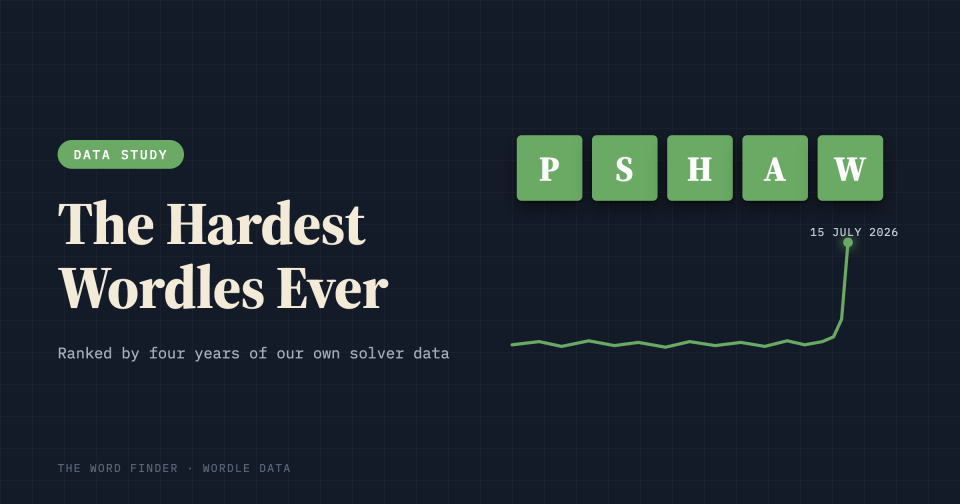
The hardest Wordle in our records is PSHAW, the puzzle for Wednesday 15 July 2026 (#1852). That day, help-seeking on our Wordle Solver ran 98.9% above a normal day. Put simply, it doubled, the biggest one-day spike in more than four years of data. GUANO (#646, 27 March 2023) is second at 84.1%, and UVULA (#1244, 14 November 2024) third at 79.9%.
Players felt it at the time. One veteran Wordle columnist called PSHAW the hardest and most unfair puzzle of all his years covering the game. WordleBot put the average solve at 4.7 guesses, and the Times’ own testers averaged six guesses out of six. The NYT Games social team even marked the day with a post of its own.
We run The Word Finder’s Wordle Solver, the page people open when today’s puzzle has beaten them. When a Wordle is hard, visits jump, because players stuck halfway down the grid go looking for a way out. That makes our traffic an unusual but useful difficulty meter.
This update adds three more months of puzzles, recalculates every figure from a fresh export, and tests the patterns behind the hardest days against all 1,948 Wordle answers so far.
What changed in this update (22 October 2026)
- Data now runs to 18 October 2026, up from 16 July.
- PSHAW’s figure is now final at 98.9%, up from a provisional 79.8%, which moves it to first place.
- We recalculated every figure from a fresh export of our analytics. Older figures all rose slightly, by 0.3 to 2.1 points, and AFFIX and ZEBRA swapped places.
- GAMUT (#1213, 14 October 2024) joins the top 12. It qualified for the original list and was missed. UMBRA, 12th last time, now sits 15th, about a tenth of a point behind OZONE and ENNUI.
- New sections: the hardest Wordles of 2026 so far, back-to-back hard days, the five patterns tested against every answer, and a full top-30 table.
How we arrived at this post
Source: Daily visits to our Wordle Solver from 15 August 2022 to 18 October 2026, taken from our own analytics.
What counts as hard: A one-day spike at least 30% above a 28-day baseline centred on that date, made up of the 14 days before and the 14 after. The days on either side must stay under that mark. Requiring a single isolated day keeps out multi-day surges, which a viral mention or a traffic event can cause as easily as a puzzle.
Matching: We match every spike to that day’s answer using our past Wordle answers archive.
A control: On 29 of our 30 hardest days, traffic to our Anagram Solver, the busiest page on our site, stayed between 2% below and 10% above normal. On PSHAW day it rose 15% while the Wordle Solver doubled. The spikes belong to Wordle, and a generally busy day for the site does not explain them.
Five limitation we have:
- Our traffic more than tripled over the period. The rolling baseline handles that, because it compares each day only with the four weeks around it.
- Our records have two holes. From 17 October 2023 to 13 May 2024, and again from 30 August to 8 September 2024, our analytics recorded almost no visits to the solver. We leave out any day whose baseline would reach into those stretches, so puzzles from late 2023 and early 2024 cannot appear here.
- The last fortnight is provisional. A centred baseline needs 14 days after the puzzle, so we measure days after 4 October against the 28 days before them instead. We will rerun them at the next update.
- We do not adjust for the day of the week. In 2026 our Saturdays ran about 7% below an average day, so the same puzzle would likely score a few points lower on a Saturday.
- Our data starts in August 2022, after the famously brutal CYNIC (#240), CAULK (#242) and NYMPH (#281). They may well belong on this list. We cannot measure them, so we leave them out.
The 12 hardest Wordles

- PSHAW (#1852, 15 July 2026): 98.9% above a normal day.Our biggest spike on record, and the day help-seeking doubled. The full breakdown is below.
- GUANO (#646, 27 March 2023): 84.1%. Bat and seabird droppings, sold as fertiliser. Most players know the word and have never typed it, and once A and N are in place it hides behind dozens of commoner words such as PLANT, STAND and GIANT.
- UVULA (#1244, 14 November 2024): 79.9%. The dangly bit at the back of your throat. Two U’s and a V, one of the rarest letters in the answer list.
- MYRRH (#1644, 19 December 2025): 63.8%. No A, E, I, O or U, a doubled R, and an RH ending. Most people meet the word once a year in a carol, and this one landed six days before Christmas.
- GIZMO (#1606, 11 November 2025): 61.2%. A Z in the middle of the word, a spot where almost no opening word looks for one.
- AFFIX (#1286, 26 December 2024): 59.9%. Two traps in five letters, a doubled F and an X, served up on Boxing Day.
- ZEBRA (#1106, 29 June 2024): 59.3%. Everyone knows the word. Almost nobody opens with Z, so by the time it turns up you can be three guesses down.
- KAZOO (#730, 19 June 2023): 58.8%. K and Z are both rare, and the double O catches people out because openers almost never repeat a letter.
- EERIE (#1773, 27 April 2026): 55.4%. Three E’s in five letters. Players who found one E early went looking for a second and never suspected a third.
- CACTI (#1627, 2 December 2025): 50.3%. An irregular plural. Players thinking of CACTUS lock in the C and the A, then cannot find the ending.
- GAMUT (#1213, 14 October 2024): 49.2%. New to the list in this update. Most people only ever use the word in one phrase, run the gamut, and the New York Times’ Wordle Review rated the day at 5.2 guesses out of 6.
- OOMPH (#1662, 6 January 2026): 49.2%. A double O at the front and an MPH cluster at the back. It is also slang, a category many players stop considering after a guess or two.
Just outside: OZONE (#1404, 47.7%), ENNUI (#716, 47.7%) and UMBRA (#1784, 47.6%). Places 11 to 15 sit within two points of each other, so treat them as a near tie.
Impact of the PSHAW Wordle
PSHAW sent nearly twice the usual number of people looking for help. Help-seeking ran 98.9% above its 28-day baseline, more than double the day before, and it was the busiest single day our solver has recorded. Compared only with the other four Wednesdays in its window, it still ran 83% higher, so the result holds whichever way you treat the day of the week.

The next day it fell back to about a quarter above normal, and by the Saturday it sat 20% below a normal day. Only the puzzle day itself cleared our 30% bar, which is what makes it an isolated spike.
Two things did the damage. PSHAW opens on PS, a pairing that barely exists at the start of English words outside Greek borrowings such as PSALM and PSYCH, so almost no opening word tests for it. And few people ever say it. Merriam-Webster lists it only as an interjection, an old-fashioned noise of dismissal, the kind of word that rarely makes a shortlist of guesses.
Its single vowel probably mattered less. As the pattern section below shows, one-vowel words turn up less often among the hardest days than in the answer list as a whole.
The hardest Wordles of 2026 so far
2026 has been rough on streaks. Four of this year’s puzzles sit in our all-time top 15. Sixteen have set off a qualifying spike with ten weeks of the year still to go, almost matching 2025’s full-year total of 17.
The ten biggest one-day spikes of 2026:
- PSHAW (#1852, 15 July): 98.9%
- EERIE (#1773, 27 April): 55.4%
- OOMPH (#1662, 6 January): 49.2%
- UMBRA (#1784, 8 May): 47.6%
- ASPIC (#1884, 16 August): 44.6%
- EMOJI (#1826, 19 June): 44.1%
- GEODE (#1882, 14 August): 43.6%
- BYLAW (#1793, 17 May): 38.6%
- DRYLY (#1909, 10 September): 38.4%
- THETA (#1916, 17 September): 37.0%

Nothing since PSHAW has come close. August produced the two biggest spikes since, two days apart. GEODE, on Friday the 14th, drew 43.6% more help-seekers than normal, under a Tom’s Guide headline that opened “I barely know the word”. ASPIC, on Sunday the 16th, went slightly higher at 44.6%. It is a savoury jelly that plenty of players have never eaten, let alone typed.
September added DRYLY on the 10th (38.4%), which has no A, E, I, O or U at all, and THETA on the 17th (37.0%), which the Times’ testers rated at 4.8 guesses. The most recent spike, UNCAP on 11 October, ran 32.1% above normal on a provisional measure, about five points short of our top 30.
Double trouble: back to back difficult days
Our rule sets a spike aside whenever the day next to it also ran 30% or more above normal. That keeps traffic surges out of the list, at a cost: when two hard puzzles land on consecutive days, neither counts.
It has happened five times this year:
- SUMAC and WAXEN, 18 and 19 January: 35.5% and 30.2%
- BEFIT and IVORY, 26 and 27 March: 41.3% and 35.6%
- ELFIN and CYCLE, 13 and 14 April: 47.6% and 41.3%
- PIZZA and SWAMI, 4 and 5 July: 31.1% and 30.3%
- RITZY and USURY, 1 and 2 October: 39.5% and 43.7%
The most striking pair came in August 2025. KEFIR (#1516) ran 62.1% above normal on the 13th, enough for fifth place on our list, and KNELL followed at 34.0% the next day. The Times’ Wordle Review for #1516 covers that puzzle.
On every one of those days, our Anagram Solver stayed within 8% of normal, so each pair looks like two hard puzzles in a row with no sign of a wider traffic event. We have kept the rule unchanged so this list stays comparable with earlier versions.
The ones the internet got wrong
Two headlines from this spring show why we rank puzzles by our own data.
On 10 May 2026, PARKA drew streak-killer coverage on the reasonable theory that its repeated A would catch people out. Players barely blinked. PARKA ran 12.4% above normal, 285th of the 1,236 days we can measure, and the next day ran higher, at 20.0%.
Four days later, Tom’s Guide said Wordle was destroying streaks that week and called WAVER even more devious than the day before. Our solver traffic rose 3.5%, an ordinary day by any measure. The day before, DOWDY had run 24.3% above normal, so by our numbers the order was the other way round. WAVER belongs to a crowded family of lookalikes, and its relatives behaved the same way: WAFER, WAGER and WATER all fell between 12% below and 4% above a normal day.
Lookalike families make good headlines. In our data, players grind through them. The -ATCH family, often blamed for lost streaks, did not register at all: CATCH, PATCH, BATCH and LATCH each resulted in a below normal day, by 3% to 22%.
What makes a Wordle hard? Five patterns
We checked our 30 hardest days against all 1,948 Wordle answers to date. Four features turn up far more often among the hard days than in the answer list as a whole, and a fifth group covers the words that have none of them.
- A repeated letter. 18 of our 30 hardest Wordles repeat a letter, against 31% of all answers. EERIE and MOMMY each use one letter three times. Most opening words test five different letters, so players rarely probe for a double until they are running out of guesses.
- A rare letter. 10 of the 30 contain J, Q, X, Z or V, against 12.5% of all answers: ZEBRA, GIZMO, KAZOO, AFFIX, OZONE, MAIZE, EMOJI, ANNEX, UVULA and REVUE. Our guide to the most common letters in English explains why good openers leave these letters out.
- No ordinary vowel at all. Only 8 of the 1,948 answers have no A, E, I, O or U. Two of them, MYRRH and DRYLY, made our top 30, and all six we can measure ran above a normal day, from SHYLY at 17% to MYRRH at 64%. A single vowel is a different matter: words with exactly one make up 31% of all answers but only 13% of our hardest days.
- An -UE ending on a specialist word. Fewer than 1% of answers end in -UE, yet FUGUE, REVUE and SEGUE, all terms from music and the stage, made the top 30. Everyday -UE words stayed under our bar: VENUE, ISSUE and VAGUE ran 14% to 19% above normal. The ending seems to hurt only when the word is one people rarely write.
- Words you know but never type. Eight of the 30 have none of the features above: PSHAW, GUANO, GAMUT, UMBRA, ASPIC, RUMBA, BYLAW and ENDOW. Their difficulty is vocabulary. Players recognise these words on sight but rarely produce them, so the right word never makes it into a guess.
Together, the first four patterns cover 22 of our 30 hardest days, compared with 40% of all answers.
If today’s answer fits one of these and you are three guesses deep, our Wordle Solver shows every word that still fits your greens, yellows and greys. To avoid the trap from the first guess, our analysis of the worst Wordle starting words shows which openers waste the most information, and our guide to the best starting words for Wordle covers the other end.
The 30 hardest Wordles in our data
| Rank | Answer | Puzzle | Date | Above a normal day |
|---|---|---|---|---|
| 1 | PSHAW | #1852 | 15 Jul 2026 | 98.9% |
| 2 | GUANO | #646 | 27 Mar 2023 | 84.1% |
| 3 | UVULA | #1244 | 14 Nov 2024 | 79.9% |
| 4 | MYRRH | #1644 | 19 Dec 2025 | 63.8% |
| 5 | GIZMO | #1606 | 11 Nov 2025 | 61.2% |
| 6 | AFFIX | #1286 | 26 Dec 2024 | 59.9% |
| 7 | ZEBRA | #1106 | 29 Jun 2024 | 59.3% |
| 8 | KAZOO | #730 | 19 Jun 2023 | 58.8% |
| 9 | EERIE | #1773 | 27 Apr 2026 | 55.4% |
| 10 | CACTI | #1627 | 2 Dec 2025 | 50.3% |
| 11 | GAMUT | #1213 | 14 Oct 2024 | 49.2% |
| 12 | OOMPH | #1662 | 6 Jan 2026 | 49.2% |
| 13 | OZONE | #1404 | 23 Apr 2025 | 47.7% |
| 14 | ENNUI | #716 | 5 Jun 2023 | 47.7% |
| 15 | UMBRA | #1784 | 8 May 2026 | 47.6% |
| 16 | MAIZE | #585 | 25 Jan 2023 | 46.1% |
| 17 | ASPIC | #1884 | 16 Aug 2026 | 44.6% |
| 18 | EMOJI | #1826 | 19 Jun 2026 | 44.1% |
| 19 | GEODE | #1882 | 14 Aug 2026 | 43.6% |
| 20 | MOMMY | #1208 | 9 Oct 2024 | 43.1% |
| 21 | RUMBA | #1335 | 13 Feb 2025 | 41.8% |
| 22 | ANNEX | #1529 | 26 Aug 2025 | 40.0% |
| 23 | FUGUE | #1604 | 9 Nov 2025 | 39.8% |
| 24 | BYLAW | #1793 | 17 May 2026 | 38.6% |
| 25 | DRYLY | #1909 | 10 Sep 2026 | 38.4% |
| 26 | NYLON | #1571 | 7 Oct 2025 | 38.2% |
| 27 | REVUE | #1325 | 3 Feb 2025 | 37.8% |
| 28 | SEGUE | #1641 | 16 Dec 2025 | 37.8% |
| 29 | ENDOW | #1265 | 5 Dec 2024 | 37.7% |
| 30 | INDIE | #1340 | 18 Feb 2025 | 37.3% |
Source: daily visits to The Word Finder’s Wordle Solver, 15 August 2022 to 18 October 2026. Each figure is that day’s isolated spike above a centred 28-day baseline.
Frequently asked questions
What is the hardest Wordle ever?
By our data, PSHAW (#1852, 15 July 2026). Help-seeking on our Wordle Solver ran 98.9% above a normal day, nearly double, the biggest one-day spike in more than four years of records. GUANO (#646, 27 March 2023) is second at 84.1%, and UVULA (#1244, 14 November 2024) third at 79.9%.
What was the hardest Wordle of 2026?
PSHAW, on 15 July. The hardest since then have been ASPIC (16 August, 44.6% above normal) and GEODE (14 August, 43.6%).
Why was PSHAW so hard?
It opens on PS, a pairing rare at the start of English words outside Greek borrowings such as PSALM and PSYCH, so almost no opening word tests for it. It is also a word few people use: dictionaries list it as an interjection, an old-fashioned noise of dismissal.
How did you measure which Wordles were hardest?
We used daily visits to our Wordle Solver from August 2022 to October 2026. A puzzle counts when its day ran at least 30% above a 28-day baseline centred on that day and the days either side did not. We then matched each spike to that day’s answer and checked that our busiest other page, the Anagram Solver, was not unusually busy at the same time.
Why are double letters hard in Wordle?
Most opening words test five different letters, so players rarely probe for a repeat. In our data, 18 of the 30 hardest Wordles repeat a letter, about twice the rate across all answers.
Was PARKA one of the hardest Wordles?
No. PARKA (10 May 2026) ran 12.4% above normal, 285th of the 1,236 days we can measure, and the following day ran higher.
Why isn’t CYNIC or CAULK in your list?
Both landed in February 2022, before our data begins in August 2022. Our records also miss most of late 2023 and early 2024, so we cannot rank puzzles from those months either.
Has there been a Wordle nobody could solve?
Not on average. Even on PSHAW day, the hardest in our data, WordleBot put the average solve at 4.7 guesses, inside the six allowed. Plenty of individual players still lost their streaks.
Where can I get help when a Wordle is too hard?
Our Wordle Solver shows every word that fits your current greens, yellows and greys. For other word lengths, try our Lingle games, and the rest of our NYT tools live in the NYT Games Hub.
Is Wordle getting harder?
Not by our measure. In every year since 2022, between four and six puzzles in every hundred we can measure have set off a qualifying spike. 2026 is running near the top of that range, with 16 so far against 17 in all of 2025.

