
Your complete guide to mastering Strands, from how the puzzles are built to spotting the Spangram faster.
What Is NYT Strands?
Strands is one of The New York Times’ most popular daily word puzzles. It sits somewhere between a word search, Connections, and a cryptic theme puzzle. You get a grid of letters and one goal: find the hidden theme words and reveal the Spangram, the special theme word that snakes across the whole board.
Strands rewards more than vocabulary. It leans on pattern recognition, theme interpretation, letter-adjacency logic, and a little linguistic intuition. Where a traditional word search runs in straight lines, Strands lets words curve, twist, and wrap around corners, which is what makes it both harder and more fun than the format it borrows from.
If you get stuck, our NYT Strands Solver with hints and answers gives you instant help.
Where to find today’s Strands hint
If you just need a nudge on today’s puzzle, our NYT Strands hint page updates daily with theme-only hints, individual word reveals, and the Spangram if you need it. It is built so you can take the smallest hint that gets you moving again. Start with the theme interpretation and escalate only if you are still stuck.
If you are searching for today’s Strands, a Strands hint, or the NYT Strands answers, that is the page that has them. Bookmark it.
How NYT Strands puzzles are constructed
The NYT Games team works to a strict set of design rules, and understanding them gives solvers a real advantage.
- Every puzzle has one unifying theme. It might be literal, like “Types of Pasta,” or clever, like “That’s a Wrap,” pulling together gifts, tortilla, and film.
- The Spangram is always solvable and always thematic. It captures the theme, often as the category name or a word that defines the connection.
- Words appear in unexpected shapes. Straight lines are rare. Constructors build hairpin turns, snaking paths, and clusters that share edges.
- Related words sit close together. Themes group themselves visually rather than scatter across the grid.
- Difficulty comes from a few levers: less common letters, grid size, misleading clusters, and whether the Spangram crosses multiple words.
Knowing this construction logic is the first step toward solving faster.
Types of Strands themes (and how to spot them)
Strands rotates through a fairly predictable set of theme styles.
1. Straightforward literal themes. Vegetables, musical instruments, types of weather. The clue is direct, so look for clusters of category-adjacent letters.
2. Misdirection themes. “Bank On It” leads to riverbank, snowbank, and sandbank. “In The Cards” leads to tarot, spade, and shuffle. These reward flexible thinking, and the Times loves a pun that sends solvers the wrong way.
3. Pun and wordplay themes. “Tee Time” covers golf, shirt, and drink. “Out of Line” covers queue, stripe, and behaviour. Look for the unexpected reading.
4. Themes with hidden subcategories. A theme like “Bright Ideas” might hold solar, neon, candle, and lantern. Obvious once revealed, tricky up front.
5. Meta themes. Themes that point at the puzzle itself or a wordplay mechanic, like “Mixed Messages” scrambling communication words along confusing paths.
The patterns constructors use over and over
This is where you gain a real edge. Strands relies on repeatable logic that shows up across nearly every puzzle.
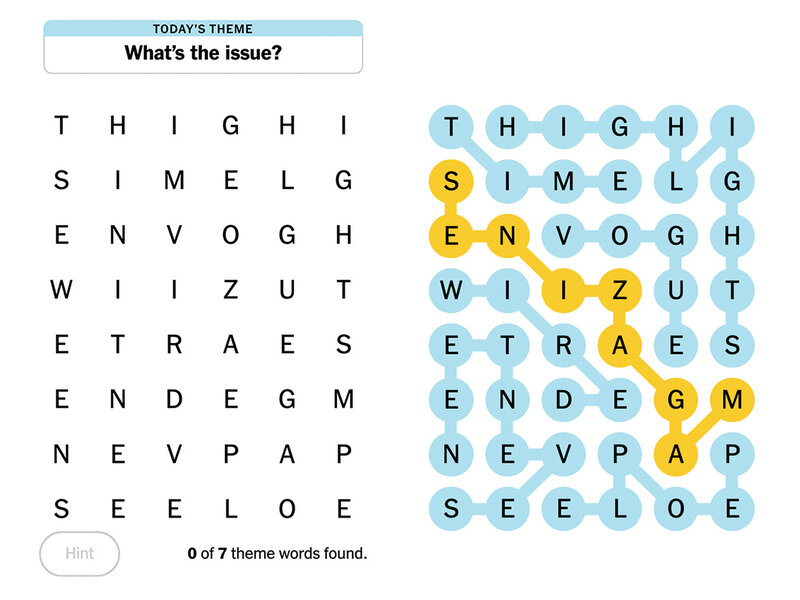
1. The letter river. A long, winding chain of adjacent letters. It often marks the Spangram, the longest word, or a theme cluster. Follow the river and you usually find the theme.
2. Mirrored clusters. Constructors like symmetry. Find a key cluster at the top left and you can often expect a matching one at the bottom right.
3. Diagonal steps. Hidden words frequently step diagonally to avoid easy spotting. Practise tracing diagonal chains lightly with your eyes.
4. Theme redundancy. For a “Birds” theme, the grid often places several bird words near each other, like owl, emu, jay, tern, and hawk. Clusters rarely spread at random.
5. Spangram intersections. A common trick is to snake the Spangram through several answer clusters, so you have to disentangle it from the words around it.
What the NYT Strands editor has said publicly
The Games desk has shared a few things that help solvers directly:
- The Spangram is always findable without a hint.
- Every theme has a “click” moment. Once you find one word, the rest tend to cascade.
- Constructors avoid obscure vocabulary.
- Difficulty comes from path complexity, not rare words.
- Every theme is meant to feel fair, even when it is tricky.
The takeaway: if you are stuck, you are probably misreading the theme rather than missing the vocabulary.
Why the Spangram is the key to solving faster
The Spangram is the backbone of the puzzle. It defines the theme, cuts across the grid, and unlocks the words around it.
To find it quickly:
- Look for the longest possible path in the grid.
- Scan for high-value letters like Q, Z, J, and K.
- Spot clusters that seem almost right.
- Search for the category word you think fits the theme.
- Trace a few possible paths before you commit.
Once you locate the Spangram, even partially, the rest of the puzzle tends to untangle quickly. If it is the Spangram itself that has you stuck, our Strands Solver reveals it as a separate hint, so you can keep solving the rest yourself.
Expert solving techniques
- Read letter density first. Words hide where repeated letters gather, such as L, S, T, and E.
- Scan for category signals. If you see LIME, LEMON, and PEEL, you are probably in a citrus puzzle.
- Try reverse solving. If you suspect the theme is tools, look for hammer or pliers shapes before the theme is confirmed.
- Trust the curves. Straight lines are rare, so an eye that searches only in straight rows is already losing time.
- Save hints for later. A hint is worth most once you know the theme, not before.
- Clear the grid visually after each find. The game dims found words, so use that to see the new shapes left behind.
When to use a solver (and still learn from it)
There is nothing wrong with using a solver. It helps you learn the puzzle’s patterns, break a repeated sticking point, speedrun the daily grid, and keep a streak alive.
The best way to use our NYT Strands Solver with hints and answers is in steps:
- Try the theme cold.
- If you are stuck, take one small hint.
- If you are still stuck, reveal the Spangram only.
- If you need it, check the full answer set.
- Look back at how the words curved. You will learn the shapes visually.
Do this and you will lean on the solver less over time.
More NYT Games solvers and hints we have built
- Wordle Solver
- Spelling Bee Solver
- NYT Connections Clues, Hints and Answers
- NYT Pips Solver
- NYT Letter Boxed Solver
- NYT Daily Crossword Answers and Hints
- NYT Midi Crossword Answers and Hints
- NYT Mini Crossword Answers and Hints
All our NYT puzzle tools live together in our NYT Games Hub. Bookmark it for the daily round.
Frequently Asked Questions: NYT Strands
Where can I find today’s NYT Strands hint?
Our NYT Strands hint page updates daily with theme-only hints, individual word reveals, and the Spangram if you need it. Take the smallest hint that gets you unstuck.
What is NYT Strands?
Strands is a daily word puzzle from The New York Times that blends a word search, Connections, and a cryptic theme puzzle. You find theme words and a hidden Spangram on a letter grid, and the words can curve, twist, and wrap.
What is the Spangram in NYT Strands?
The Spangram is a special theme word that snakes across the grid and touches at least two opposite sides. It defines the puzzle’s theme, so finding it early is the fastest route to the rest.
What is the hardest part of NYT Strands?
Most solvers struggle with the Spangram, because it winds through the grid in unexpected ways. Finding it early makes everything else easier.
How do I find the theme in Strands?
Look for clusters of related letters, especially repeating patterns. Once you spot one thematic word, the rest tend to appear quickly.
Does Strands get harder during the week?
Yes. Early-week puzzles tend to use straightforward themes, while later in the week you get misdirection, puns, and trickier path shapes.
What counts as a valid word in Strands?
Only the words chosen by the puzzle’s constructor count. They are always real English words and always match the theme.
How do hints work in Strands?
Every three valid non-theme words you find earns a hint, and each hint reveals one theme word on the grid.
Is it cheating to use a Strands solver?
No. A solver helps you learn the puzzle’s structure, decode themes faster, and keep a streak alive. Take the smallest hint that gets you unstuck.
Where can I play NYT Strands?
Strands is free on the NYT Games site, with a new puzzle every day.
