
Everyone has their go-to Wordle opener. Maybe it’s ADIEU because someone told you vowels matter. Maybe it’s CRANE because a YouTube video said so. Maybe it’s PIZZA because you’re chaotic and life is short.
But here’s the thing: some starting words are measurably better than others. Not as a matter of taste or habit, but as a function of how many possible answers they eliminate on average. When you run the numbers across all valid Wordle solutions, certain words consistently outperform the rest. This article breaks down what the data actually says, why it says it, and how to pick the best opening word for how you play.
Why Your First Word Matters More Than You Think
Wordle gives you six guesses to find a five-letter word. Your first guess is the only one you make with zero information. Every guess after that is shaped by what you’ve learned: green letters (right letter, right spot), yellow letters (right letter, wrong spot), and grey letters (not in the word at all).
A strong first word does one thing well: it generates the most useful information. The more common letters you test, and the more you spread them across common positions, the more you learn from that first set of coloured tiles. A weak first word wastes your only blind guess on rare letters or repeated letters that don’t tell you much.
The difference isn’t trivial. A well-chosen opener can narrow the remaining possibilities from over 2,300 words to under 100. A poor one might leave you with 500 or more. That’s the gap between a player who solves in three and a player who barely scrapes by in six.
The Method: How We Analysed Wordle’s Word List
Before getting to the results, it’s worth understanding how this works. There’s no single “correct” way to rank starting words, but the most common approaches share the same foundation: letter frequency analysis across Wordle’s answer list.
The answer list matters. Wordle doesn’t pull from the full English dictionary. It uses a curated list of common five-letter words (originally around 2,300). You can see every word that’s already been used on our past Wordle answers page. This means the letter frequencies that matter aren’t English-language frequencies in general; they’re specific to this list. The letter E, for instance, is the most common letter in English overall, and it’s also very common in Wordle’s answers. But the relative ranking of other letters shifts when you narrow the pool to five-letter words the average person would recognize.
Letter frequency by position. It’s not enough to know that S is common. You need to know where it’s common. S appears frequently as the first letter in Wordle answers, but it’s also common as the last letter. A starting word that places S in the first or last position tests a more likely scenario than one that buries it in the middle.
No repeated letters. The best starting words almost never contain duplicate letters. Using a word like SPEED wastes a slot by testing E twice. You want five distinct letters covering as much ground as possible.
With those principles in mind, here’s what the data points to.
The Top 10 Starting Words (Ranked by Information Value)
Different analyses produce slightly different rankings depending on the scoring method, but certain words appear near the top of almost every credible list. These are consistently among the strongest openers:
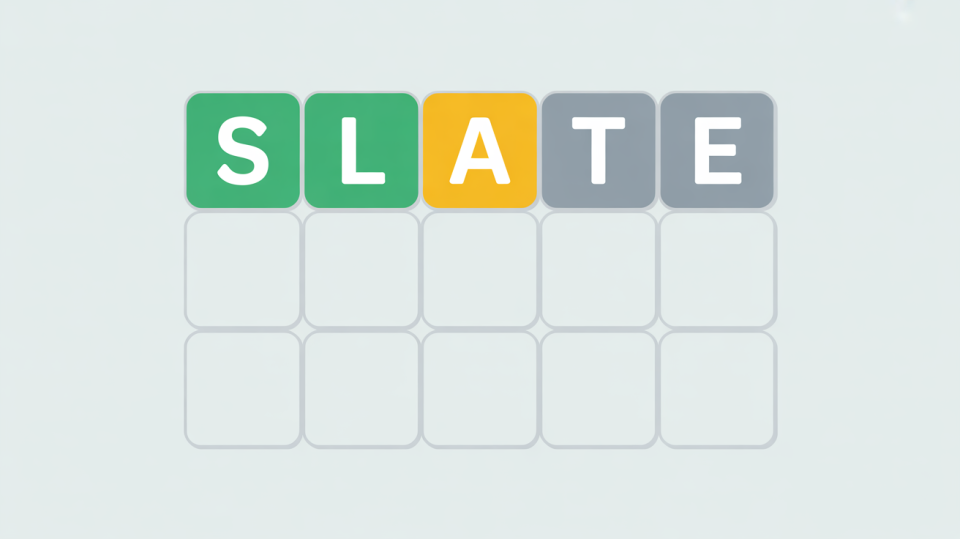
1. SLATE Letters: S, L, A, T, E. Covers three of the five most common letters in Wordle’s answer list (A, E, S) plus two strong consonants (L, T). The positioning is strong: S in first position and E in last position are both high-frequency placements.
2. CRANE Letters: C, R, A, N, E. This one gained fame after a widely shared analysis. It tests two top vowels (A, E) and three common consonants (C, R, N). R in second position is statistically strong.
3. TRACE Letters: T, R, A, C, E. Similar letter coverage to CRANE with T swapped into the first position, which is a high-frequency spot for T in Wordle answers.
4. CRATE Letters: C, R, A, T, E. Another rearrangement of the same high-value letters. The positioning differs, which means it performs slightly differently depending on the scoring model.
5. SALET Letters: S, A, L, E, T. An anagram of SLATE. Some algorithmic analyses rank this as the single best opener because of how its letter positions align with frequency distributions. It’s a less common English word, though, which bothers some players.
6. RAISE Letters: R, A, I, S, E. Swaps in a third vowel (I) at the cost of dropping a consonant. Strong for players who prioritize vowel identification early.
7. ARISE Letters: A, R, I, S, E. Same letters as RAISE, different arrangement. The positioning gives it a marginally different information profile.
8. STARE Letters: S, T, A, R, E. Another arrangement of the high-frequency A, E, S, T, R cluster. Familiar word, easy to remember, and statistically sound.
9. SNARE Letters: S, N, A, R, E. Brings N into the mix, which is the sixth most common letter in Wordle answers. Trades T for N compared to STARE.
10. ROATE Letters: R, O, A, T, E. Some computational analyses rank this as the absolute optimal opener. The catch: it’s not a word most people recognize (it’s an archaic/obscure term). Wordle accepts it as a valid guess, but if you prefer words you’d actually use in a sentence, look elsewhere on this list.
The Pattern You Should Notice
Look at those ten words. The same letters keep appearing: A, E, R, S, T show up in nearly all of them. Add L, N, I, O, C and you’ve covered the letters that appear in the vast majority of Wordle answers.
This tells you something useful. The specific word matters less than the letters it contains and where it places them. SLATE, CRANE, TRACE, and STARE are all excellent choices not because of some magic property, but because they each test a high-value set of letters in reasonable positions.
If your current go-to word contains at least three of A, E, R, S, T and doesn’t repeat any letters, you’re probably already in solid shape. The difference between the “best” starting word and the tenth-best is marginal. The difference between any of these and a word like JAZZY is enormous.
What About Vowel-Heavy Openers?
ADIEU is one of the most commonly recommended starting words online. The logic seems sound: test four of the five vowels in one shot, and you’ll know exactly which vowels are in play.
The data tells a more nuanced story. Vowel-heavy words do identify vowels quickly, but they sacrifice consonant coverage. Knowing the answer contains A and I but having no consonant information leaves you with a surprisingly large pool of possibilities. Consonants do more to narrow things down because there are more of them, and their placement is more distinctive.
That said, ADIEU isn’t a bad word. It’s just not as efficient as the top performers. If you enjoy the vowel-first approach because it suits your solving style, you’re giving up a small statistical edge, not a large one. Play in a way that’s fun for you. Wordle is, after all, a game.
A stronger compromise: a word like RAISE or AUDIO tests multiple vowels and includes at least one common consonant. You get most of the vowel information without completely sacrificing consonant coverage.
The Two-Word Opening Strategy
Some players use their first two guesses as a combined opener, choosing two pre-planned words that together cover ten distinct letters. This is a more advanced approach, and the data supports it if you’re optimising for a solve in three or four guesses.
Strong two-word combos include:
SLATE + CRONY — covers S, L, A, T, E, C, R, O, N, Y. That’s ten common letters across two guesses, including three vowels and seven consonants.
CRANE + TOILS — covers C, R, A, N, E, T, O, I, L, S. Another ten-letter spread with strong frequency coverage.
RAISE + CLOUT — covers R, A, I, S, E, C, L, O, U, T. Four vowels and six consonants. Good for players who want broad vowel coverage.
The trade-off is clear: you’re spending two of your six guesses on information-gathering before you’ve attempted a real solve. This works well when the answer is common enough that two guesses of information are enough to pinpoint it. It’s less effective when the answer is obscure and you need every guess for actual attempts.
Letters to Avoid in Your Opener
Just as certain letters are statistically strong, others are statistically weak as starting choices. These letters appear in the fewest Wordle answers:
Q, J, Z, X are the rarest. Words containing these letters test very low-probability scenarios. If the answer happens to contain a Z, you’ll find out eventually from process of elimination. Using your first guess to test for it is wasteful.
V, W, K are uncommon enough that they’re generally not worth spending a first-guess slot on. They’ll come into play in later guesses when you’ve narrowed the field.
Repeated letters are the biggest efficiency drain. A word like ABBEY tests only four distinct letters. B appears twice, and that second B gives you almost no new information. Save the double-letter testing for later guesses when you have reason to suspect a repeat.
Hard Mode Changes the Calculus
In Wordle’s Hard Mode, every subsequent guess must use the green and yellow letters you’ve already found. This constraint makes your starting word even more important, because you can’t “waste” a later guess on a completely unrelated information-gathering word.
In Hard Mode, the top starting words are largely the same (SLATE, CRANE, TRACE still perform well), but the two-word strategy becomes less viable. You can’t pre-plan your second word if Hard Mode forces you to incorporate what you learned from the first.
If you play Hard Mode, pick one strong opener from the top ten and stick with it. Consistency matters here because your second guess needs to build directly on what you learn, and having a reliable first move reduces the cognitive load.
So What Should You Actually Use?
Here’s what it comes down to.
If you want the statistically strongest opener and don’t mind a less common word: SALET or SLATE.
If you want a strong opener that’s also a word you’d recognise: CRANE, TRACE, or STARE.
If you want to prioritise vowels: RAISE.
If you want a two-word system: SLATE + CRONY.
If you want permission to keep using whatever word you’ve been using: you have it. The margin between a top-ten opener and a decent one is a fraction of a guess on average. Wordle rewards consistent thinking more than a perfect first move. A player who starts with MUSIC and thinks clearly will beat a player who starts with SLATE and panics after the second guess.
The data gives you an edge. How you use it is up to you. And if you ever get properly stuck mid-solve, our Wordle Solver will show you every remaining possibility based on your greens, yellows, and greys. Give it a try next time you’re staring at a board full of grey tiles and questioning your life choices.
