
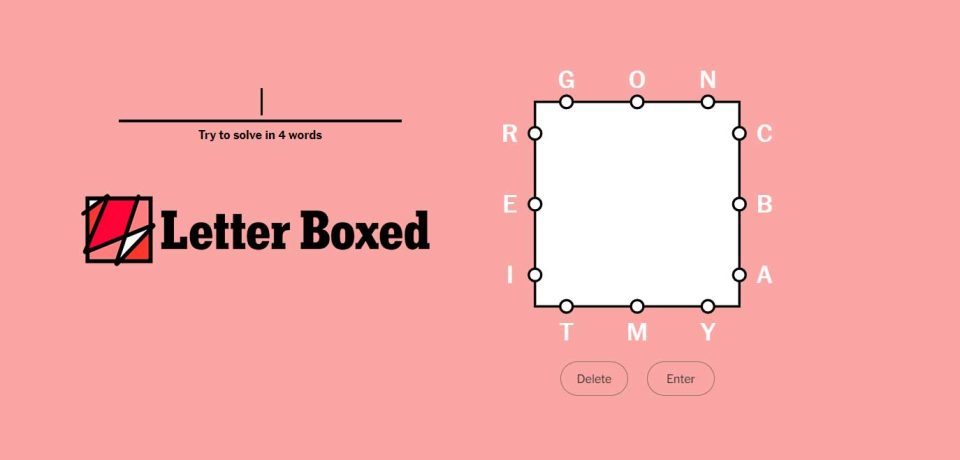
If you’re new to NYT Letter Boxed or you’ve stared at that square wondering how on earth people get a “two-word solution,” this guide breaks it all down clearly, visually, and without jargon. Think of it as the definitive beginner-friendly explainer you can come back to anytime, plus a gentle boost toward using a Letter Boxed solver as a learning tool, not a cheat code.
What Is NYT Letter Boxed?
Letter Boxed is one of the clever word puzzles inside the New York Times Games lineup—home to Wordle, Spelling Bee, Connections, and more. Created by the NYT’s puzzle team in 2018, Letter Boxed is all about linking words using a 12-letter square board.
Unlike Wordle (a single hidden word) or Spelling Bee (make as many words as you can), Letter Boxed is about creating one continuous chain of words that uses all letters at least once.
Here’s what makes it unique:
- The letter placement around the square matters.
- The last letter of each word must start your next word.
- And no two consecutive letters can come from the same side.
The daily puzzle resets at midnight, and many players try to solve it in as few words as possible—ideally two.
Letter Boxed Rules in Plain English
The official rules can feel strangely complicated, so here’s the simplest possible version.
1. The board is a square with 12 letters.
Each side contains three letters, and you must use them according to specific movement rules.
2. You must use all letters at least once.
This is what counts as “solving” the puzzle—your word chain must touch every letter on the board, in any order.
3. Each word must be at least 3 letters long.
4. You may not use two letters from the same side consecutively.
Example: If the left side has L T M, you can’t go L → T in the same word. You must “jump” to a letter on a different side.
This rule is the #1 thing newcomers miss.
5. Your words must form a continuous chain.
The last letter of your word becomes the first letter of your next.
Example:
BRANCH → HAZE → ELIMINATE
6. Only standard dictionary words count.
The game does not allow:
- Proper nouns
- Abbreviations
- Acronyms
- Slang not found in common dictionaries
If your solver suggests a word the game rejects, it’s usually because NYT uses a more curated dictionary.
How NYT Judges a “Good” Solution
Every player who uses all letters earns a win. But NYT adds some friendly gamification:
Two-word solutions are the gold standard.
They’re rare, tricky, and extremely satisfying. The game will often spotlight them as the “ideal” solution, even though:
- Many puzzles have multiple valid two-word solutions
- Some puzzles don’t practically allow a two-word solve for most humans
Two-word solutions almost always require:
- A long word that sweeps up many unique letters
- A clever pivot word that finishes the board cleanly
But any full-board solution is a win.
Whether you solved it in 2 words or 7, you still completed the puzzle.
The game will display “Bravo!” messages.
These vary depending on whether you got a clean completion or a particularly efficient chain.
Core Letter Boxed Strategies for Everyday Solvers
These strategies instantly level up your solving ability—even if you’re brand new.
1. Start small with 3–4 letter “warm-up words.”
Use these to get a feel for the board and test side-to-side movement.
2. Scan for common clusters and endings.
Letter Boxed favors words containing:
- TH
- CH
- STR
- -ING
- -ER
- RE- and UN-
These clusters help sweep multiple letters fast.
3. Use awkward letters early (Q, X, Z, J).
If you leave them until the end, they can trap you.
Use them intentionally in your first or second word, often with a vowel bridge.
Examples:
- Q → “QUIT,” “QUILL,” “QUIRE”
- X → “AXIAL,” “EXERT,” “MIXED”
- Z → “ZEST,” “GRAZE,” “AMAZE”
4. S is your secret weapon.
The letter S is the most powerful connector in the game.
It helps:
- Pluralize
- Create smooth transitions
- Extend chains when stuck
If your board has an S, you almost always want to use it strategically.
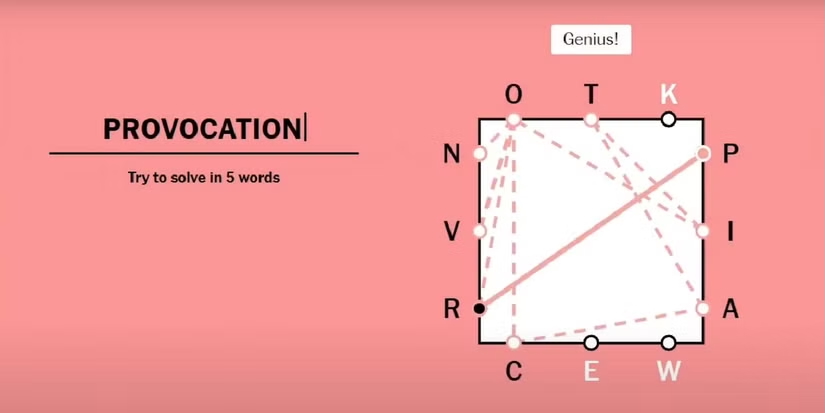
An example NYT Letter Boxed board showing how word paths connect around the square — a visual guide to understanding Letter Boxed strategy.
When to Use a Letter Boxed Solver (Without “Cheating”)
Let’s be honest: solvers aren’t cheating—they’re learning tools if you use them well.
Here’s the healthy, growth-oriented way to integrate one.
1. Try the puzzle yourself first.
Even 5–10 minutes of effort gives your brain valuable training.
2. Then plug the letters into a Letter Boxed solver.
The Word Finder’s solver shows:
- All valid combinations
- Word chains
- Possible 2-word and 3-word solutions
- Alternate paths you might never think of
3. Treat solver output as “study material,” not the answer key.
A solver helps you:
- Build vocabulary
- Notice letter-movement patterns
- Explore creative long-word opportunities
- Compare your route vs. optimal solutions
4. Re-solve the puzzle manually after seeing the best chain.
This reinforces pattern recognition and drastically improves long-term skill.
FAQs about NYT Letter Boxed
Is there always a two-word solution?
Usually, but not always one accessible to human solvers. Some boards are “technically possible” but extremely unnatural.
What happens if you reuse letters?
Totally allowed. Reusing letters does not break the puzzle.
You simply must use all letters at least once somewhere in your chain.
Why won’t the game accept some words my Letter Boxed solver finds?
Letter Boxed uses a curated NYT dictionary—much smaller than most word lists.
If a word isn’t common or feels too obscure, NYT may reject it.
Can you replay old Letter Boxed puzzles?
Through the NYT’s archives, yes. But the official app only shows the current day’s puzzle unless you have a subscription.
