
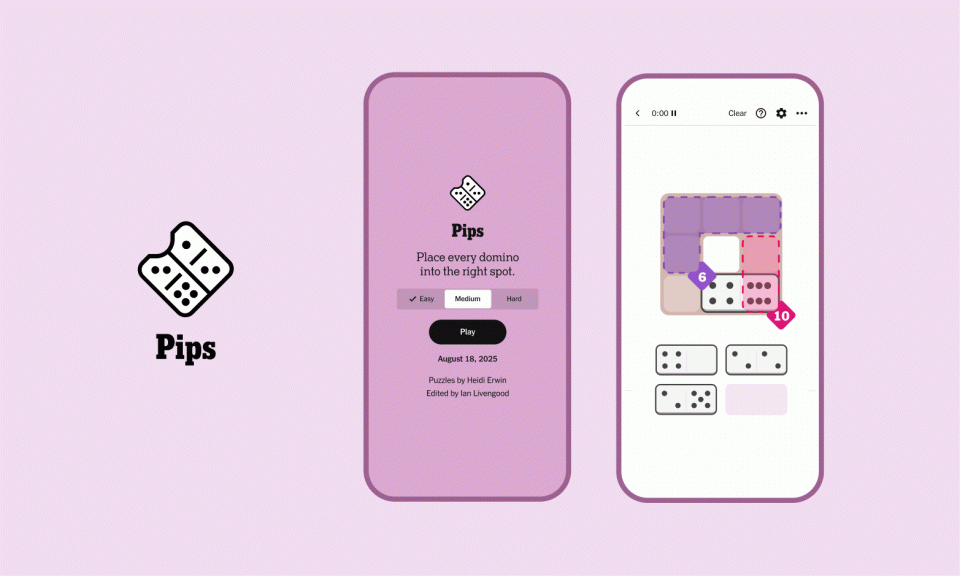
When The New York Times quietly rolled out NYT Pips, it didn’t take long for it to explode across group chats, Reddit threads, and office Slack channels. Suddenly, people were confessing: “I can’t stop playing this tiny math puzzle.” And that’s the key — tiny. Pips is fast, clever, addictive, and perfectly designed for the way we consume puzzles in 2025.
But why this game? Why now? And why are so many players — from Wordle die-hards to former Digits fanatics — completely hooked?
Let’s dig into the cultural moment behind why NYT Pips went viral and what this new puzzle says about the future of daily brain games.
A Brief History of Micro-Logic Games (Mini Sudoku → Digits → Pips)
Though Pips feels brand new, it’s actually the latest evolution of a decades-long movement: micro logic puzzles optimized for busy people and shrinking attention spans.
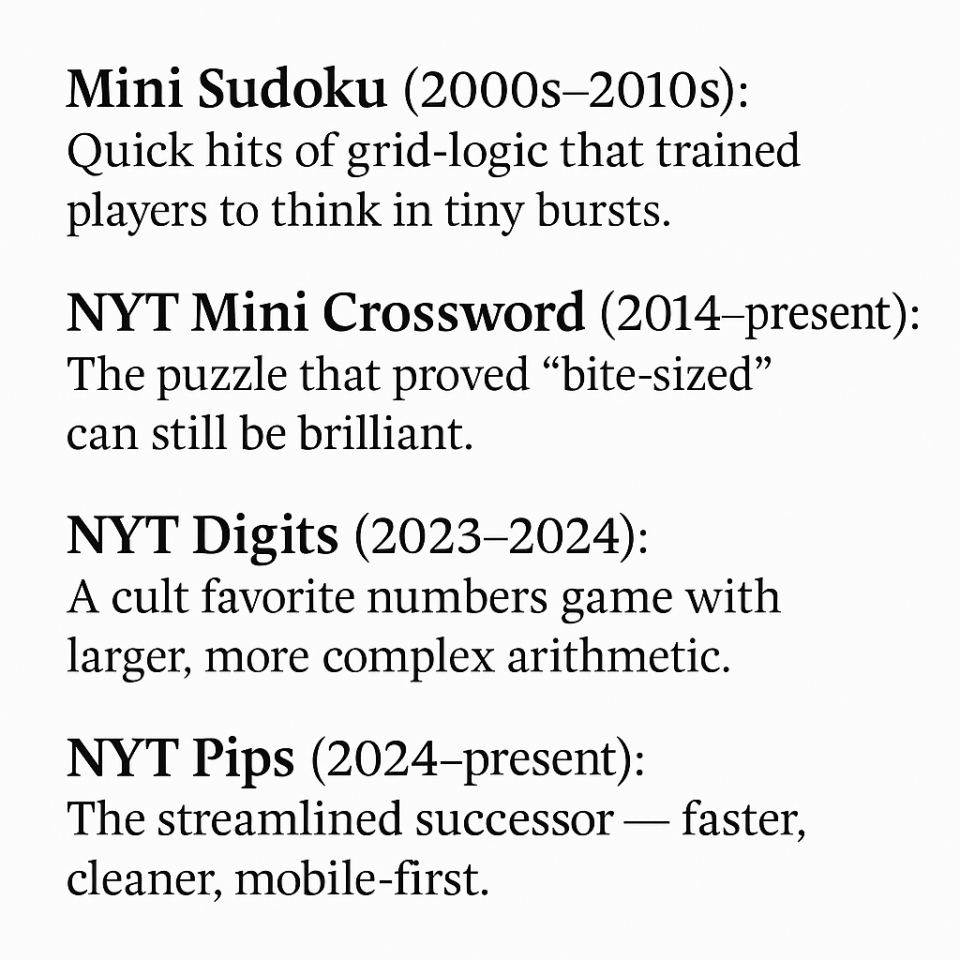
Digits showed there was serious appetite for math puzzles, but Pips refined the formula: simpler moves, clearer rules, faster resolution. It’s Sudoku’s minimalist cousin and Digits’ more accessible sibling
Why Players Love Micro-Logic Puzzles
Pips fits a growing category: micro-logic, puzzles that deliver a satisfying burst of problem-solving without demanding 20–40 minutes of concentration.
Why players love them:
1. Low time investment
One puzzle = 30 seconds to 2 minutes. That’s shorter than a TikTok.
2. High intellectual reward
Even a small win activates the same “aha!” response you get from solving a big crossword clue.
3. Portable, replayable, and socially shareable
Players want puzzles they can do on the train, on the toilet, or in a meeting they definitely should’ve skipped.
4. The “I should be able to solve this!” effect
Because puzzles are small, people feel guilty if they don’t get them — which leads to more attempts, more obsession, more viral spread.
Micro-puzzles thrive on this tension between simplicity and ego. And Pips nails it.
Why Pips Works So Well on Mobile
The game feels like it was engineered for a phone screen.
1. One-hand gameplay
Every interaction is a tap. Not a drag. Not a long calculation. Just tap, tap, tap.
2. Ultra-clear visual language
Dots (pips), numbers, and simple boxes. No clutter. No reading. No instructions needed.
3. Each board feels like a “tiny boss battle.”
Like Wordle’s five empty squares, the Pips interface triggers the “I can crack this” instinct.
4. Perfect for notification-style rituals
Morning coffee? Pips.
Waiting for your Uber? Pips.
In line at the grocery store? Pips.
A puzzle doesn’t need to be big anymore. It needs to be everywhere — and Pips is.
The Dopamine Science: Fast Wins, Fast Losses, Fast Replays
Pips sits at the perfect psychological intersection:
- Fast success → dopamine hit
- Fast failure → quick restart → more dopamine
- Short puzzles → minimal frustration
- Clear progress markers → easy mastery loop
Neuroscience calls this a “tight feedback circuit.”
Consumers call it addictive.
Pips gives you the satisfaction of solving a math puzzle without the intimidation of “doing math.”
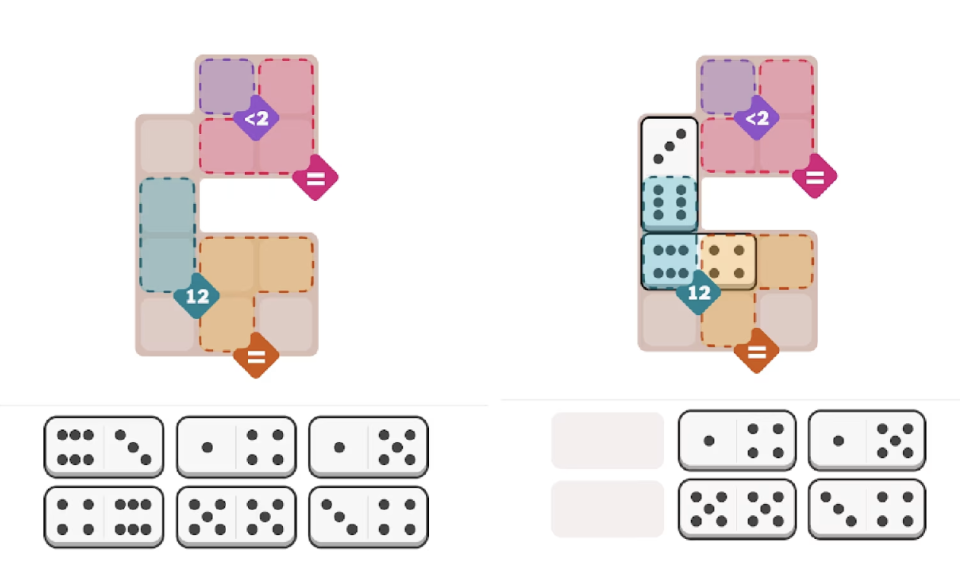
NYT Pips is the latest viral micro-puzzle captivating millions with its fast, friendly take on math logic
Pips vs Digits vs Sudoku vs Mathler
Let’s break down how Pips compares to its puzzle peers.
Pips vs Digits
- Digits required bigger calculations, order of operations, and multi-step planning.
- Pips uses smaller numbers, tighter grids, and fewer moves.
- Digits felt like math class.
- Pips feels like candy.
Pips vs Sudoku
- Sudoku is large, slow, and multi-layered.
- Pips is fast and snack-sized.
- Sudoku requires planning ahead.
- Pips rewards intuition and quick logic.
Pips vs Mathler / Nerdle
- Mathler/Nerdle rely on equations and syntax.
- Pips uses arithmetic and spatial logic — simpler, more universal.
This is why Pips scaled so quickly: it pulled the best elements of multiple math games, stripped away the friction, and left only the fun.
Try our NYT Pips Solver if you ever get stuck.
What the Rise of Pips Says About the Future of Brain Games
Here’s what its popularity tells us:
1. People want “snack puzzles,” not marathon puzzles
Wordle, Mini, Connections → now Pips joins the club.
2. The future of puzzles is mobile-first
And mobile-first puzzles must be simple and visually clean.
3. Minimalism sells
Tiny rules. Tiny boards. Big satisfaction.
4. We’re entering the “daily ritual puzzle era”
Users expect a rotating buffet of puzzles they can complete in 1–3 minutes per day.
5. Math is back — but friendlier
Pips proves people want math puzzles… as long as they don’t feel like math puzzles.
FAQ: NYT Pips – Quick Answers for New Players
What is NYT Pips?
NYT Pips is a daily math-logic puzzle from The New York Times where players combine numbers and “pips” (dots) to reach a target result using simple operations.
Why is NYT Pips so popular?
Because it’s fast, intuitive, and deeply satisfying. Each round takes under two minutes, offering a quick hit of problem-solving dopamine. It’s also mobile-friendly and easy to learn
Is NYT Pips harder than Digits?
No. Pips is intentionally simpler than Digits. It uses smaller numbers, fewer steps, and visual cues that make the logic easier to follow.
Is there an NYT Pips solver?
Yes, you can use The Word Finder’s NYT Pips Solver to check solutions or get hints when you’re stuck.
How long does it take to solve Pips?
Most puzzles take 30 seconds to two minutes, depending on difficulty and experience with similar logic games.
Do Pips puzzles get harder each day?
]Typically yes. Like Wordle and the NYT Mini Crossword, early-week puzzles tend to be easier, with difficulty increasing as the week progresses.
We have a Wordle Solver and a page with NYT Mini Crossword Answers and Hints built for puzzle fans like you.
