
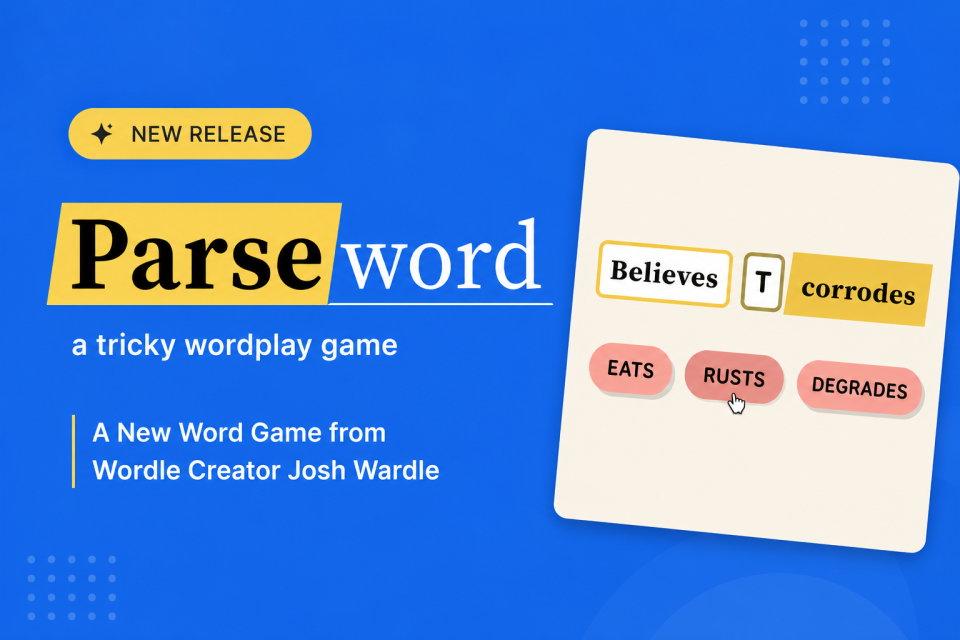
Josh Wardle, the creator of Wordle, is back with a brand-new word game, and this time, it is built for players who enjoy a deeper, trickier kind of wordplay. The new game is called Parseword, and instead of asking you to guess a hidden word, it teaches you how to untangle clue mechanics inspired by cryptic crosswords. It launched on March 10, 2026 and is available to play now.
If Wordle was elegant because of its simplicity, Parseword is interesting for the opposite reason: it embraces complexity, then tries to make that complexity learnable. On its official site, Parseword describes itself as “a tricky wordplay game” and frames the challenge around transforming phrases through wordplay to solve cryptic-style puzzles. Its about page says cryptics are “beautiful and rich puzzles” but also “notoriously hard to learn,” which is exactly the problem the game is trying to solve.
What is Parseword?
Parseword is a daily browser word game from Josh Wardle and collaborators Chris Dary and Matt Lee. According to reporting in The New Yorker, Wardle became deeply interested in cryptic crosswords after Wordle, and Parseword grew out of that fascination. Rather than making another mass-market guessing game, he appears to have built something more niche: a game designed to teach players how cryptic clue logic works.
That makes Parseword feel less like “the next Wordle” and more like a bridge into cryptic puzzle solving. Coverage from The Verge and Tom’s Guide emphasizes that the game includes tutorials, starter puzzles, helpful videos, and multiple difficulty settings, all aimed at reducing the intimidation factor that usually comes with cryptic clues.
How Parseword works
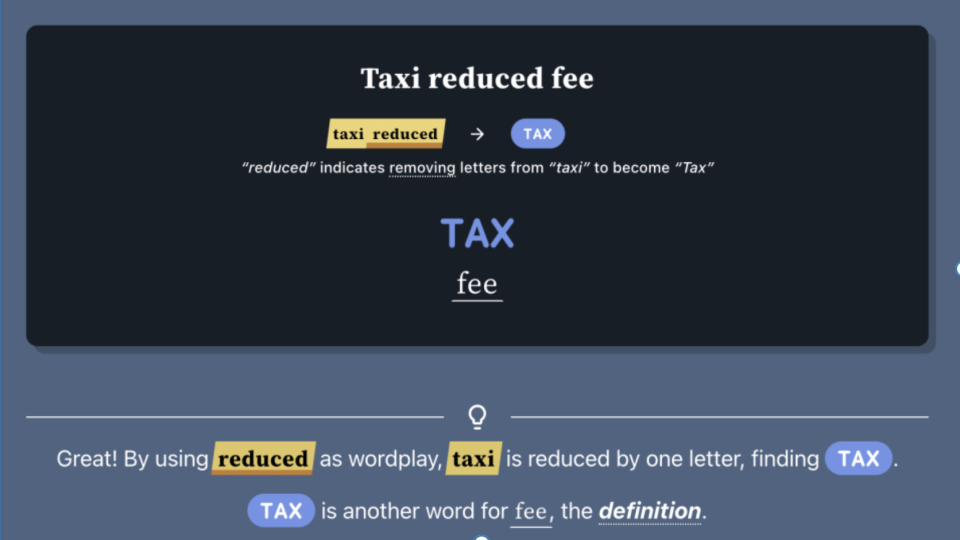
The official tutorial introduces Parseword as a game where you solve a puzzle by reducing it into two matching parts, swapping words with synonyms, and combining them with wordplay techniques such as reversing words or removing letters. The site encourages players to click around, explore, and learn by doing.
That interactive, exploratory style seems to be the key design choice. The New Yorker describes Parseword’s central idea as treating the cryptic clue not as a vague riddle, but as something closer to an equation. You click on words, inspect possible synonyms, identify indicator words, and gradually reduce the clue until the answer becomes visible. In one example highlighted there, “Taxi reduced fee” teaches the player to remove the “i” from “taxi” to get tax, which matches the definition “fee.”
In practice, that means Parseword is teaching players to recognize common cryptic operations, including:
- replacing a word with a synonym or abbreviation,
- joining word parts together,
- putting one string inside another,
- selecting letters by position,
- making anagrams,
- deleting letters,
- reversing letters,
- spotting hidden words,
- using homophones,
- and occasionally translating short foreign-language elements. These transform families are reflected across the official tutorial/hints material and in third-party coverage of how the game teaches “replacements,” “containers,” and related clue logic.
Parseword game modes

Parseword also supports different levels of experience through three game modes:
Learn is the most beginner-friendly version. It reveals definitions, offers keyword suggestions, and gives extra help for players still learning how cryptic-style wordplay works.
Play is the standard mode, with fewer guardrails. Definitions are hidden and there are no starting hints.
Challenge is the hardest version, designed for experienced solvers, with less information shown up front. Coverage notes that solution length and indicator information are hidden here as well.
This tiered approach matters because one of the biggest barriers to cryptic games is simply getting started. Parseword seems built to soften that learning curve without removing the satisfaction of solving.
Why Parseword matters
For casual word-game players, Parseword is noteworthy because it is the first major puzzle release from Josh Wardle since Wordle. For people who already love crossword-style logic, it is even more interesting: it suggests that cryptic mechanics may be moving into a more mainstream, browser-native format.
It also arrives at a moment when the daily puzzle market is crowded. As The Verge points out, Wordle’s success helped create an explosion of daily word and logic games, from the New York Times’ growing puzzle ecosystem to newer entrants like Puzzmo, with other major platforms exploring the space too. In that environment, Parseword stands out by not copying Wordle’s format directly. Instead, it goes after a more advanced kind of wordplay.
That may limit its mass-market reach, but it could also make it more durable with serious word-game fans. In other words, Parseword may never be as instantly legible as Wordle — but it has a strong chance of becoming a favorite among players who enjoy clues, structure, and that satisfying “click” when a piece of wordplay suddenly makes sense.
Who made Parseword?
While Josh Wardle is the headline name, reporting shows that Parseword was built with collaborators Chris Dary and Matt Lee, both longtime colleagues from Reddit. The game also launched with help from legendary constructors Emily Cox and Henry Rathvon (Hex), who allowed the team to use their clue backlog for launch. That detail matters, because it connects Parseword not just to modern web-game design, but to a much older tradition of high-quality cryptic construction.
Our take
At The Word Finder, we think Parseword is one of the most interesting new word-game launches in a while — not because it is easy, but because it is trying to make a famously difficult form more approachable. That is a smart and ambitious idea.
If you love games like Wordle but want something more layered, Parseword is worth trying. And if you bounce off it at first, that may be part of the experience: this is clearly a game built around learning a language of clues, not just guessing a word.
As Parseword grows, we will also be tracking its mechanics closely and building resources to help players understand the game faster.
Other Cryptic-Style Word Games to Try
If Parseword sparks your interest, you’re not alone. Cryptic puzzles have a long history in British newspapers and are slowly finding a wider audience online. Several modern games explore similar ideas — combining wordplay, transformations, and clever clue logic.
Here are a few other cryptic-style puzzles worth trying.
Minute Cryptic
Minute Cryptic is a daily puzzle where players solve a single cryptic crossword clue each day. The site provides video explanations that walk through the logic step-by-step, making it one of the most approachable ways to learn cryptic clue mechanics. Like Parseword, the goal is not just to get the answer — it’s to understand how the clue works.
Bracket City (The Atlantic)
Bracket City is a daily puzzle from The Atlantic that asks players to insert words into brackets to form valid phrases or sentences. While it isn’t technically a cryptic crossword, it relies on similar mental skills: spotting hidden meanings, manipulating word fragments, and recognizing unusual phrase constructions.
Cryptic Crosswords (Traditional Format)
The classic form of cryptic puzzles appears in newspapers like The Guardian, The Telegraph, and The New York Times’ occasional cryptic crossword. Each clue contains two parts: a definition and a piece of wordplay that leads to the same answer. These puzzles are famous for their clever constructions and can take years to master.
Stuck on today’s Parseword?
Our solver is here to help, providing step-by-step hints that guide you through each transformation while minimizing spoilers! Try our Parseword – Hints & Answers.
Frequently Asked Questions: Parsewords
What is Parseword?
Parseword is a new daily word game from Josh Wardle, the creator of Wordle. It is inspired by cryptic crossword logic and asks players to solve clues by using synonyms, transformations, and other forms of wordplay.
Is Parseword the new game from the creator of Wordle?
Yes. Parseword is Josh Wardle’s newest major puzzle release since Wordle. It launched in March 2026.
How do you play Parseword?
You solve a clue by breaking it into matching parts, replacing words with synonyms, and using wordplay operations like deletion, reversal, joining, and similar cryptic-style transforms. The official tutorial encourages players to click around and explore.
Is Parseword like Wordle?
Only in the sense that it is a daily browser word game from the same creator. Wordle is a straightforward word-guessing game, while Parseword is based on cryptic clue mechanics and is designed to teach a more advanced form of wordplay.
Does Parseword have different difficulty modes?
Yes. Parseword includes Learn, Play, and Challenge modes for different experience levels.
Is Parseword hard?
Yes, and intentionally so. The game openly positions itself as a tricky wordplay game and is built around making cryptic-style solving more approachable over time
