
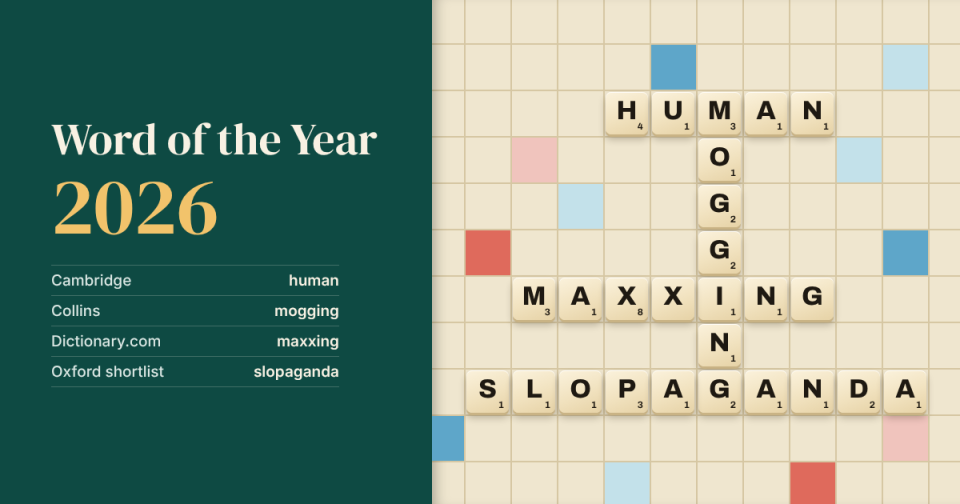
Three dictionaries have named their Word of the Year 2026 so far. Dictionary.com chose maxxing on 25 October, Collins chose mogging on 3 November and Cambridge chose human on 17 November. Oxford published its shortlist of four the same day (doomerism, microdrama, post-literate and slopaganda), keeps its public vote open until 24 November and names the winner on 1 December. Merriam-Webster hasn’t announced its pick yet.
We also looked up every winner and shortlisted word in NASPA’s word database, the official record for North American Scrabble. Two of the three winners, HUMAN and MOGGING, are already playable, though MOGGING only gets in on a much older meaning. MAXXING and SLOPAGANDA are out. We’ll update this page when Oxford names its winner and when Merriam-Webster announces.
Every 2026 Word of the Year So Far
Four of the big English dictionaries have published something for 2026, and three have settled on a single word. The table gives each pick in the dictionary’s own words, with the date it was announced.
| Dictionary | 2026 pick | What it means | Announced |
|---|---|---|---|
| Oxford | Shortlist: doomerism microdrama post-literate slopaganda | Four candidates, defined below; the winner is due on 1 December | 17 November (shortlist) |
| Cambridge | human | “relating to people, as opposed to animals, machines, or gods” | 17 November |
| Collins | mogging | “outperforming or outshining someone or something else” | 3 November |
| Dictionary.com | maxxing | “the practice of pursuing an activity to the fullest or optimizing a certain aspect of your life” | 25 October |
| Merriam-Webster | Not announced yet | Its 2025 word was slop | Not yet |
The words of the year 2026 published so far share one subject: artificial intelligence. Oxford defines slopaganda as propaganda “produced using generative artificial intelligence”, and its definition of doomerism names AI as a threat. Cambridge chose human as a counterbalance to AI and shortlisted agent, an AI system. Collins shortlisted P(doom), how likely someone thinks it is that AI will bring about collapse, and Dictionary.com shortlisted data center, a word CBS News tied to the rise of AI.
Oxford’s Shortlist Is Open to a Public Vote Until 24 November
Oxford University Press announces the Oxford Word of the Year 2026 on 1 December. Until 11.59pm GMT (6.59pm EST) on Tuesday 24 November, anyone can vote on Oxford’s Word of the Year page for one of four shortlisted words. Oxford defines them like this:
- doomerism (n.): “Extreme pessimism, especially the view that catastrophic damage to humanity from a perceived threat such as artificial intelligence or climate change is inevitable and impossible to prevent.”
- microdrama (n.): “A drama series made up of very short episodes, presented in a vertical format for viewing on a smartphone, and typically featuring a melodramatic and fast-moving plot.”
- post-literate (adj.): “Designating a period or society in which literacy and the importance of the written word have declined significantly.”
- slopaganda (n.): “Low-quality propaganda produced using generative artificial intelligence and widely distributed online, esp. via social media.”
Oxford’s language experts chose the shortlist after analysing its 32-billion-word corpus of language data, according to Oxford’s shortlist announcement. The vote is one of three inputs. After voting closes, Oxford says its experts will “conduct a final analysis of the corpus data, your votes, and public discussion” before naming the winner.
Turnout swings a lot from year to year. Oxford counted over 340,000 votes in 2022, when goblin mode won, and more than 37,000 people took part in 2024.
Two details stand out on this year’s list. Post-literate is the only adjective, and slopaganda blends slop, Merriam-Webster’s 2025 Word of the Year, with propaganda.
Cambridge Chose Human
Cambridge Dictionary named human its Word of the Year 2026 on 17 November. Cambridge Dictionary’s Word of the Year page defines the adjective as “relating to people, as opposed to animals, machines, or gods” and points to compounds such as human-written, human-generated and human-made.
Colin McIntosh, Cambridge Dictionary’s chief editor, said artificial intelligence “seemed to be everywhere” this year, which made human “the perfect choice for our Word of the Year.” The University of Cambridge’s announcement adds a second sense: “having the qualities, faults, and feelings that people have, as opposed to gods, animals, or machines.”
The rest of the shortlist leans the same way. Agent is “an artificial intelligence system that can operate in a complicated way without human control”, analogue now covers screen-free activities such as knitting or listening to vinyl records, and chic picked up a new sense from the “kinda chic” Instagram trend.
Wholesome comes with a puzzle story. Lookups spiked in mid-July, and Cambridge first wondered whether people were “seeking an antidote to doomscrolling and rage bait”. Then “the date of the spike led us to the conclusion that they were just looking for the solution to a popular online word game.” Cambridge doesn’t name the game. In our Strands answers archive, WHOLESOME was a theme answer in the New York Times’ Strands puzzle on 18 July 2026, clued “A healthy breakfast”, with the spangram BOWLOFGRANOLA. That date fits Cambridge’s account.
Collins Chose Mogging
Mogging means “outperforming or outshining someone or something else”, according to Collins’ announcement, which named it the Collins Word of the Year on 3 November. Collins believes it is a shortening of AMOG, short for “alpha male of the group”. The word “started life around 2016 as a noun in bodybuilding culture”, meaning the most physically dominant man in the gym, before “morphing into a verb and doing the rounds in the manosphere.”
The targets have shrunk since then. Collins’ own example is “your friend’s sourdough mogs the loaf you spent all weekend proving”, and it says the word is “mostly used with tongue firmly in cheek these days.”
Nine more words made Collins’ shortlist, including carspreading (cars getting “longer, wider and heavier with every new model”), ghost job (a job advertised with no intention of hiring anyone), firewave (“multiple wildfires breaking out over a short period of time, often in towns and cities”), friendslop (low-budget indie games built for groups of friends) and P(doom).
Dictionary.com Chose Maxxing
Maxxing is short for “maximizing”. Dictionary.com named it on 25 October, and its Word of the Year page defines it as “the practice of pursuing an activity to the fullest or optimizing a certain aspect of your life”. It works on its own or as a suffix, as in looksmaxxing, sleepmaxxing and fibermaxxing.
According to CBS News, Dictionary.com chose it “to capture a society that’s deeply online and focused on optimization in all forms.” Steve Johnson, director of lexicography at Dictionary Media Group, which runs Dictionary.com, told CBS that “‘Maxxing’ is so accessible”, and that use of looksmaxxing in the media Dictionary.com analysed “rose more than 1,000% since the start of the year”. He traced the optimising sense back to the 1940s “mini-max” strategy in game theory and to “min-maxing” in Dungeons & Dragons.
Dictionary.com’s shortlist also included affordability (“the quality of being inexpensive”), data center, odyssey (“a long and eventful journey”, which CBS tied to Christopher Nolan’s summer film of Homer’s epic) and unc, Gen Z and Gen Alpha slang for an older person seen as uncool or trying too hard, short for “uncle”.
Merriam-Webster Hasn’t Named Its 2026 Word Yet
On 19 November 2026, Merriam-Webster’s Word of the Year page still showed its 2025 pick, slop, defined as “digital content of low quality that is produced usually in quantity by means of artificial intelligence.” Merriam-Webster says its human editors chose slop, and it lists other words that stood out in its lookup data that year, from tariff to touch grass. We’ll add the 2026 word here when Merriam-Webster announces it.
Two of the Three Winners Are Already Scrabble Words
HUMAN and MOGGING are playable in North American Scrabble, and MAXXING isn’t. On 19 November 2026 we checked every word in NASPA’s word database, the official record for North American tournament play. NWL2023 has been the tournament and club list since 29 February 2024 and includes words of nine letters or more. The 2026 home dictionary, the eighth edition of the Official Scrabble Players Dictionary, covers two- to eight-letter words. Points are face values, before premium squares.
| Word | Chosen by | Playable in North American Scrabble | Face value |
|---|---|---|---|
| HUMAN | Cambridge (winner) | Yes | 10 |
| MOGGING | Collins (winner) | Yes, as a form of MOG, “to move away” | 12 |
| MAXXING | Dictionary.com (winner) | No. MAXING, with one X, is playable | 16 (MAXING) |
| DOOMERISM | Oxford (shortlist) | No | n/a |
| MICRODRAMA | Oxford (shortlist) | No | n/a |
| POST-LITERATE | Oxford (shortlist) | Only without the hyphen: POSTLITERATE is in the tournament list | 14 |
| SLOPAGANDA | Oxford (shortlist) | No. SLOP is playable | 6 (SLOP) |
| AGENT | Cambridge (shortlist) | Yes | 6 |
| ANALOGUE | Cambridge (shortlist) | Yes (ANALOG too) | 9 |
| WHOLESOME | Cambridge (shortlist) | Yes, in the tournament list | 17 |
| CHIC | Cambridge (shortlist) | Yes | 11 |
| AFFORDABILITY | Dictionary.com (shortlist) | Yes, in the tournament list | 25 |
| ODYSSEY | Dictionary.com (shortlist) | Yes | 14 |
| UNC | Dictionary.com (shortlist) | Home dictionary only (new in 2026); not in the tournament list | 5 |
| DATA CENTER | Dictionary.com (shortlist) | No (two words; DATACENTER isn’t listed) | n/a |
Checked in NASPA’s word database on 19 November 2026.
MOGGING gets in on a technicality. North American word lists have included MOG, “to move away”, since at least the 2005 home edition, more than a decade before the slang appeared. MOGGING also uses all three Gs in a set and, at seven letters, can be a bingo worth a 50-point bonus.
MAXXING fails twice: it isn’t listed, and it needs two Xs when a set has one. MAXING, with one X, scores 16. No tile carries a hyphen, so POST-LITERATE can’t go down as Oxford spells it, but POSTLITERATE is in the tournament list as “one who postdates the obsolescence of literacy”. SLOPAGANDA isn’t listed, though SLOP is, as “to spill or splash”.
UNC is one of the words added to the 2026 Scrabble dictionary, so it counts at home but not yet in NASPA tournaments. Our list of new Scrabble words for 2026 covers the rest. Crossplay uses the tournament list, so HUMAN and MOGGING play there and UNC doesn’t (see how Crossplay compares with Scrabble). None of Collins’ single-word shortlist is in the tournament list. We didn’t check Collins Scrabble Words, used outside the US and Canada.
The definitions were the best part of checking: the tournament list still calls HUMAN “a primate of species Homo sapiens”. For everyday racks, our Scrabble Word Finder can help.
New Words Take Years to Reach the Scrabble Lists
Words that pick up a new sense are usually playable before they win. HUMAN, SLOP and MOG have been in North American lists since at least 2005, and UPCYCLING, Cambridge’s 2019 word, was already in the 2018 home edition, a year before Cambridge chose it. Brand-new coinages have to wait for a new edition:
| Word | Word of the Year | First playable in North American Scrabble |
|---|---|---|
| SELFIE | Oxford, 2013 | 2014, in the fifth edition and the 2014 tournament list |
| VAPE | Oxford, 2014 | 2018, in the sixth edition and NWL2018 |
| GASLIGHTING | Merriam-Webster, 2022 | 2018, as a form of the verb GASLIGHT, four years before it won (the noun was added in NWL2023) |
| VAX | Oxford, 2021 | 2022 at home (new in the seventh edition); 29 February 2024 in tournaments (NWL2023) |
| ALLYSHIP | Dictionary.com, 2021 | 2022 at home (new in the seventh edition); 29 February 2024 in tournaments (NWL2023) |
| RIZZ | Oxford, 2023 | 28 September 2026 at home (eighth edition); not in the tournament list yet |
| NOMOPHOBIA | Cambridge, 2018 | Not playable yet |
GASLIGHTING is the extreme case: it was playable as a form of GASLIGHT from 2018, four years before Merriam-Webster chose it. VAX and ALLYSHIP, both 2021 picks, reached the home dictionary a year later and tournaments in 2024. RIZZ took the slow lane. Oxford picked it in 2023, it reached the home dictionary on 28 September 2026, and it still isn’t in the tournament list. PARASOCIAL, Cambridge’s 2025 word, joined Merriam-Webster’s online dictionary in September 2026, but it isn’t in NWL2023. NOMOPHOBIA, Cambridge’s 2018 word, still isn’t playable eight years on.
The last four home editions came out four years apart, in 2014, 2018, 2022 and 2026. If that rhythm holds, our estimate puts the next one around 2030. Merriam-Webster hasn’t announced one, and we found no announcement of NASPA’s next tournament list. We’ll check this year’s words again when NASPA publishes it.
Frequently Asked Questions
What is the Word of the Year for 2026?
It depends on the dictionary. Cambridge chose human, Collins chose mogging and Dictionary.com chose maxxing. Oxford names its pick on 1 December from doomerism, microdrama, post-literate and slopaganda, and Merriam-Webster hasn’t announced yet.
When will Oxford announce its Word of the Year 2026?
Oxford announces its Word of the Year 2026 on 1 December 2026. Its public vote closes at 11.59pm GMT (6.59pm EST) on Tuesday 24 November, and Oxford’s experts then weigh the corpus data, the votes and public discussion before choosing.
How do you vote for the Oxford Word of the Year?
Choose one of the four shortlisted words on Oxford’s Word of the Year page and submit your vote before 11.59pm GMT on 24 November. Oxford counted over 340,000 votes in 2022, and more than 37,000 people took part in 2024.
What does slopaganda mean?
Oxford defines slopaganda as “Low-quality propaganda produced using generative artificial intelligence and widely distributed online, esp. via social media.” The word blends slop, Merriam-Webster’s 2025 Word of the Year, with propaganda.
What does mogging mean?
Mogging means “outperforming or outshining someone or something else”, according to Collins, which made it its 2026 Word of the Year. Collins believes it comes from AMOG, short for “alpha male of the group”, and says it began around 2016 in bodybuilding culture.
What does maxxing mean?
Maxxing is short for “maximizing” and refers to pursuing an activity to the fullest or optimising part of your life, according to Dictionary.com, which made it its 2026 Word of the Year. It works alone or as a suffix, as in looksmaxxing.
Can you play the 2026 Words of the Year in Scrabble?
Some of them. In North American Scrabble, HUMAN and MOGGING are playable, and so is POSTLITERATE if you drop the hyphen. MAXXING, SLOPAGANDA, DOOMERISM and MICRODRAMA aren’t in the tournament list, which we checked in NASPA’s word database on 19 November 2026.
What were the Words of the Year in 2025?
Oxford chose rage bait, Merriam-Webster chose slop, Cambridge chose parasocial, Collins chose vibe coding and Dictionary.com chose 67. Two of the five, slop and vibe coding, are about artificial intelligence.

