
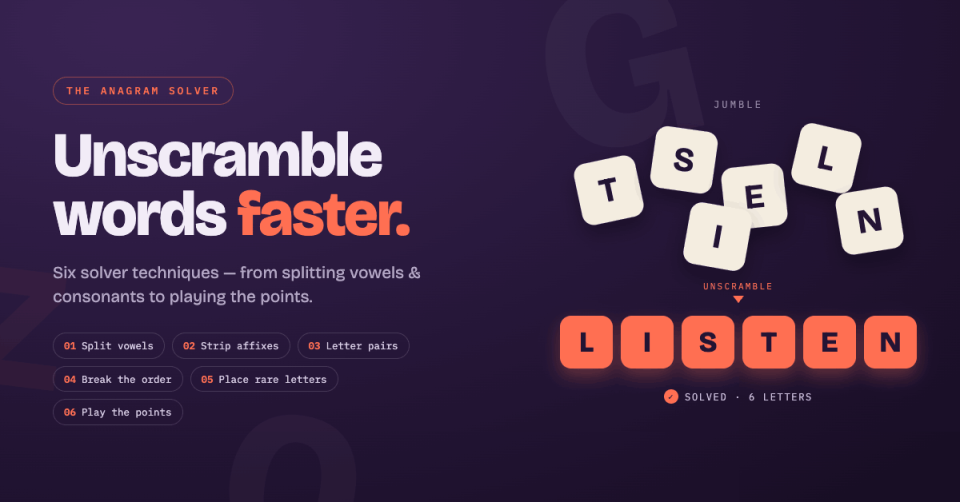
Some people see SILENT and read LISTEN in a second. Others stare at the same six letters for a minute. The difference is rarely raw talent. Unscrambling is a learnable skill, and a handful of habits make it much faster.
Here are the techniques that move you from staring to solving, whether you are cracking a newspaper jumble, a puzzle clue, or a rack of Scrabble tiles.
Split the vowels from the consonants
Start by separating your letters into vowels and consonants. From RABCET you would see A, E as vowels and R, B, C, T as consonants. English words alternate the two groups in fairly predictable ways, so seeing the balance tells you quickly whether you are likely building one syllable or two, and where the vowels probably sit.
Pull off the prefixes and suffixes first
Most longer words are a small core wrapped in familiar parts. Scan for endings like -ING, -ED, -ER, -TION, and -LY, and beginnings like RE-, UN-, and DIS-. Strip those off, solve the shorter middle, then add them back. The word becomes two easy problems instead of one hard one.
Group the common letter pairs
Certain letters travel together. TH, CH, SH, ST, BR, TR, and PL show up constantly at the start of words, while -CK, -NG, and -NT cluster at the end. When you spot those tiles, lock them as a unit and arrange the rest around them.
Break the order on the page
The scrambled order is a trap, because your brain keeps re-reading the shape it already sees. Rewrite the letters in a circle, or simply shuffle them into a new line. Physically reordering the tiles clears the stuck image and lets fresh combinations surface. This is the single most useful trick for a jumble that will not budge.
Place the awkward letters first
Rare letters do most of the work of narrowing options. A Q almost always needs a U beside it. A lone J, X, or Z has very few homes in a word. Decide where those go first, and the common letters fall into place around them.
Play the points when points matter
In Scrabble or Words With Friends, the goal shifts from any word to the best-scoring one. Once you have a few options, build around the high-value tiles and the bonus squares rather than playing the first word you find. A shorter word across a triple can beat a longer word that scores nothing extra.
When to reach for a solver
Sometimes the letters just will not cooperate, and that is fine. The Anagram Solver turns a single set of letters into every valid word they can make, sorted by length or by Scrabble and Words With Friends points. For a clue that unscrambles into a phrase rather than one word, the Multiple Word Anagram Solver handles the spaces. When you need to confirm a play is legal, the Scrabble Word Finder checks it against the official lists, and the All Words Database lets you search by pattern when you know some of the letters and their positions.
Used well, a solver is practice rather than a shortcut. Look at the words it returns, notice the patterns you missed, and you will spot them yourself next time.
Anagram Fun
If you enjoy solving anagram, we offer a Daily Anagram puzzle for all word game lovers.
Frequently asked questions
How do you solve anagrams quickly?
Separate the vowels from the consonants, pull off common prefixes and suffixes, and group letter pairs like TH and ST. Then rewrite the letters in a new order to break the scrambled shape your eye keeps returning to. Most anagrams give way once you stop reading them in their original order.
What is the trick to unscrambling words?
The most reliable trick is to physically rearrange the letters, in a circle or a fresh line, so your brain stops fixating on the jumble. Combine that with spotting the rare letters first, since a Q, J, X, or Z has very few possible positions in a word.
How do you solve multi-word anagrams?
Treat the spaces as part of the puzzle. Look for a small common word you can build first, then solve what remains. For tougher cases, a multiple word anagram solver works through the combinations for you, which a single-word solver cannot do.
Do anagrams have to use all the letters?
A true anagram uses every letter exactly once. In everyday puzzles, people often want any word they can make from some of the letters, which is technically a sub-anagram. A good solver returns both, so you can choose.
What is the best tool for solving anagrams?
For a single word, a dedicated anagram solver that sorts by length and game points is fastest. For phrases, use a multiple word solver. For board games, pair the solver with a Scrabble word finder so you only play words that are legal.
