
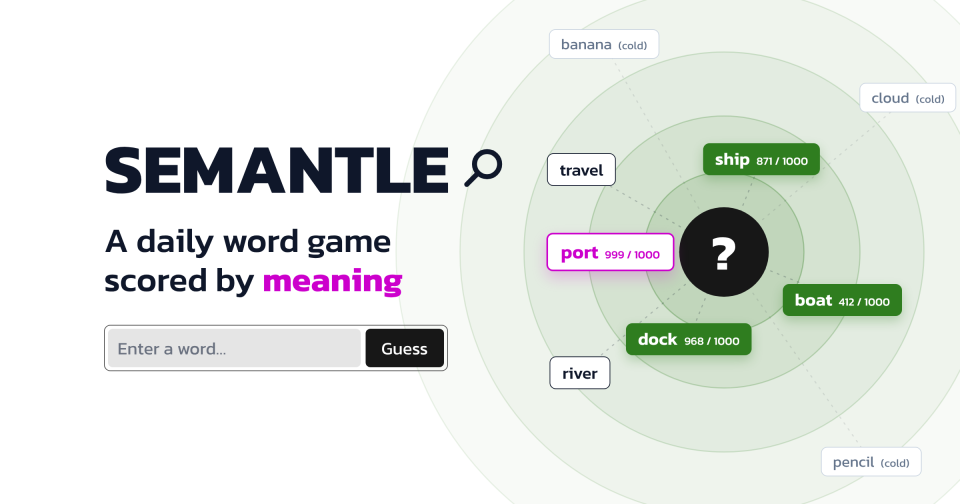
Semantle is a daily word game scored by meaning. You guess a secret word one word at a time; each guess receives a similarity score that shows how close its meaning is to the answer. If your guess sits among the 1,000 closest words, it also receives a proximity rank out of 1,000, where 999 is the closest word. Guesses are unlimited and there is one new word a day.
We, at The Word Finder, runs Semantle, so every number in this guide comes from the game itself. We replayed a past puzzle and found that “easy” ranked among the closest words to “impossible”. We also tested 16 common starting words across 120 puzzles and found no reliable opener.
Semantle Is a Daily Word Game Scored by Meaning
The goal of Semantle is to find one secret word a day. Every guess must be a single word, and the game returns a score that measures how close the meaning of your guess is to the secret word. It does this with word2vec, an artificial-intelligence model that places words used in similar contexts near one another. You may make as many guesses as you like.
David Turner created Semantle. It is now part of The Word Finder, which manages the game at semantle.com. The daily answers come from a list of common English words that have been shuffled; capitalised and hyphenated forms are removed, so the secret word is always a single ordinary word. It can be any part of speech. Recent answers have included “about”, “within”, “forth”, “who”, “nevertheless”, “already”, the verbs “behave” and “succeed”, and the adjectives “historic” and “fantastic”.
Play today’s Semantle puzzle. For the full rules, see Semantle’s FAQ.
How to Play Semantle, Step by Step
- Open today’s Semantle puzzle.
- Read the three numbers shown above the guess box. They report the similarity of the nearest word, the tenth-nearest word and the thousandth-nearest word for that day’s secret word.
- Type one word into the box and press Guess.
- Look at the Similarity score (to two decimal places) and the Proximity column. A rank such as 995 / 1000 means the word is among the thousand closest; otherwise you will see a label such as tepid, cold or far.
- Keep guessing. The list of your guesses stays sorted by similarity, so the strongest leads sit at the top.
- If you are stuck, use the Hint button or Give Up. A correct guess scores 100 and ends the game.
Every guess in the list links to its definition on The Word Finder.
What Semantle’s Scores and Ranks Mean
Semantle works by turning each guess into a similarity score that reflects how close the word’s meaning is to the secret word. The secret word itself scores 100. Scores can fall below zero (the practical floor is around –34), so the number is not a percentage; higher simply means closer.
When a guess is one of the 1,000 nearest words, the Proximity column shows a rank out of 1,000 with a green bar. 999 is the closest word, 998 the second-closest, and so on down to 1 / 1000, the thousandth-closest. An in-game note confirms that a guess showing 999 is the closest word to the secret word. Guesses outside the top 1,000 receive a label instead: “(tepid)” for a score of 20 or more, “(cold)” for a score under 20, and “(far)” for a negative score.
The three numbers above the guess box change every day. In puzzle #1751 they were 71.95, 50.35 and 26.01; in puzzle #1752 they were 66.07, 53.92 and 37.10. The third figure is the score you need to reach the top 1,000 on that day.
We replayed puzzle #1751 and scored a few extra guesses with the game’s own scoring service. Scores from Semantle puzzle #1751, checked 16 November 2026:
| Guess | Similarity | What Semantle showed |
|---|---|---|
| impossible (the secret word) | 100.00 | game won |
| difficult | 71.95 | 999 / 1000 (the closest word) |
| inconceivable | 60.66 | 998 / 1000 |
| easy | 54.76 | 995 / 1000 |
| feasible | 49.39 | 987 / 1000 |
| doable | 45.50 | 969 / 1000 |
| impossibly | 39.42 | 923 / 1000 |
| possible | 32.73 | 720 / 1000 |
| chance | 22.25 | (tepid) |
| maybe | 18.72 | (cold) |
| cat | 3.47 | (cold) |
“Easy” ranked 995 of 1,000, making it the fifth-closest word to the secret word “impossible”. You can replay the same puzzle at puzzle #1751.
Why Opposites Score High in Semantle
Word2vec learned from roughly 100 billion words of Google News text and produced 300-dimensional vectors for three million words and phrases. Words that appear in similar contexts end up with similar vectors, so opposites often score high. The linguist J. R. Firth put the idea neatly: “You shall know a word by the company it keeps.”
Researchers at Radboud University’s Donders Institute illustrate the point with “hot” and “cold”: both fill the same kinds of sentences (“The tea is too _”), so the model treats them as close. Our own checks on Semantle’s scoring service show the same pattern. “Hate” is the fifth-closest word to “love”, scoring 60.04 and ranking 995 / 1000. For the secret word “soar”, the five nearest words include “plummet” in second place. In the table above, “easy” ranked higher than “impossibly” even though the latter shares nearly every letter with the answer.
A word with more than one meaning is scored by the sense that appears most often in news writing. “Leather” sits far from “patent”, and “display” is treated more often as a verb than as a noun. When a word scores well, its opposite and its other forms deserve a guess.
The underlying model is described in Google’s word2vec release and in the 2013 paper that introduced word2vec.
Starting Words Matter Less Than You Think
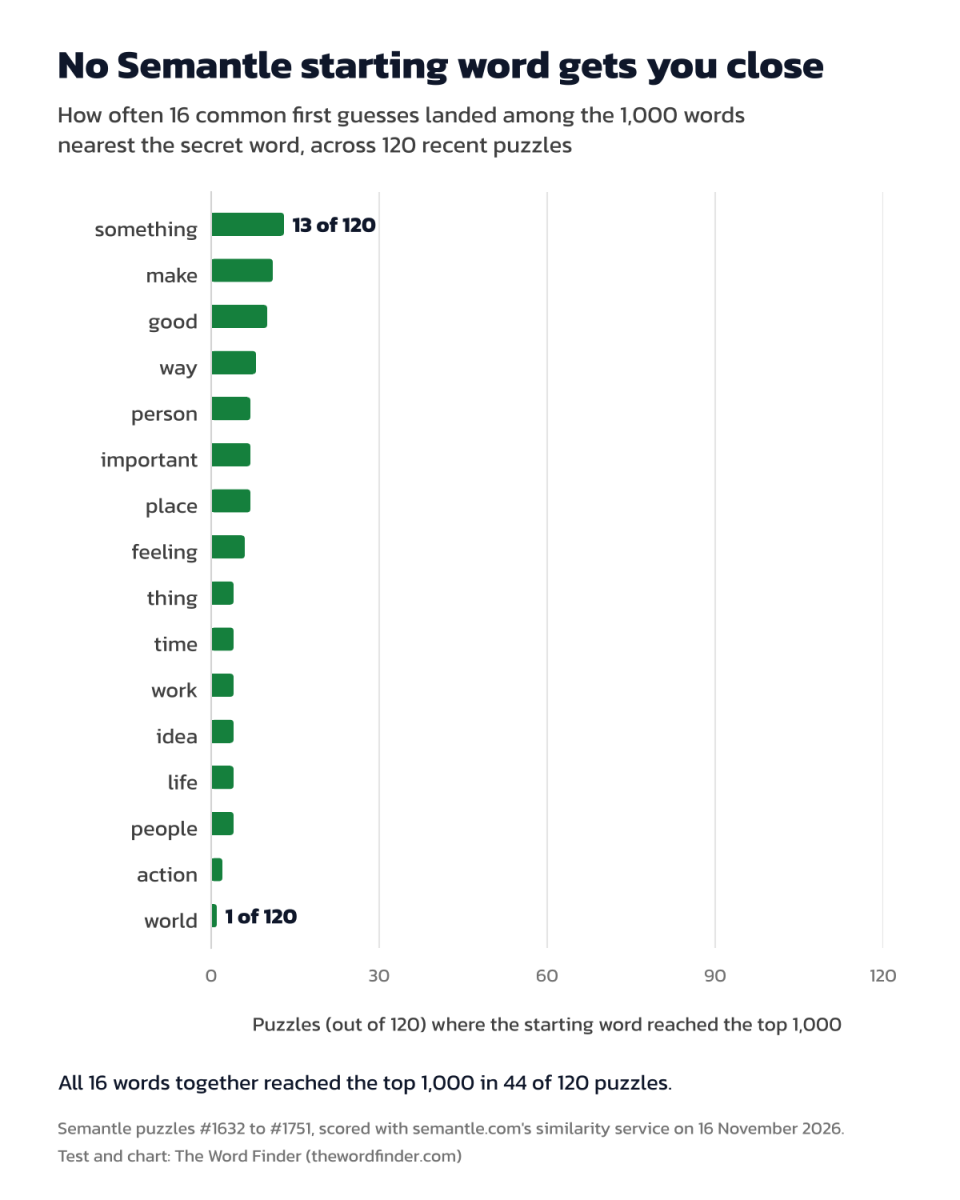
We scored 16 common starting words against the secret words of 120 Semantle puzzles, #1632 to #1751, using Semantle’s own scoring service. That produced 1,920 scored guesses.
| Starting word | Reached the top 1,000 (puzzles out of 120) | Scored 20 or more (out of 120) | Median score |
|---|---|---|---|
| something | 13 | 30 | 12.42 |
| make | 11 | 22 | 8.70 |
| good | 10 | 17 | 9.74 |
| way | 8 | 16 | 11.48 |
| person | 7 | 13 | 8.92 |
| important | 7 | 13 | 8.24 |
| place | 7 | 8 | 7.59 |
| feeling | 6 | 15 | 8.65 |
| thing | 4 | 15 | 10.36 |
| time | 4 | 13 | 10.31 |
| work | 4 | 14 | 10.24 |
| idea | 4 | 10 | 9.51 |
| life | 4 | 8 | 9.01 |
| people | 4 | 8 | 8.65 |
| action | 2 | 4 | 7.80 |
| world | 1 | 3 | 6.95 |
In our test the best single starter, “something”, reached the top 1,000 in 13 of 120 puzzles. The weakest, “world”, managed it once. Taken together, the 16 words reached the top 1,000 in 44 of 120 puzzles. A five-word spread (make, something, good, place, time) did so in 29 of 120. Of all 1,920 guesses, only 96 (5 %) entered the top 1,000.
Semantle has no reliable starting word. An opening’s job is simply to find a warm direction, and several different kinds of word do that better than any single favourite. (We have published a separate analysis of the best starting words for Wordle; the two games reward different habits.)
A Semantle Strategy That Works
These Semantle tips rest on the scores and tests above.
- Open with several different kinds of word: a noun, a verb, an adjective and a small function word such as “about”. Secret words can be any part of speech; recent answers include “about”, “within” and “nevertheless”. No single starter is reliable.
- Read the three numbers above the guess box. The thousandth-nearest score is that day’s threshold for the top 1,000.
- Follow your best guess. Treat a score of 20 or more as a lead and any rank as a strong one, then build from the top of the list, which is sorted by similarity.
- Once you have a rank, try opposites, close synonyms and other forms of the word. “Easy” ranked fifth for “impossible”; “plummet”, “soars” and “soared” all sat near “soar”.
- Think like a newspaper. The model learned from Google News text, so a word is scored by its most common newspaper meaning.
- Use US spelling. The game tries to map British forms, but some senses never come through.
- Take a hint when you are truly stuck. It returns a word slightly better than your best guess.
David Turner’s original rules still warn that “You will probably need dozens of guesses.” You can read them at David Turner’s original rules.
Hints, Semantle Junior and Other Ways to Play
While you play you can scroll down for a hint or give up. A hint supplies a word that is slightly better than your current best guess and joins the list with a light-bulb icon. In our replay of puzzle #1751 the best guess was “easy” at 995 / 1000; the hint returned “inconceivable” at 998 / 1000. Give Up ends the game and reveals the secret word.
After a correct guess a Bonus Round appears. When the secret word has eight letters or more it asks you to list 12 words made from its letters; for shorter answers it asks for 12 more words from the top 1,000. Once you have finished the round, the anagram solver is useful practice.
Semantle Junior is an easier daily version whose secret words are typically nouns or very common terms. Teams lets you create or join a group with a code. You can also set your own secret word and share the puzzle. Both semantle.com and the Semantle archive on The Word Finder keep every past puzzle playable. An account saves your games and stats across devices, and a Spanish version runs at semantle.com/espanol.
Where Semantle Came From
David Turner created Semantle and first released it on his own site, semantle.novalis.org. The earliest puzzles date to the end of January 2022; the very first secret word, in puzzle #1, was “executive”. By mid-November 2026 the daily series had passed 1,750 puzzles.
In April 2022 The Washington Post described the game under the headline “Semantle is like the Dark Souls of Wordle” and reported that nearly 200,000 people were playing each day’s puzzle. In a 2024 interview with Hey Good Game Turner recalled a peak of a quarter of a million unique IPs every day. The original version still runs at legacy.semantle.com. The game is now part of The Word Finder and lives at semantle.com.
When you have finished today’s puzzle, more daily word games to play after Wordle are waiting.
Naomi Bruwer writes for The Word Finder and answers Semantle players’ support emails.
Frequently Asked Questions
1. How does Semantle work?
You guess the secret word one word at a time, and Semantle scores each guess by how close its meaning is to the answer, using word2vec. The answer scores 100. A guess among the 1,000 closest words also gets a rank out of 1,000, where 999 is the closest; other guesses show tepid, cold or far. Guesses are unlimited, with one new word a day.
2. Why is Semantle so hard?
The score reflects how words are used in news writing, so opposites and loosely linked words can score high: “easy” was the fifth-closest word to “impossible”. The answer can be any part of speech, including words like “about” and “within”. Turner’s own rules warn that you’ll probably need dozens of guesses.
3. How do you get good at Semantle?
A practical Semantle strategy is to open with several different kinds of word, follow your best guess, try opposites and other forms of a strong word, and check the day’s thousandth-nearest score. Use a hint only when you are stuck.
4. What is the best starting word for Semantle?
There isn’t a reliable one. In our test of 16 starting words across 120 puzzles, the best, “something”, reached the top 1,000 in 13 of them. All 16 together reached it in 44 of 120, so open with several different words.
5. Does Semantle use AI?
Yes. Semantle’s FAQ says it measures meaning with artificial intelligence, specifically word2vec. The model comes from Google and learned from about 100 billion words of Google News text, which is why it rates words by how they’re used.
6. What is today’s Semantle word?
We don’t print the day’s answer here, because it would spoil the puzzle. Play it on semantle.com; its FAQ reveals yesterday’s word, and every past puzzle stays playable in the archive.
7. What do the question marks mean in Semantle?
On the original version at legacy.semantle.com, “????” marks an unusual word, often a capitalised one, that scores close but isn’t in the list of normal words used for the top-1,000 ranks. The current game at semantle.com shows no question marks; it labels guesses outside the top 1,000 as tepid, cold or far.
8. Who created Semantle?
David Turner created Semantle, and its first puzzles went out at the end of January 2022 on his own site. The game is now part of The Word Finder, which runs it at semantle.com.

