
Crossplay plays like Scrabble but scores differently.. The New York Times game uses the standard North American Scrabble word list, NWL2023, on a classic 15 by 15 grid with 100 tiles and a seven-tile rack. However, the Times tweaked four key mechanics: the locations of the premium squares, point values for nine letters, the bingo bonus for playing a full rack, and the endgame conditions.
We mapped both boards square by square and scored the same words in both formats to analyse how these structural changes affect overall strategy. By pushing the big multipliers toward the edges, Crossplay makes short opening plays less lucrative, even with higher tile values, and turns the middle game into a contest over opening or blocking lanes to the edge. For live game assistance, our Crossplay board solver analyses and ranks every move on your board.
Your Scrabble words carry over to Crossplay
A common critique of Crossplay is that it’s merely Scrabble in a new coat of paint, and that intuition isn’t entirely wrong. Mack Meller, the 2024 North American Scrabble Champion, noted to Scrabble writer Stefan Fatsis that for most players, it feels “functionally pretty much like Scrabble, strategy-wise.” Your existing anagramming skills and lexicon translate directly because the underlying word list is the same one North American clubs use.
However, default Scrabble habits can prove costly once you account for Crossplay’s altered layout and scoring math. Rohit Crasta, Crossplay’s lead designer, told Fatsis that Scrabble puts too much weight on the bingo, and a smaller bonus levels the playing field. Consequently, Crossplay awards 40 points for using all seven tiles in one turn (a “sweep”) compared to Scrabble’s 50-point bingo.
Crossplay and Scrabble at a glance
Three core elements remain identical: board dimensions, seven-tile racks, and the North American lexicon.
| Scrabble | Crossplay | |
| Players | 2 to 4 | 2 |
| Board | 15 × 15 | 15 × 15 |
| Tiles | 100, with 2 blanks | 100, with 3 blanks |
| Tiles in hand | 7, on a rack | 7, on a tray |
| Bonus for using all 7 | 50 points (a bingo) | 40 points (a sweep) |
| Word list in North America | NWL2023 | NWL2023 |
| First word | Doubled by the centre star | No bonus on the centre square |
| Leftover tiles at the end | Subtracted from your score | Not counted |
| Where you play | Board game, plus the Scrabble GO app | Free app for iPhone and Android |
Crossplay uses North American Scrabble’s word list
Crossplay adopts the NASPA Word List 2023 (NWL2023), licensed directly from NASPA Games, the governing body for North American tournament play. Because NWL2023 has been official since 29 February 2024, virtually any word valid in North American club play is accepted in Crossplay. The main exceptions are trademarks and proper nouns, which the Times filters out according to its official Help Center. Word definitions draw from the Oxford English Dictionary, using NASPA definitions as a backup.
International players accustomed to Collins Scrabble Words (CSW), the standard lexicon outside North America, will notice missing words. Even though Crossplay is available in Collins territories like the UK, Australia, India, and Singapore, CSW-exclusive entries are invalid. For instance, while Crossplay supports all 107 valid North American two-letter words, the 20 Collins-only twos (such as CH, DI, FY, KO, and ZO) will be rejected. Our 2-letter words list details all 107 playable two-letter entries. [Editor: keep this last sentence only once item 4 of Rae’s ticket is live. Otherwise cut it.]
Crossplay validates words automatically before accepting a move. Unlike physical Scrabble under Mattel rules, where playing an invalid word risks a challenge and a lost turn, Crossplay simply prevents illegal plays from hitting the board, eliminating bluffing and challenge penalties entirely.
The board keeps its size and moves the bonuses
| Bonus square | Scrabble | Crossplay |
| Triple word | 8 | 8 |
| Double word | 17, including the centre star | 8 |
| Triple letter | 12 | 20 |
| Double letter | 24 | 20 |
| Total | 61 | 56 |
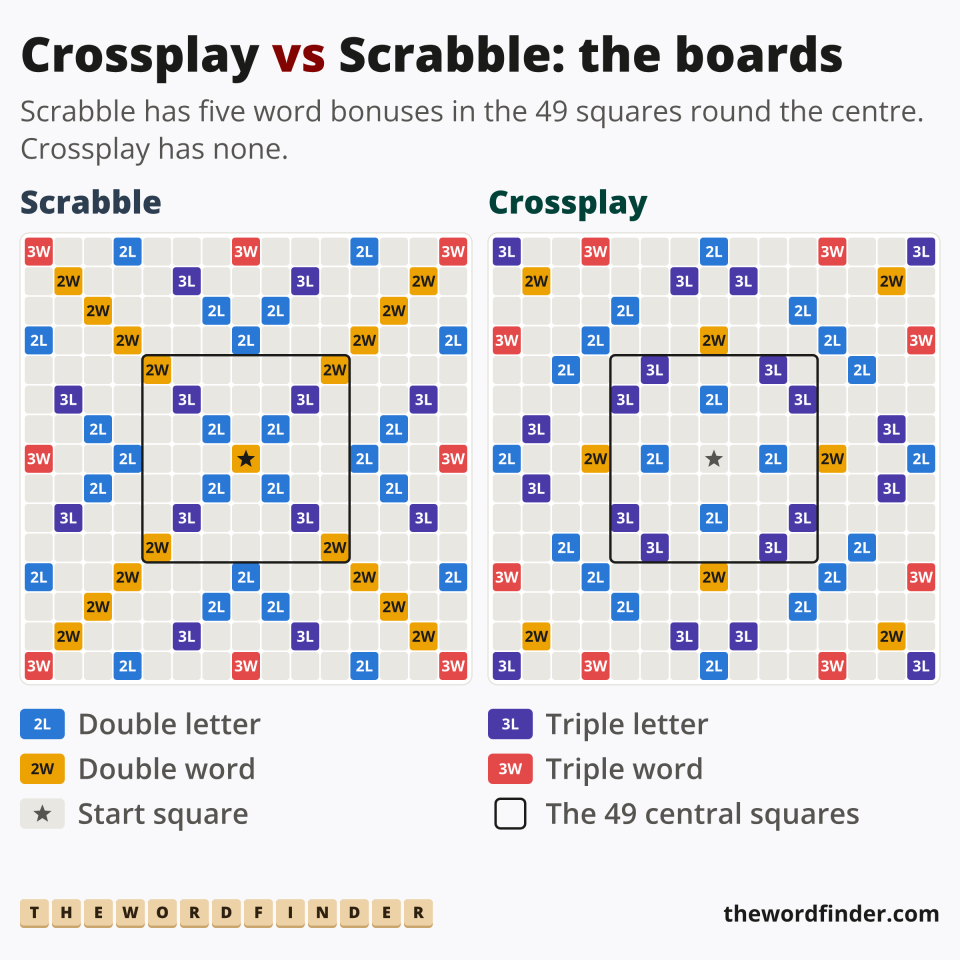
While both games use a 15 by 15 layout, Crossplay features five fewer total bonus squares and redistributes them significantly. Scrabble places Triple Words on corners and outer midpoints, running Double Words along diagonals to a central double-scoring star. Crossplay places Triple Letters on corners, shifts Triple Words three squares along each edge from the corners, and removes any multiplier from the starting centre square.
This structural shift is most prominent in the board’s interior. In the central 49 squares, Scrabble offers five word multipliers (four Double Words and the centre star), whereas Crossplay offers zero word multipliers. Instead, Crossplay packs that area with eight Triple Letters and four Double Letters, positioning its Double Words just outside this central block or near the corners. As Fatsis observed, this geometry encourages defensive positioning as players fight to control or block access to outer high-value squares.
Short opening words score less in Crossplay
In Scrabble, the centre star doubles the entire opening play. Crossplay’s centre square carries no multiplier, so short opening words score strictly at face value: playing QI on turn one yields 22 points in Scrabble, but only 11 in Crossplay.
Opening plays must cover the centre square in both games, but word length dictates reach in Crossplay. A 3- or 4-letter word can reach a Double Letter two squares out. Reaching a Double Word four squares away requires a 5-letter word extending to the side. A full 7-letter opening play can hit that Double Word plus two Double Letters simultaneously, which allows JUKEBOX (J on Double Word; K and X on Double Letters) to score 132 points in Crossplay versus 120 in Scrabble (including all-tile bonuses).
JUKEBOX is an outlier, however. Analysing optimal opening placements across the 10,000 most frequent 2- to 7-letter English words demonstrates that Crossplay yields lower average opening scores across most word lengths.
| Opening word | Scores less in Crossplay | Scores more in Crossplay | Average change in Crossplay |
| 2 letters | 100% | 0% | 47% lower |
| 3 letters | 73% | 13% | 14% lower |
| 4 letters | 86% | 8% | 18% lower |
| 5 letters | 44% | 38% | Level |
| 6 letters | 36% | 48% | 6% higher |
| 7 letters | 70% | 18% | 5% lower |
Crossplay matches Scrabble’s opening output primarily at five and six letters, where plays reach Double Words and benefit from higher base letter values. Seven-letter openings lag behind because the 40-point sweep bonus falls short of Scrabble’s 50-point bingo. Unless your opening rack makes a five- or six-letter word, expect a lower opening score than in Scrabble.
How we tested it: we took the 10,000 most common English words of two to seven letters in the wordfreq frequency list that also appear in the public-domain ENABLE word list, placed each one at its best position across the centre square on both boards, and added the 50-point bingo or the 40-point sweep for seven-letter words.
Long words need different lanes
The highest scoring plays come from bridging multiple word multipliers. In Scrabble, a 7-letter word can hit a Double-Double (4x score), while a Triple-Triple (9x score) requires 8 letters. In Crossplay, both Double-Double and Triple-Triple setups require a 9-letter word across the board.
However, Crossplay introduces a unique combination: bridging a Triple Word and a Double Word for a 6x multiplier. This requires an 8-letter word extending along the fourth row or column from any edge toward the centre, a configuration impossible in Scrabble because its only aligned Double Word multiplier is the centre square, which is used on move one.
Words exceeding seven letters require existing board anchors. Fatsis points out that 9-letter words are hard to come by, which leaves the 8-letter Double-Triple as Crossplay’s most realistic jackpot.
Nine letters changed value, and the bag is worth 12% more
| Letter | Scrabble | Crossplay |
| B | 3 | 4 |
| G | 2 | 4 |
| H | 4 | 3 |
| J | 8 | 10 |
| K | 5 | 6 |
| L | 1 | 2 |
| U | 1 | 2 |
| V | 4 | 6 |
| W | 4 | 5 |
Only H decreased in value (from 4 to 3). Meanwhile, G doubled from 2 to 4 points, and J joined Q and Z in the 10-point tier.
Tile distribution was also revised. Alfred Butts, who invented Scrabble, based his tile counts on how often each letter appears in English print. Crossplay adds an S, an H, and a third blank tile while reducing I, N, and U by one each. The additional S is especially impactful; Butts capped S at four tiles to preserve its tactical power as a hook, whereas Crossplay provides five.
In aggregate, Crossplay’s tile pool is worth 210 face-value points compared to Scrabble’s 187, a 12% increase. Across 10,000 common English words, 63% score higher at face value in Crossplay, 31% score identically, and only 6% score lower (specifically words containing H). Fatsis found his games against other experts scored higher than he expected, which he puts down to the richer tile values, the extra S and the third blank.
| Same word, face value | Scrabble | Crossplay |
| JUKEBOX | 27 | 32 |
| GLOW | 8 | 12 |
| VOWEL | 11 | 15 |
| BULK | 10 | 14 |
| STONE | 5 | 5 |
| HEART | 8 | 7 |
Words composed of common vowels and consonants (like STONE) maintain identical face values. Words using G, K, V, and W see the largest boosts, while H-heavy words drop slightly. For a full breakdown, explore our Crossplay tile values guide alongside our Scrabble tile values reference.
Using all seven tiles pays 40 points
Playing all seven rack tiles awards a 50-point bingo in Scrabble, a 40-point sweep in Crossplay, and 35 points in Words With Friends. Scrabble experts defend the 50-point bingo: as Fatsis puts it, the bigger bonus fairly rewards finding hard seven- and eight-letter words.
Combined, these adjustments reshape scoring dynamics. With a 20% smaller bonus for rack clearance and 12% higher tile values overall, a larger percentage of your total score stems from grid placement and tile leverage. A third blank makes sweeps easier to find, but it can’t split evenly between two players, and the smaller sweep makes each blank worth slightly less than in Scrabble.
A Crossplay game ends faster, and leftover tiles cost nothing
Under traditional Mattel rules, Scrabble concludes when the bag is empty and one player plays off their final tile (or when every player passes twice in a row). Players deduct unplayed rack tiles from their scores, and the player who goes out receives the sum of their opponent’s remaining tiles. Holding a 10-point tile like Q at the end creates a dramatic 20-point swing.
Crossplay streamlines endgame play. Once the tile bag is empty, each player receives exactly one final turn before the game ends, with no score penalties for remaining tiles. Swapping or passing consumes a turn. Because the player who draws the last tile guarantees themselves the final move, Fatsis recommends managing tile draws carefully near the endgame to secure that advantage.
Every Crossplay game runs on a clock, too. Each turn has a seven-day limit, and a player who misses it times out, which counts as a resignation.
Crossplay is for two players, with a coach built in
Scrabble takes two to four players around a board. Crossplay is two-player only, against a friend, a matched opponent or the computer at easy, medium or hard, and you can keep several games going at once. There’s no pass-and-play mode, so two people at one table each need a phone.
The computer is the weak spot. Fatsis played more than 30 games against the hardest setting and won all of them, by about 150 points on average, so it suits beginners better than experienced players.
Cross Bot, the built-in coach, is the stronger feature. Every player gets tips after each game, and NYT Games subscribers get its full postgame review of games against other people, which picks out the key moments and the plays you missed. It can be wrong. In one of Fatsis’s games it told a former champion to spend a blank for zero points early on, a play experts avoid.
The app tracks tiles for you, showing what’s left in the bag. Over a Scrabble board that job is yours, which is why tournament players keep tracking sheets.
For the full rules and a strategy plan, our guide to playing NYT Crossplay picks up where this comparison stops.
Where you can play each game
Crossplay is a free app for iPhone and Android, and you need a New York Times account to play. A Games subscription removes the ads and unlocks Cross Bot’s full review. There’s no web version. The Times tested it in New Zealand from June 2025, launched it in the US on 21 January 2026, and now offers it in 34 countries, from Canada and the UK to India and Singapore, plus Android in Ghana. By April 2026 players had downloaded it 3 million times and played more than 30 million games, a Times spokesperson told Fatsis.
Scrabble is a board game, sold by Hasbro in the US and Canada and by Mattel everywhere else. Its licensed app is Scopely’s Scrabble GO.
For the rest of the Times’ lineup, our breakdown of which NYT games are free covers every game in the main app, and our NYT Games hub collects our daily hints and solvers.
Which one to play
Opt for Crossplay if you want an asynchronous, mobile-friendly word game with generous turn limits and built-in postgame analysis. Your North American Scrabble vocabulary transfers seamlessly; you simply need to adjust to board geometry by shifting focus away from the centre toward outer perimeter lanes.
Stick with classic Scrabble for over-the-board play or multiplayer sessions of three to four players. Scrabble remains the benchmark for competitive club and tournament play, where 50-point bingos and precise endgame tile tracking dictate winning outcomes. Compare other digital word games in our Scrabble vs Words With Friends analysis and our Wordfeud guide.
When a game has you stuck, take a screenshot and load it into our Crossplay board solver. It reads the board and ranks every play by what it would score.
How we compared the two games
We used Scrabble’s standard board and mapped Crossplay’s from our board solver, then checked all 225 squares against a screenshot of the app. Tile values and counts come from our Crossplay tools and match four published guides. We took the rules from the NYT Help Center and Mattel’s Scrabble instructions, and the designer and player interviews from Stefan Fatsis’s reporting. We computed every score in code.

Frequently asked questions
Is Crossplay the same as Scrabble?
No, though it’s close. Crossplay uses North American Scrabble’s word list, the same 15 by 15 board and 100 tiles, and seven tiles in hand. It changes where the bonus squares sit, nine letter values, the all-tiles bonus (40 points instead of 50) and the endgame, and it’s for two players only.
What dictionary does NYT Crossplay use?
The NASPA Word List 2023 (NWL2023), the list North American club and tournament Scrabble uses. Definitions come from the Oxford English Dictionary, and the Times excludes trademarks and proper nouns.
What is a sweep in Crossplay?
Using all seven tiles from your tray in one turn. A sweep earns 40 bonus points, against 50 for a bingo in Scrabble.
How many tiles are in Crossplay?
100, including three blanks. Scrabble also has 100 tiles, with two blanks.
What are the tile values in Crossplay?
Most letters score as they do in Scrabble. Nine changed: B 4, G 4, H 3, J 10, K 6, L 2, U 2, V 6 and W 5. Our Crossplay tile values page lists all 27 tiles with their counts.
Is Crossplay free?
Yes. You need a free New York Times account, and a Games subscription removes the ads and unlocks Cross Bot’s full game review.
Can more than two people play Crossplay?
No. Crossplay is two-player only, against a friend, a matched opponent or the computer.
How does a Crossplay game end?
Once the bag is empty, each player gets one final turn and the game ends. Leftover tiles on your tray don’t count against you.
Is Crossplay available outside the US?
Yes. The Times offers it in 34 countries, including Canada, the UK, Ireland, Australia and New Zealand, plus Android users in Ghana.
Is Crossplay like Words With Friends?
Close, with different details. Words With Friends uses 104 tiles, its own word list and a 35-point bonus for using all seven tiles. Crossplay uses 100 tiles, the NASPA list and a 40-point sweep.
Can you play Crossplay on a computer?
No. Crossplay is a phone app for iPhone and Android, with no web version.
