
Some English words run long because the language borrowed a stack of Greek and Latin parts and bolted them together. Others run long because someone wanted to win the argument over the longest word of all. Here are the real heavyweights, where they come from, and why they tie most people’s spelling in knots.
The 45-letter record holder
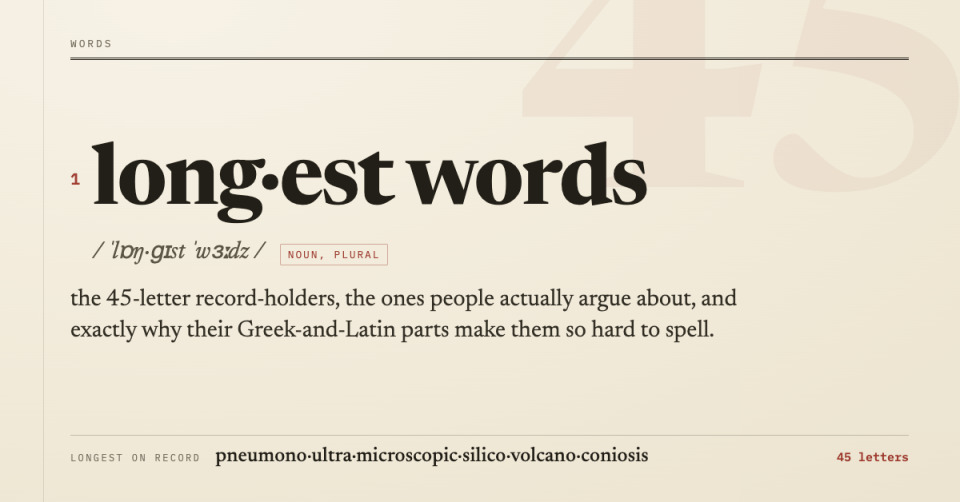
The longest word you will find in a major dictionary is pneumonoultramicroscopicsilicovolcanoconiosis, at 45 letters. It names a lung disease caused by breathing in very fine silica dust. The word appears in references including Merriam-Webster, though lexicographers are open about the fact that it was popularised partly to claim the longest-word crown rather than because doctors use it daily.
Break it into parts and it stops looking impossible: pneumono (lung) + ultra + microscopic + silico (silica) + volcano + coniosis (a disease from dust). Each chunk is a word or root you already half-recognise.
The long words people actually argue about
Two words have spent decades as the schoolyard champions.
Antidisestablishmentarianism (28 letters) means opposition to withdrawing state support from an established church. It is a real political term, even if almost nobody needs it now.
Floccinaucinihilipilification (29 letters) means the act of judging something to be worthless. It is often cited as the longest non-technical word recorded in the Oxford English Dictionary, and it is a small joke in itself, since the word is mostly a pile-up of Latin roots that all mean “nothing much.”
Shakespeare’s longest word
Long before any of these, Shakespeare reached for honorificabilitudinitatibus (27 letters) in Love’s Labour’s Lost. It roughly means the state of being able to receive honours. It is a favourite of word lovers because it alternates consonant and vowel the whole way through, which makes it oddly easy to say once you get going.
The invented ones
Some long words were built for effect and then earned a dictionary entry anyway. Supercalifragilisticexpialidocious (34 letters) came from the 1964 film Mary Poppins and now sits in several dictionaries. It counts as a word, but it was coined rather than grown from older roots, which is why purists keep it in a separate category.
The one that beats them all (and is not really a word)
The full chemical name of the muscle protein titin runs to roughly 189,819 letters and takes more than three hours to read aloud. It is a chemical formula spelled out, not a dictionary entry, which is exactly why word lists leave it out. A name that long describes a molecule, not a thing you would ever write in a sentence.
Why long words are so hard to spell
Length is only part of the problem. The harder issue is that these words are built from morphemes, the small meaning-units of language, and most of us were never taught to see them. Three things trip people up:
Repetition of similar syllables, like the “-ilipili-” run in floccinaucinihilipilification, where the eye loses its place. Unfamiliar Greek and Latin roots that follow spelling rules English speakers do not use by instinct. And sheer length, which overloads the working memory you rely on to hold a word together while you write it.
The fix is the same one that cracks the 45-letter monster: stop reading the word as one block and break it into parts. Spell each chunk, then join them.
How to check a long word
If you want to confirm a long word is real, or find what fits a specific set of letters, the All Words Database lets you filter by length and pattern. The Anagram Solver turns a jumble of letters into every valid word they can spell, which is handy when a long word is on the tip of your tongue. And if you are settling a board-game dispute, the Scrabble Word Finder tells you whether a word is tournament-legal before you play it.
Frequently asked questions
What is the longest word in English?
The longest word in a major English dictionary is pneumonoultramicroscopicsilicovolcanoconiosis, at 45 letters. It refers to a lung disease caused by inhaling fine silica dust. Longer “words” exist as technical chemical names, but they are formulas rather than dictionary entries.
What is the longest non-technical word?
Floccinaucinihilipilification (29 letters), meaning the act of estimating something as worthless, is commonly cited as the longest non-technical word in the Oxford English Dictionary. Antidisestablishmentarianism (28 letters) is the other frequent contender.
What is the longest word in Shakespeare?
Honorificabilitudinitatibus, 27 letters, which appears in Love’s Labour’s Lost. It means the state of being able to receive honours.
Is there a word longer than 45 letters?
Only if you count chemical names. The full name of the protein titin runs to about 189,819 letters, but it is a spelled-out formula, not a word you would find in a dictionary or use in writing.
How do you spell very long words more easily?
Break them into their building blocks rather than reading them as one shape. Pneumonoultramicroscopicsilicovolcanoconiosis becomes pneumono, ultra, microscopic, silico, volcano, coniosis. Spell each part, then join them together.
