
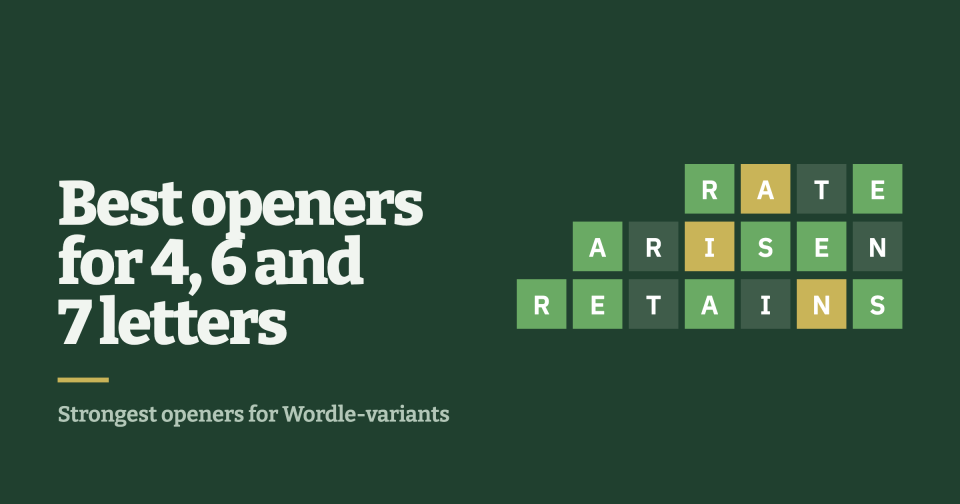
Almost every starting-word guide you will find is written for five-letter Wordle. Change the word length and the arithmetic underneath changes with it, which is why the canonical openers stop being the right answer the moment you move to a Lingle variant.
This guide covers 4-, 6- and 7-letter Lingle. Every pair below is built from words in ordinary use, checked against letter-frequency data, and chosen so you can actually recall it under time pressure. If you are here for standard five-letter Wordle, our data-driven analysis of the best 5-letter starting words is where SLATE, CRANE and the rest live, and our companion piece on the worst Wordle starting words covers what to keep out of guess one.
Why variant Wordles need different starting words
Five-letter advice is built around one specific puzzle: five slots, a curated answer list of about 2,300 common words, and six guesses. Change any of those and the maths moves.
Start from the baseline. Peter Norvig’s analysis of 743 billion words of Google Books text, an update of Mayzner’s 1965 work, puts English letter frequency in the order ETAOIN SRHLDCU. The top eight letters (E, T, A, O, I, N, S, R) account for 65% of all letters in English text. The bottom six (V, K, X, J, Q, Z) account for 2.2% between them. Every starting-word strategy is an attempt to exploit that distribution, and the number of slots you have decides how much of it you can reach in one guess.
4-letter Lingle: fewer slots, less room for error. Four positions means at most four of the top eight letters per guess, and only if a real word uses them. The answer pool is also smaller. In the 274,000-word English list we used for this analysis, there are 5,469 four-letter words against 12,578 five-letter ones, so the long tail matters proportionally more and generic openers get punished. Two-word openers are close to essential here.
6-letter Lingle: repeated letters arrive. The chance of a repeated letter climbs sharply with length. In that same word list, 21.9% of four-letter words contain a repeat, 35.8% of five-letter words, 53.3% of six-letter words and 67.2% of seven-letter words. By six letters it is more likely than not. Your instinct on guess two has to change accordingly: a confirmed letter might well appear twice.
7-letter Lingle: one guess cannot cover it. The seven-letter pool runs to 33,192 words, and even a perfect opener tests only seven of the top eight letters. Two-word openers are the baseline strategy at this length, not an optimisation.
One pattern holds across all three. Per-word letter frequency rises with word length: A appears in 41.2% of five-letter words but 55.4% of words of any length. At six and seven letters you can be fairly confident an opener containing A, E, R, I or T will hit something. The question shifts from whether you covered enough letters to whether you learned anything about position.
Best starting words for 4-letter Lingle
Four letters is the tightest variant. Most serious players use a planned pair rather than improvising.
Each pair below is scored on letter coverage: the share of all letters in English text that the two guesses between them put on the board.
1. EAST & IRON (65.0% coverage)
These eight letters are E, A, S, T, I, R, O and N, which is exactly ETAOINSR, the eight most common letters in English. No four-letter pair covers more ground, and both words are as common as four-letter words get. This is the default we would give anyone.
2. BOIL & TEAR (56.9%)
Covers B, O, I, L, T, E, A, R, which is seven of Norvig’s top ten. T and L both run high at the end of four-letter words (the -ALT, -ILL, -OAT and -ELT shapes), so this pair reads common endings slightly better than its raw score suggests.
3. ALOE & FISH (53.8%)
The vowel-first option. Three vowels in the opening guess gives you near-complete vowel information in one move, and FISH fills in S and H behind it. Useful because four-letter answers so often turn on which vowel is present: BOAT, BEAT, BIT and BUT differ by a single letter.
Our earlier version of this guide led with READ & COIN. It is a reasonable pair, but it covers six of the top ten letters where BOIL & TEAR covers seven and EAST & IRON covers eight, so we have moved it out of the list.
Best starting words for 6-letter Lingle
Six letters is the strategic sweet spot: enough slots to cover real ground in two guesses, short enough to finish in three or four. Coverage is easy at this length, so the pairs below are chosen for vowel completeness and for how easily you will remember them.
Statistical analysis of English bigrams shows the most common doubled letters are LL, SS, EE, OO and TT, and that doubles cluster around positions three and four. That is precisely where six-letter answers hide them.
1. RETAIN & SHOULD (80.7% coverage)
Twelve distinct letters, all five vowels, and SHOULD is one of the most frequently used words in English, which matters more than it sounds: you will never fumble for it. The strongest all-round pair at this length.
2. AROUND & ETHICS (80.0%)
Twelve distinct letters and all five vowels again, with a different consonant mix: this pair tests C, H and S where the first tests S, H, L and D. H is worth having early because it rides the TH, SH and CH bigrams, so finding it narrows the field quickly.
3. CARBON & DUTIES (76.4%)
Slightly lower coverage, and still all five vowels. Worth keeping for players who want U tested early. U is rarer than the other vowels but near-mandatory alongside Q, and it turns up reliably in the -OUS, -OUR and -URE endings.
We have retired the ICEMAN & BORSHT and CREDIT & MANGOS pairs from the earlier version. BORSHT in particular barely registers in ordinary English usage, and an opener you cannot recall is not an opener.
Best starting words for 7-letter Lingle
Seven letters is where single-guess strategy stops working. Grant Sanderson’s information-theory analysis of Wordle shows the best five-letter openers extract about 5.9 bits from guess one against a 2,300-word pool. Against a pool of 33,192 words the arithmetic gets much harsher, so every recommendation below assumes two guesses.
1. AUCTION & FRESHLY (84.3% coverage)
Fourteen distinct letters, every vowel including Y, no overlap. We searched the full word list for the best possible disjoint seven-letter pair covering A, E, I, O, U and Y, and the theoretical maximum is 85.7%. AUCTION & FRESHLY lands within 1.4 points of it using two words you already know. AUCTION also carries the -TION ending that appears in thousands of seven-letter words.
2. INSTEAD & ROUGHLY (84.2%)
Effectively the same coverage, and the easiest pair here to remember: both words are in everyday use. Pick this one if recall under pressure is your weak point rather than coverage.
3. FACTION & HURDLES (86.4%)
The highest coverage of any everyday pair we tested. It buys that by skipping Y, which is a real trade at seven letters, where Y ends a lot of words. Use it when you would rather maximise letter information and handle Y later.
A note on EULOGIA, which the previous version of this guide recommended. It is famous for holding all five vowels in seven letters, and it is a word almost nobody has met. The same applies to ICEBOAT and GRUMPHY. A starting pair has to survive contact with a timer, so we have replaced all three.
If you are playing standard 5-letter Wordle
If you are playing the original five-letter Wordle from The New York Times rather than a Lingle variant, the answer pool is curated rather than open, and the position-frequency patterns differ.
The canonical openers (SLATE, CRANE, TRACE, SALET, RAISE) and the reasoning behind them are covered in our analysis of the best 5-letter Wordle starting words. That post also covers two-word combinations tuned to the NYT answer list, Hard Mode adjustments, and which letters to leave out.
Try the Lingles and the tools
The fastest way to internalise an opener is to play it twenty times in an evening, which is what the unlimited variants are for.
- 4-letter Lingle for the tightest, least forgiving variant
- 5-letter Lingle if you are easing across from standard Wordle
- 6-letter Lingle for the sweet spot above
- 7-letter Lingle for two-word opener practice
When you get stuck, and at six and seven letters everyone does, the Wordle Solver will show every remaining possibility from the greens, yellows and greys you have locked in. It works at any length. The archive of past Wordle answers is the place to check how your opener would have fared against real answers.
Frequently asked questions
What is the best starting word pair for 4-letter Lingle?
EAST & IRON. Between them the two words cover E, A, S, T, I, R, O and N, which are the eight most common letters in English. No other four-letter pair covers more, and both words are easy to recall. BOIL & TEAR is the next best at seven of the top ten letters.
What is the best starting word pair for 6-letter Lingle?
RETAIN & SHOULD. Twelve distinct letters, all five vowels, and both words are in constant everyday use. AROUND & ETHICS gives the same vowel coverage with a different consonant mix if you would rather test C and H early.
What is the best starting word pair for 7-letter Lingle?
AUCTION & FRESHLY. Fourteen distinct letters including every vowel and Y, landing within 1.4 percentage points of the best pair available anywhere in the dictionary. INSTEAD & ROUGHLY is the easier pair to remember at effectively the same coverage.
How is Lingle different from standard Wordle?
Lingle is The Word Finder’s unlimited Wordle-style family, available at 4, 5, 6 and 7 letters. Standard Wordle is the New York Times game: one five-letter puzzle a day drawn from a curated list of roughly 2,300 answers. Lingle draws from the open universe of valid English words at each length, which changes which openers perform best.
Should I use the same starter every game?
Use the same one. The value of a planned opener is pattern recognition: after a dozen games you read the tile colours faster because you know what each result means against a fixed opening. Switching every game gives that up and adds cognitive load you do not need.
How likely is a repeated letter in a longer word?
Much more likely than most players assume. In a 274,000-word English list, 21.9% of four-letter words contain a repeated letter, rising to 35.8% at five letters, 53.3% at six and 67.2% at seven. From six letters upward, assume a repeat until the board rules it out.
What are the rarest letters in Wordle and Lingle?
Z, Q, J and X are the rarest in English text, each under 0.25% of all letters in Norvig’s analysis, with V and K close behind. In the standard Wordle answer list, J, Q, Z and X each appear in under 2% of answers. No recommended opener at any length contains one.

