
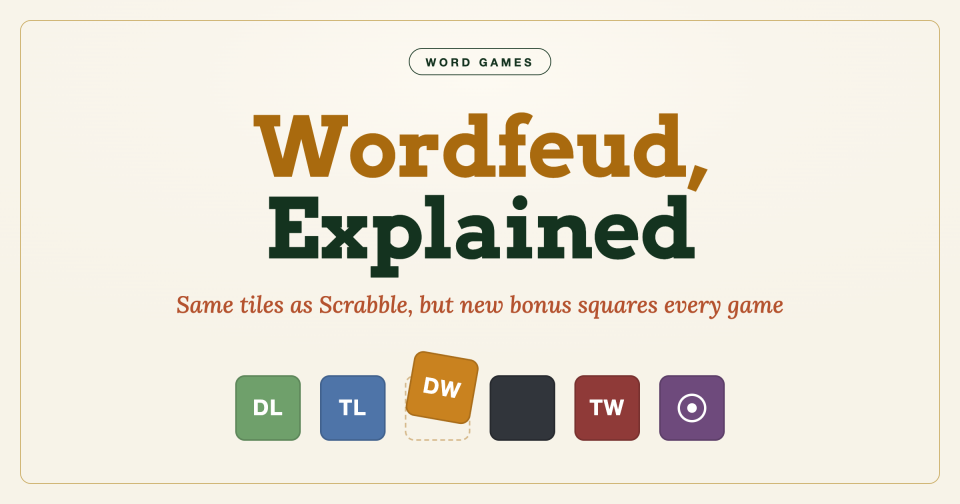
Wordfeud is a turn-based multiplayer word game built on Scrabble’s mechanics, written in 2010 by a Norwegian developer with no previous app experience. It has passed 40 million downloads, runs in ten languages, and lets you keep 30 games going at once, which is the feature that explains most of its staying power.
Here is how it works, what separates it from Scrabble and Words With Friends, and where it sits now that NYT Crossplay has entered the same space.
Where Wordfeud came from
Håkon Bertheussen built Wordfeud in 2010 through his company Bertheussen IT, wanting a way to play Scrabble-style games with people at a distance. It reached the App Store and Google Play in 2011 and Windows Phone in 2012. Within its first year it had close to eight million users, and by August 2025 it had crossed 40 million downloads.
The early growth was Scandinavian, which is where the game’s reputation was made. The more recent growth has come largely from the United States, so the old framing of Wordfeud as a purely European phenomenon no longer holds. Its design helps here: the rules work in any language using a Latin alphabet, which is why the game now ships in English, German, French, Spanish, Dutch, Swedish, Norwegian, Danish, Portuguese and Finnish.
Wordfeud Gameplay
Wordfeud was based on Scrabble, so it is very similar to that game, as well as to Words with Friends. The primary benefit of Wordfeud is that a player can engage in up to 30 different games at once. Playable on both iOS and Android devices, the game allows you to play against almost anyone, almost anywhere in the world.
The game is pretty much just like Scrabble: players start with seven tiles and work to lay them down on the board into words to get points. Because of its digital form, you can choose to randomize the board before you start, assigning double- and triple-letter spaces, as well as double- and triple-word spaces, to random points on the board.
If you’re looking to mix things up from Words with Friends, Wordfeud might not be your best bet. But if you’re hoping to connect with players elsewhere in the world, or if you want to find a way to play games with friends across long distances, WordFeud might be just the game for you.
How Wordfeud plays
The core of this game is very much inspired by Scrabble. Seven tiles on your rack, words laid across a 15×15 grid, premium squares multiplying letters and words, points for length and placement.
There are, however, three things that differentiate it from Scrabble.
Thirty simultaneous games. You can challenge friends or random opponents in up to 30 simultaneous games. Turns are asynchronous, so a game can run for days across time zones.
Randomised boards. Before a game starts you can shuffle the positions of the double and triple letter and word squares. The canonical Scrabble layout becomes one option among many, which matters more than it sounds: memorised opening patterns stop working, and every board has to be read fresh.
Per-language dictionaries. Wordfeud maintains its own word lists for each of its ten languages rather than using one global dictionary. Anyone coming from tournament Scrabble should check which list applies before arguing about a challenge, since the international Collins and North American NASPA lists differ by thousands of words.
It runs on iPhone, iPad and Android, with your games syncing between them.
Wordfeud, Scrabble, Words With Friends and NYT Crossplay
Four games now dominate this word-building-on-a-board space:
- Scrabble: The OG. A popular board game where players use letter tiles with different point values to build interlocking words on a grid.
- Words With Friends is the biggest in the United States. It blocks invalid words rather than letting a challenge decide, which beginners like and purists do not. Slightly larger board and different tile values.
- Wordfeud is the flexible one. Randomised boards, ten languages, thirty games at once, and it will accept an invalid word if your opponent does not challenge it, the way a physical board does.
- NYT Crossplay launched on 21 January 2026 as the New York Times’ first two-player word game. It is strictly head-to-head and asynchronous, with up to seven days per turn, and it rebalances the tile values: G moves from 2 points to 4, V from 4 to 6, and using all seven tiles pays 40 rather than Scrabble’s 50. It uses NWL2023, the North American Scrabble word list, and once the bag is empty each player gets one final turn.
The practical consequence for anyone moving between them is that the tile letter scores which differ between games. A play that is optimal in Scrabble can be mediocre in Crossplay, and the reverse. Our Scrabble vs Words With Friends comparison goes further into that pair specifically.
How Wordfeud differs from Scrabble
- Board layout. Wordfeud can randomise premium squares before each game. The official Scrabble app uses the standard layout only.
- Language coverage. Ten languages with their own word lists, against Scrabble’s regional editions.
- Concurrent games. Thirty at once. The official Scrabble app supports fewer.
- Invalid words. Wordfeud accepts an unchallenged invalid word. Words With Friends refuses to let you play one at all.
- Pace. Wordfeud is built for asynchronous play across days. A board game of Scrabble happens in one sitting.
Our Wordfeud solver
Our Wordfeud Board Solver takes your rack and your current board and returns every legal play ranked by score, using Wordfeud’s tile values rather than Scrabble’s. It defaults to the Scrabble UK dictionary, so check that against the word list your game is using before you rely on a marginal word.
It sits alongside our other board solvers, including Scrabble, Words With Friends, Word Chums and NYT Crossplay. For rack work away from a board, the Scrabble Word Finder and the Anagram Solver do the same job from letters alone.
A word on using one at all. In a friendly game a solver is a training tool: it shows you the play you missed, and after a few weeks of seeing what you missed, you stop missing it. Most people who use one regularly end up needing it less. In a competitive game, it is cheating, and you already knew that.
Frequently asked questions
What is Wordfeud?
Wordfeud is a turn-based multiplayer word game for iPhone, iPad and Android, created in 2010 by Norwegian developer Håkon Bertheussen. Players lay letter tiles on a 15×15 board to form words and score points, following Scrabble’s core mechanics. It has passed 40 million downloads and is available in ten languages.
Is Wordfeud the same as Scrabble?
No. Wordfeud uses Scrabble’s core mechanics but adds three differences: up to 30 simultaneous games, an option to randomise the premium squares before a game starts, and its own per-language dictionaries rather than the official Scrabble word lists.
Is Wordfeud free?
Wordfeud is free to download and play with advertising, and a paid ad-free version is available on both app stores.
Where can I play Wordfeud?
What dictionary does Wordfeud use?
Wordfeud maintains its own word list for each of its ten supported languages rather than using a single global dictionary. These differ from the tournament lists used in competitive Scrabble, where the international Collins list and the North American NASPA list differ by thousands of words.
How is Wordfeud different from Words With Friends?
Wordfeud lets you randomise the board layout, runs in ten languages, and will accept an invalid word if your opponent does not challenge it. Words With Friends blocks invalid words outright, uses a slightly larger board with different tile values, and has a much larger player base in the United States.
How does Wordfeud compare to NYT Crossplay?
Crossplay launched in January 2026, is strictly two-player, and uses rebalanced tile values with NWL2023, the North American Scrabble word list. Both games are asynchronous: Crossplay allows up to seven days per turn, and Wordfeud lets you run 30 games at once. Wordfeud is older, multilingual and more flexible on board layout.

