
What NYT Tiles is
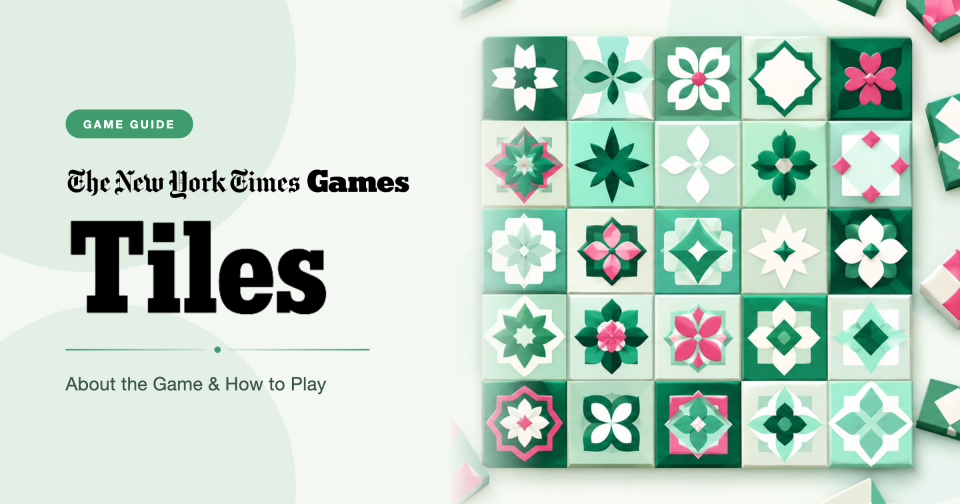
Tiles plays out on a grid of squares. Each square holds a small design built from layered elements such as a shape, a color, and a background pattern. Times art director Sam Von Ehren created the puzzles, which is why a daily board reads more like textile design than a game screen.
You win by clearing the board, and you clear it by matching tiles that have something in common. The game rewards attention more than logic. The daily board runs without a timer, and the only number it tracks is your combo count, so it stays calm even when the matches turn fiddly.
How to play NYT Tiles
The rules take about ten seconds to learn.
Your first tile is free, so tap any square to start. After that, every tile you tap has to share at least one design element with the tile before it. Say the last tile carried a yellow ring, a blue circle, and a striped background. Your next tile then needs to repeat one of those three. Each valid match strips the shared element from both tiles.
Chain matches together and you build a combo. The game records your longest combo of the session, and that streak is the only real scoreboard. Tap a tile that shares nothing with the previous one and the combo breaks, though you can keep playing from one again.
When a tile loses its last element, it clears completely and hands you another free choice, the same as your opening move. Clear every tile and you have solved the board.
How to clear a board cleanly
What separates a clean solve from a messy one comes down to the order you match in. Read the whole board before you touch anything. Tiles match whether or not they sit next to each other, so the grid behaves like a web of shared elements, and tracing that web first pays off.
Find the element that shows up most often, a single color or shape that threads through a dozen tiles, and build your run along it. Hold the rare elements back. A pattern that appears on only two tiles can strand you if you match it early and leave your combo with nowhere to go. The free choice you earn each time a tile clears is your reset. Use it to jump to a fresh cluster instead of painting yourself into a corner.
Clearing every tile in one unbroken combo is possible on most daily boards. It is also hard, which is why regular players keep showing up.
Where Tiles fits in NYT Games
Tiles is one of the older titles in the catalog. It arrived before the Times bought Wordle in 2022 and before Connections launched in 2023, and it shares the Games app and nytimes.com/games with the Crossword, the Mini, Spelling Bee, Strands, and Letter Boxed.
One thing has shifted for returning players: access. Tiles is no longer free to play the way it used to be. Our companion guide covers what changed, what it now costs, and where you can still play.
Frequently asked questions
What is NYT Tiles?
NYT Tiles is a visual matching game from the New York Times. You clear a grid of patterned squares by tapping tiles that share a design element, such as a color, shape, or background, with the tile you tapped before. It launched in 2019 and belongs to the NYT Games collection.
How do you play NYT Tiles?
Tap any tile to start, then tap a second tile that shares at least one visual element with it. Each valid match removes the shared element. Keep chaining matches to build a combo, and clear every tile to solve the board. Tapping a tile that shares nothing with the previous one breaks your combo.
Is there a timer in NYT Tiles?
No. The daily Tiles puzzle runs without a timer. The only thing the game tracks is your longest combo, so you can take as long as you like to plan a clean solve.
What does the longest combo mean?
Your combo counts the tiles you matched in a row without a break. The game records the longest unbroken streak you reach in a session. Clearing the entire board in a single combo is the unofficial perfect game.
Who designed NYT Tiles?
New York Times art director Sam Von Ehren created the Tiles puzzles, which is why each board carries the look of a designed pattern rather than a generic game grid.
Is NYT Tiles a word game?
No. Wordle, the Crossword, and Spelling Bee run on letters and words. Tiles runs on visual patterns instead, which makes it a useful change of pace from the word games in the NYT lineup.
