
If you enjoy elegant constraint satisfaction, classic graph theory, or tight word ladders, LinkedIn’s daily suite offers surprisingly rich design. While pitched as quick morning breaks for professionals, these eight LinkedIn puzzle games hide mechanical nuances that often trip up casual players. Understanding LinkedIn games rules isn’t just about reading the tutorials—it’s about mastering the edge cases.
Whether you are trying to parse the non-standard attack ranges in Queens, deduce parity in Tango, or construct valid Hamiltonian paths in Zip, this comprehensive guide breaks down how to play LinkedIn games from first principles.
Below is an exhaustive mechanical explainer for all eight puzzles, detailing their core objective, formal rules, mathematical roots, and common tactical traps.
The eight games, in the order they arrived
LinkedIn began rolling out its puzzle arcade on 1 May 2024, expanding from three initial offerings to eight daily logic and word challenges.
| Game | Launched | Type |
|---|---|---|
| Pinpoint | 1 May 2024 | Word association |
| Queens | 1 May 2024 | Logic grid |
| Crossclimb | 1 May 2024 | Word ladder |
| Tango | 7 October 2024 | Binary logic grid |
| Zip | 18 March 2025 | Path puzzle |
| Mini Sudoku | August 2025 | Number logic |
| Patches | 18 March 2026 | Tiling puzzle |
| Wend | 8 June 2026 | Word search variant |
There is a new puzzle every day and you get one go at each.
Zip: Hamiltonian Paths and Corner Traps
Core Objective: Draw a single, unbroken orthogonal path through a grid connecting numbered waypoints in strict numerical order.
The Hidden Rule: The path must visit every single cell on the board exactly once. Simply visiting the numbers in order without covering the entire grid will result in an incomplete state.
Puzzle Nerd Breakdown: Mathematically, Zip is a grid-graph Hamiltonian path problem with ordered spatial constraints. Because diagonal moves and cell-crossing are prohibited, dead-ends form easily around corners and structural walls. Always analyze degree-2 vertices (such as tight corners) first, as your path is forced to pass through them regardless of sequence numbers.
Tango: Binary Systems and Equality Constraints
Core Objective: Fill a 6×6 grid with two symbols (Suns and Moons) adhering to specific distribution limits.
Core Rules: Every row and column must contain exactly three Suns and three Moons. No more than two identical symbols may sit adjacent to one another orthogonally.
The Edge Case Constraints: Between select adjacent cells sit relational markers: = (equality) and × (difference). An = forces both cells to match, while an × forces them to differ. These are mandatory logical constraints necessary to prevent multiple valid solutions.
Puzzle Nerd Breakdown: Derived from classical Takuzu (Binairo), Tango requires parity tracking and forced-choice reduction. If a line segment contains two identical symbols, the boundary cells are strictly forced. Furthermore, chaining relational markers across rows often resolves entire sub-grids without needing explicit symbol placement.
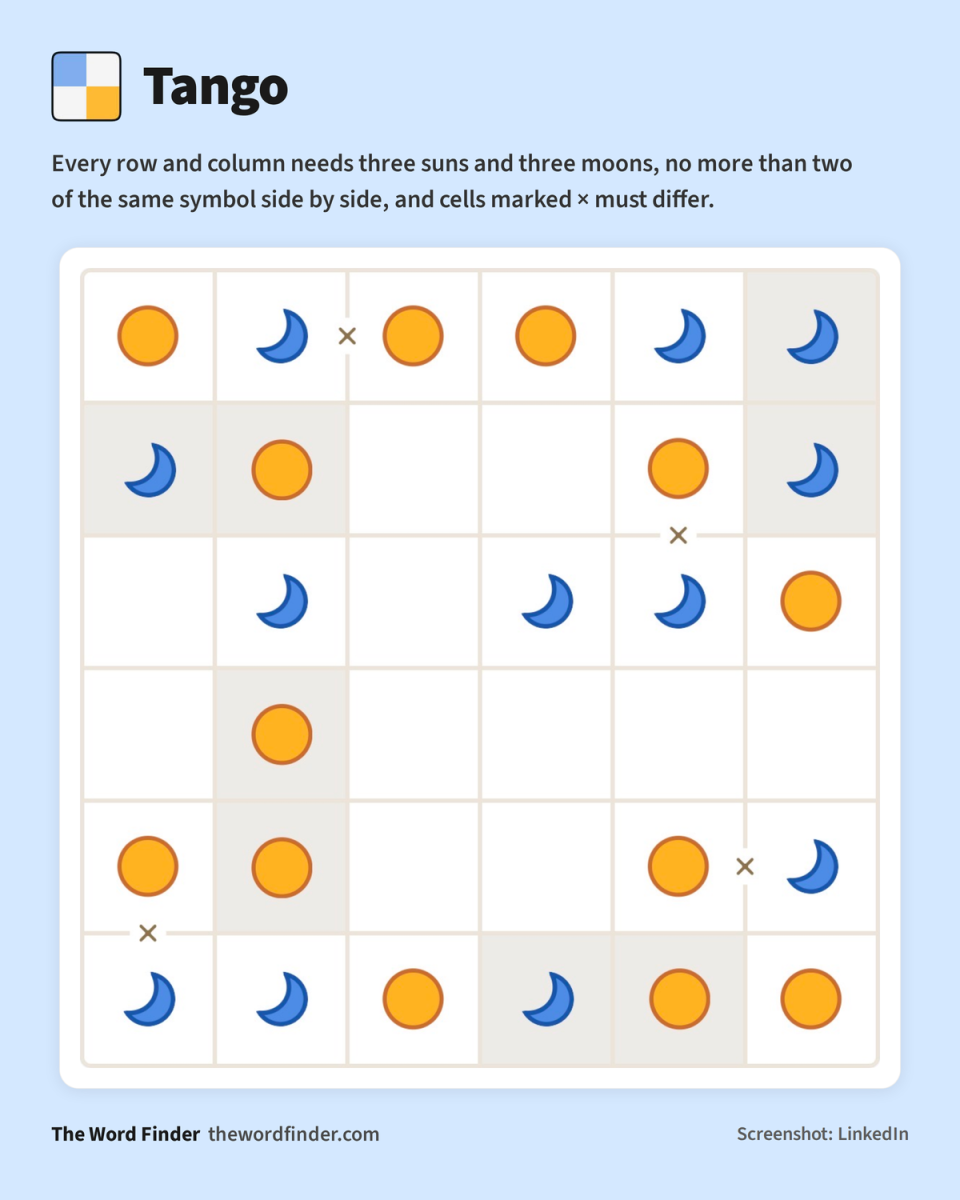
and three moons, and the x markers flag pairs that cannot match.
Queens: Non-Attacking N-Queens on Irregular Regions
Core Objective: Place exactly one Queen per row, column, and contiguous color region on an N x N board.
The Non-Chess Rule Trap: Queens in this puzzle do not attack across full diagonals. Instead, they project a 1-cell king-neighborhood (3×3 grid centered on the queen). Two queens may occupy the same diagonal line as long as they are separated by at least one empty square.
Puzzle Nerd Breakdown: This is a variant of Star Battle / N-Queens mapped onto arbitrary polyomino shapes. The primary strategy involves region-counting: if an N-cell region overlaps strictly with specific rows/columns, you can eliminate candidates across surrounding sectors. Using the double-tap marker to cross out invalid cells is mandatory for visual deduction.
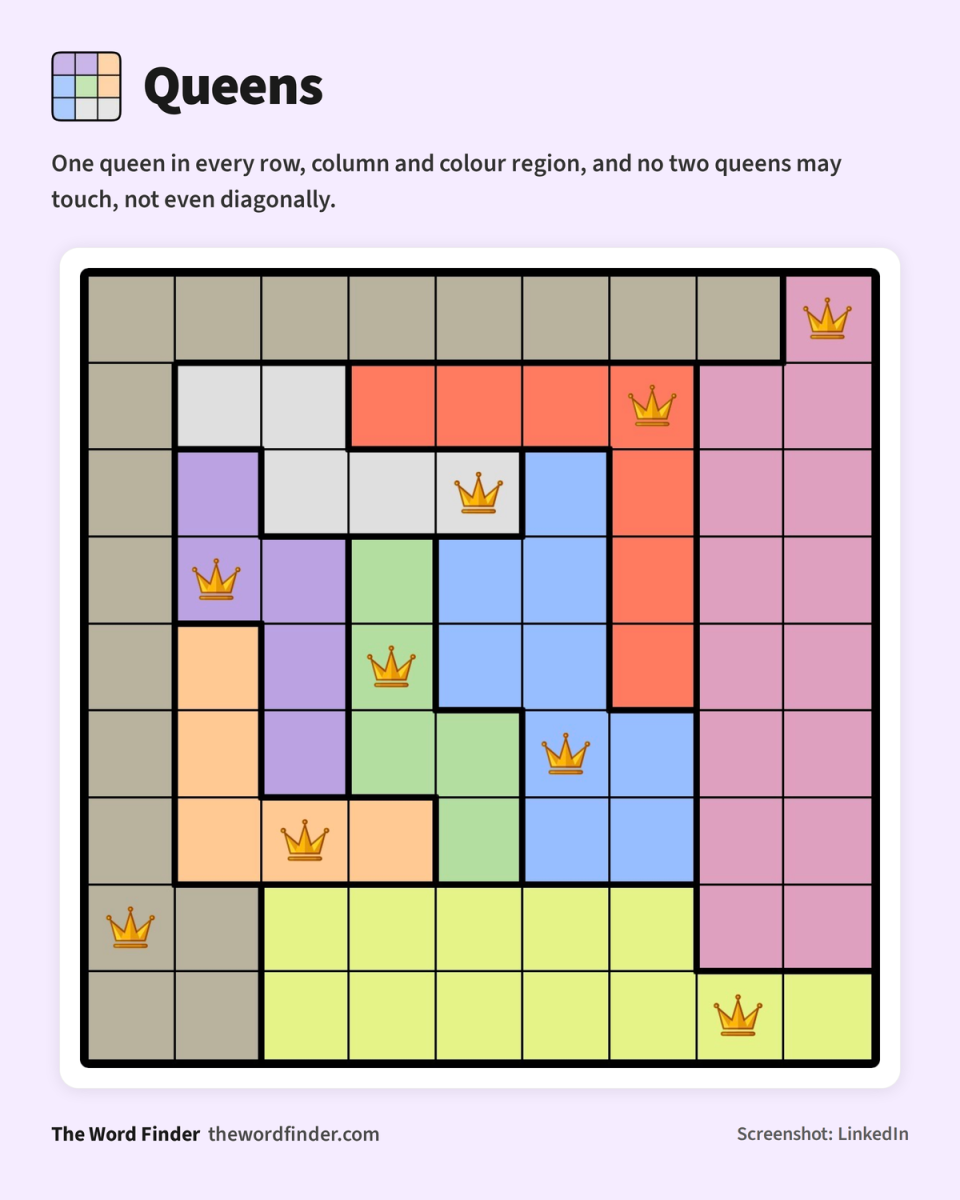
one queen, and no two ever sit side by side.
Crossclimb: Word Ladders with Unlocking Anchors
Core Objective: Solve clue-based word rungs to create a word ladder where each adjacent word differs by exactly one letter substitution (Hamming distance = 1).
The Locked Boundary Rule: The top and bottom rows are thematic meta-clues that frame the puzzle. They do not adhere to the 1-letter change rule with the adjacent ladder rungs and remain completely locked until the interior ladder is entirely solved.
Pinpoint: Word Association and Information Entropy
Core Objective: Identify the overarching semantic category linking up to five revealed clue words.
Mechanics & Scoring: Clues reveal sequentially. Each wrong guess or clue reveal consumes one of your five total attempts. Scoring rewards high-risk, low-information guesses—solving on Clue 1 yields maximum efficiency compared to waiting for complete information on Clue 5.
Mini Sudoku, Patches, and Wend
Mini Sudoku (Latin Squares): A 6×6 grid partitioned into 2×3 sub-regions. Numbers 1–6 must appear once per row, column, and block. The non-square sub-regions alter standard 9×9 elimination patterns, emphasizing cross-hatching across rectangular sub-grids.
Patches (Tiling & Partitioning): Tile the grid into non-overlapping rectangular blocks, each enclosing exactly one numeric clue that specifies the precise cell area of that rectangle. Requires careful bounding box analysis along grid margins.
Wend (Non-Linear Word Search): Trace paths through adjacent letters (including diagonals) to discover theme-related words. Paths can flex in any direction, meaning candidate words can wrap around themselves without straight-line constraints.
Where today’s answers live
If you are stuck on a specific puzzle rather than a rule:
- Pinpoint hints and answers
- Crossclimb hints and answers
- Queens hints and answers
- Tango hints and answers
- Zip hints and answers
- Mini Sudoku hints and answers
- Patches hints and answers
- Wend hints and answers
All of them sit on our LinkedIn Games hub, which updates every morning.
If one go a day is the problem, our Lingle word games run unlimited rounds at four word lengths, and the NYT Games hub covers the other big daily set.
Frequently Asked Questions
How many LinkedIn puzzle games are currently available?
There are eight active daily games: Pinpoint, Queens, Crossclimb, Tango, Zip, Mini Sudoku, Patches, and Wend. Each game refreshes once every 24 hours.
What is the most critical rule in Zip?
The path must visit every single grid square exactly once while connecting the numbers in order. A route that hits every number sequentially but leaves open cells is invalid.
Are LinkedIn games free?
Yes. They are available to LinkedIn members on mobile and desktop at no cost.
Do Queens work like chess queens?
No. In LinkedIn Queens two queens conflict only if they are touching, including diagonally. They do not attack along a full diagonal the way a chess queen does, so two queens can share a long diagonal provided they are not adjacent.
What do the equals and cross symbols mean in Tango?
An = between two cells means those cells must contain the same symbol. An × means they must contain opposite symbols. They are constraints, not decoration, and most Tango puzzles cannot be solved without using them.
Why will Crossclimb not accept my answer to the first clue?
The top and bottom rows are a themed pair that only unlock once the middle ladder is complete. They do not follow the one-letter-change rule that governs the rest of the puzzle, so they cannot be solved first.
