
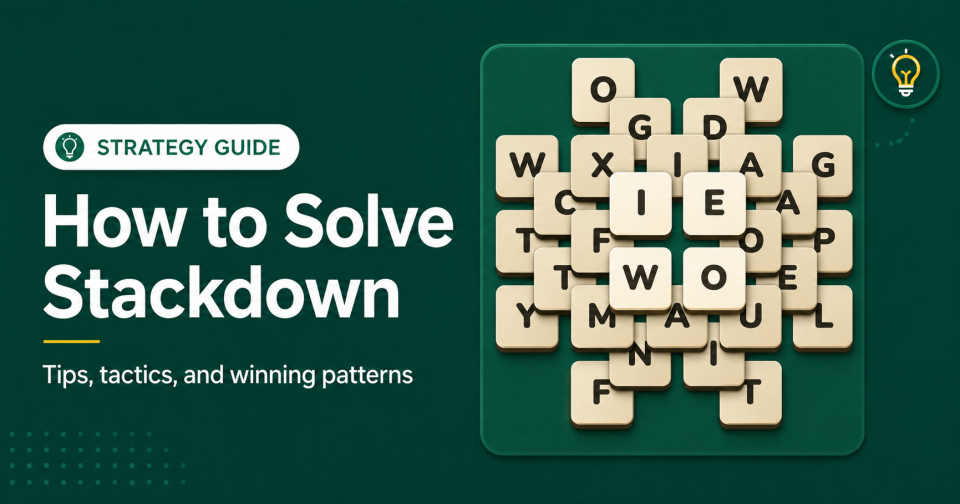
If you’ve played Stackdown for a few weeks and you’ve started caring about your star score, you’ve already discovered the problem. Hints feel cheap to use in the moment and expensive when the daily summary lights up two stars instead of three. There’s a gap between solving the puzzle and solving it well. This guide is about closing that gap.
The core insight is that Stackdown’s “one valid sequence” rule isn’t just a constraint. It’s a strategic structure you can read. Once you learn to see the stack as a dependency graph rather than a pile of tiles, the puzzle stops being trial and error and starts being a planning exercise. You make moves with intent, and your hint usage drops sharply.
This guide assumes you already know how Stackdown works. If you anthing, start with our Stackdown explainer blog. What follows is the strategic layer: how expert players read the stack, plan sequences, recognise five-letter word patterns under pressure, and decide when a hint is worth its cost.
Our Stackdown solver is referenced throughout as a practice tool. It’s how you build the pattern recognition this guide describes.
The Core Insight: One Valid Sequence Changes Everything
Most word games reward you for finding any valid word as quickly as possible. Stackdown punishes you for finding the wrong valid word first.
This is the deepest strategic point in the game, and most beginner-level coverage misses it. When you see five exposed tiles that could spell a valid English word, your instinct is to solve that word. In Stackdown, that instinct is wrong about half the time. The puzzle designers have built each stack so that the obvious-looking word from the exposed tiles is sometimes the right first solve and sometimes the trap that locks the puzzle.
The reason this works as a design is that the stack has dependency structure. Each word you solve uncovers tiles beneath it. Those uncovered tiles need to form valid words with the other tiles that will be exposed in subsequent moves. If you solve the wrong first word, you uncover the wrong supporting tiles. The remaining stack can no longer be cleared because the words it would need to form don’t exist in valid English.
The strategic implication is that a valid first word isn’t always a correct first word. Before you commit to a five-letter solve, the question to ask is: if I solve this word and these tiles slide off, will the next layer’s exposed tiles form a valid word? And the layer after that?
This shifts Stackdown from a word-finding game into a tile-exposure planning game. The vocabulary work is necessary but not sufficient. The sequence work is what separates a careful three-star solve from a hint-heavy two-star scramble.
Grant Sanderson’s analysis of optimal word-game strategy frames this kind of problem as information theory. In Wordle, the information you’re optimising for is letter coverage. In Stackdown, the information you’re optimising for is path viability. Same framework, different objective.
Reading the Stack as a Dependency Graph
Once you accept that sequence matters as much as vocabulary, the natural next move is to start reading the stack visually.
Look at the stack before you make any move. Identify the tiles in the bottom layer (the ones covered by everything else). Those tiles will be the last to be exposed, which means whatever word they belong to will be the last word solved. Now look at the tiles directly above them. Those need to be solved second-to-last. Work backwards mentally from the bottom of the stack to the top, identifying which tiles will be exposed at each stage.
This is functionally a dependency graph. Tile A blocks tile B which blocks tile C, and the order you solve in must respect those blocking relationships.
For most puzzles, you can identify at least two or three forced moves just from this exercise. Some words can only be solved at a specific point in the sequence because of which tiles they require. Identifying those forced moves gives you anchors. Everything else gets planned around them.
The pattern that takes the longest to internalise is recognising when an exposed tile looks like part of one word but is actually part of a different word that gets solved later. A common Stackdown trap is exposing an E, S, or T early and assuming it belongs to whichever word is most obvious. Often it belongs to a word that won’t be solveable until two or three layers down. Treating those tiles as flexible early on, rather than committing them to the first word that fits, is one of the most reliable hint-saving habits in the game.
Pattern Recognition for Five-Letter Words
Every Stackdown word is five letters. After you’ve played a hundred puzzles, you start recognising five-letter word patterns from partial tile sets. This pattern recognition is the difference between a slow solve and a fast one.
A few patterns worth memorising.
The most common five-letter word endings in English are -ING, -ATE, -OUND, -OUSE, and -IGHT. If your exposed tiles include the right letter combinations, scan for these endings first. They cover a disproportionate share of valid five-letter words.
Common starting consonant clusters include ST-, CH-, BR-, CL-, TR-, FL-, GR-, SP-, and PR-. When you see two consonants exposed together in the leftmost positions of your forming word, one of these clusters is often the answer.
Double letters are common in five-letter words because so many English words pair a double consonant in the middle (-LL-, -SS-, -TT-, -PP-, -EE-, -OO-). Statistical analysis of English bigrams shows these doubled-letter pairs appear in significantly more five-letter words than chance alone would predict.
Vowel placement is another shortcut. Most five-letter English words have either two vowels or three. Single-vowel and four-vowel five-letter words exist but are rare. If your forming word has only one vowel, double-check the spelling before committing.
These patterns aren’t just useful for finding words. They’re useful for ruling words out. If you’ve exposed tiles that don’t fit any common pattern for the position you’re in, that’s a signal you’re about to solve the wrong word. Pause and look at the next layer of tiles before committing.
Hint Economy: When to Spend, When to Save
The Puzzlist hint system has three options: Reveal Letter, Reveal Word, and Show Hint. Each costs you stars. Each has a specific job.
Show Hint is the cheapest signal because it reveals nothing about the letters, only the meaning. If you’re truly stuck and don’t even know what theme of word you’re looking for, this is the right hint. The cost-to-information ratio is favourable for early-game confusion.
Reveal Letter is the right hint when you have most of the word and you’re missing one specific letter. It’s a targeted assist. Spending it on a word where you don’t know any letters yet is almost always a waste because the first letter alone isn’t usually enough to identify a five-letter word.
Reveal Word is the nuclear option. Use it only when you’ve identified that you’d rather take the star hit than spend ten more minutes on a single word. The right time for this is late in a puzzle where you have one word left and you can’t see it.
The hint economy rule that matters most: don’t spend hints on early words. Save them for the end. The hardest words in any Stackdown puzzle are usually the last two, because by that point your remaining tiles are the leftover letters that the easier words didn’t need.
Common Pitfalls That Cost You Stars
Three traps catch intermediate players repeatedly.
The first-word-fits trap. You see a valid five-letter word in the exposed tiles, you solve it, the next layer doesn’t work. The pattern: not every valid word is a correct word. Pause before committing.
The double-letter blindness. Many five-letter Stackdown answers contain doubled letters (BALLY, SETTE, GOOSE patterns). New players miss these because they default to assuming each exposed tile maps to a unique letter position. Letting your eye consider doubled-letter spellings opens up answers that look impossible otherwise.
The hint-stack collapse. This is the most expensive pitfall. You use one hint, then another, then a third. By the time you’re on your fourth hint you’ve already lost the star score, but you keep going because you’ve already spent. The right move once you’ve used your second hint is to stop and either walk away or reset the puzzle. In our solver, you can replay without star penalty. Three hints in a row is the inflection point where you’ve turned a learning experience into a finishing exercise.
Cognitive load research consistently shows that decision quality drops once you’re in extraction mode rather than planning mode. Stackdown rewards planners. The hint-stack collapse is what happens when you stop planning.
Using the Solver to Practice (Not Cheat)
Our Stackdown solver is the practice tool that builds the pattern recognition this guide describes. The most useful way to use it is the opposite of how most players use solver tools.
Don’t open the solver when you’re stuck on the daily puzzle and want the answer. That destroys both your star score and the learning opportunity that comes from getting stuck.
Do open the solver after you’ve completed (or given up on) a puzzle, plug in the original tile arrangement, and work through it again with the layered help options on. The solver will show you the intended sequence, let you see which words were solvable at which stages, and explain why the puzzle was designed the way it was. That second pass teaches you the dependency structure in a way the live game can’t.
Players who use the solver this way (post-puzzle, for pattern learning) consistently improve their unaided star scores within two or three weeks. Players who use it during the puzzle don’t improve at all, because they’ve outsourced the planning work the game was meant to develop.
Frequently Asked Questions
Can you play Stackdown without using hints?
Yes, and it’s the only way to earn the maximum star score. With practice, most players can solve standard-difficulty Stackdown puzzles without hints within their first month of daily play. The key skill is reading the stack as a dependency graph and planning your solve sequence before committing to your first word.
What’s the best first move in Stackdown?
The best first move isn’t always the most obvious five-letter word you can spot. Before solving any word, look at the bottom layer of the stack. Identify which tiles will be exposed last. Work backwards from there to identify forced moves. Your first word should be one that supports the dependency chain, not one that breaks it.
How do you avoid hint-stack collapse in Stackdown?
Set a hint budget before you start the puzzle. Most players who chase three-star scores use no more than one hint per puzzle, and only on the last word. If you’ve used two hints, stop and either walk away or reset. Continuing past that point usually compounds the cost without solving the underlying planning problem.
How long does a Stackdown puzzle take to solve?
Average solve time is around 5 to 8 minutes for an experienced player. Time isn’t scored, but the planning approach this guide recommends tends to be faster than trial-and-error solving because you avoid the dead-end resets that come from solving the wrong word first.
Do all Stackdown puzzles have only one valid solution sequence?
Yes. Each puzzle is designed with exactly one valid sequence that clears the stack. This is what makes the order constraint strategically meaningful rather than just a difficulty tweak. Multiple valid sequences would make the puzzle a vocabulary test. One valid sequence makes it a planning exercise.
