
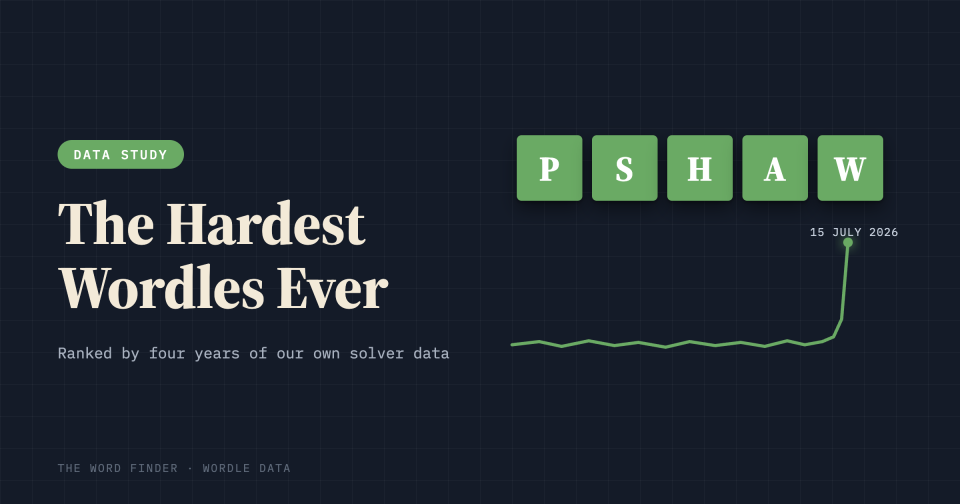
On Wednesday 15 July 2026, Wordle served up PSHAW, and a great many long streaks died. One veteran columnist called it the hardest and most unfair puzzle he had seen in all his years writing the column. The New York Times’ own WordleBot put the average solve at 4.7 guesses, which is uncomfortably close to failing. The NYT Games’ social media team even made a post (sorry, not sorry!) and teased in the comments that they had the post lined up, before even launching the puzzle.
We can tell you exactly how bad it was, because we watched it happen.
We run The Word Finder’s Wordle Solver, the page people open when today’s puzzle has beaten them. Across 1,432 days we have logged how many people come looking for help each morning. When a Wordle is hard, that number jumps, because real players, mid-puzzle, go hunting for a way out.
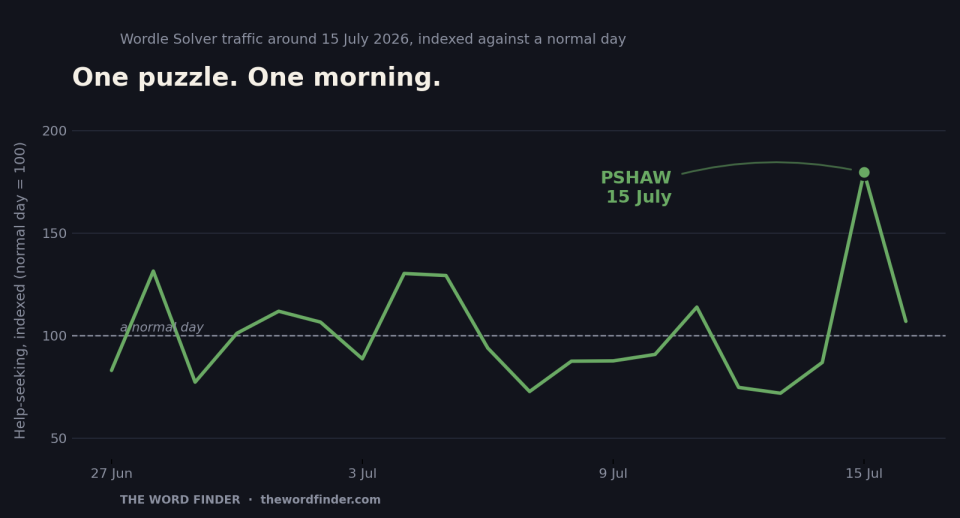
On 15 July, it did not jump. It detonated. Our solver had it’s single busiest day in four years of running it, nearly double the day before.
Here are the twelve hardest Wordles in our data, what PSHAW did, and the five patterns that explain most of them.
How we worked this out
Source: 1,432 days of daily traffic to our Wordle Solver, 15 August 2022 through 16 July 2026.
Definition of hard: an isolated single-day spike, measured as a percentage above a 28-day rolling baseline centred on that date. We insist on isolated, meaning the days either side return to normal. Sustained multi-day surges are almost always something else, a viral mention or a traffic event, rather than a puzzle.
Cross-reference: every spike matched to that day’s published answer, using our past Wordle answers archive.
Three limitations, stated plainly:
Our baseline moves, because our traffic grew several times over across the period. A 28-day rolling baseline centred on each date controls for that.
PSHAW is measured differently, and we want you to know. A centred baseline needs 14 days on each side, and only one day has passed since. So PSHAW’s figure uses a complete trailing 28-day baseline instead. We will republish the centred figure once the window fills. We are being fussy about this for a reason: an earlier version of this article overstated EERIE at 66% because its window was still filling when we ran it. The honest number is 55.1%, and it is corrected below.
Our data starts in August 2022. The famously brutal early puzzles, CYNIC (#240), CAULK (#242) and NYMPH (#281), all landed before that. They would very likely rank here. We cannot verify them, so we leave them out.
The 12 hardest Wordles
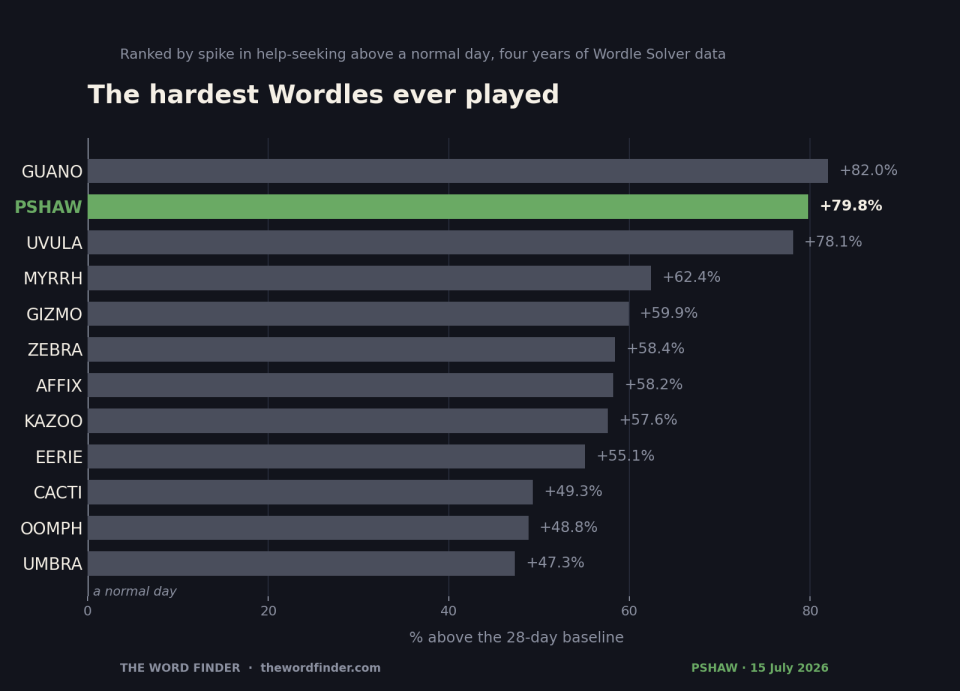
1. GUANO (#647, 27 March 2023). 82.0% above baseline.
Bat and seabird droppings, used as fertiliser. A real word that sits nowhere near most players’ active vocabulary. Burn three guesses on friendlier -ANO endings and it is over.
2. PSHAW (#1852, 15 July 2026). 79.8% above baseline.
Our biggest single day ever recorded. See the breakdown below.
3. UVULA (#1245, 14 November 2024). 78.1% above baseline.
The dangly bit at the back of your throat. Two U’s in non-adjacent slots, plus a V, one of the rarest letters in the answer list and one almost nobody tests early.
4. MYRRH (#1645, 19 December 2025). 62.4% above baseline.
No conventional vowel, Y carrying the whole word, and an RH ending. Most people meet this word once a year, in a carol.
5. GIZMO (#1607, 11 November 2025). 59.9% above baseline.
Z is rare, and rarer still buried in the middle. Y as the second vowel adds another layer.
6. ZEBRA (#1107, 29 June 2024). 58.4% above baseline.
Everyone knows the word. Almost nobody opens with Z, so by the time you find it you are three guesses down.
7. AFFIX (#1286, 26 December 2024). 58.2% above baseline.
Two traps in five letters: a doubled F and an X. Boxing Day meant heavy holiday traffic ran straight into it.
8. KAZOO (#731, 19 June 2023). 57.6% above baseline.
K and Z are both rare, but the double O is the quiet killer, because openers almost never repeat a letter.
9. EERIE (#1774, 27 April 2026). 55.1% above baseline.
A double E opening and an IE ending. Players who found an E early could not work out where the second one lived.
10. CACTI (#1628, 2 December 2025). 49.3% above baseline.
An irregular plural. You type CACTUS, lock in the C and the A, and cannot see past it.
11. OOMPH (#1663, 6 January 2026). 48.8% above baseline.
A double O opening, a consonant pile-up, and an informal word, at a moment when players are hunting for respectable nouns.
12. UMBRA (#1784, 8 May 2026). 47.3% above baseline.
The darkest part of a shadow. An astronomy term most people have read but never typed.
Special mention:
Just outside: EMOJI (#1826, 19 June 2026) at 43.5%, which is its own kind of joke, since the hardest thing about it was believing the answer could be that modern.
What PSHAW actually did
One puzzle, on one morning, sent more people looking for help than any day in our four-year history. Measured against the same weekday across the period, PSHAW ran 83% above a normal Wednesday.
Why did it land so hard? Because it stacks three of our five patterns into five letters.
It carries one vowel. It opens on PS, a pairing that barely exists in English outside a handful of Greek-derived medical terms, so virtually no opening word tests for it. And it is an interjection, an old-fashioned noise of dismissal rather than a noun or a verb, which is precisely the category players stop entertaining after guess two.
Rare pairing, single vowel, and a word your brain refuses to accept as a word. PSHAW is not an unfair puzzle so much as a perfectly engineered one.
The one the internet got wrong
Here is why we bother with our own data rather than reading the room.
On 10 May 2026, PARKA drew streak-killer coverage of its own, on the reasonable theory that a repeated letter would catch people out.
Players did not blink. PARKA ranks 100th out of 1,432 days in our data, at 12.4% above baseline, which is barely a ripple. The day after it was busier than the day itself.
Sometimes a puzzle looks lethal on paper and lands softly. The only way to know the difference is to watch what people actually do at 8am with a half-finished grid.
What makes a Wordle hard? Five patterns
Across the 30 hardest Wordles in our data, five patterns explain nearly every entry.
1. Rare letters in unexpected positions. Z, J, X, Q and V wreck players who optimised their openers for common letters. ZEBRA, GIZMO, KAZOO, AFFIX and EMOJI all live here, and PSHAW’s PS opening is the same problem wearing a different hat.
2. Double letters. The most underestimated trap in the game. Most opening words test five distinct letters, so when the answer repeats one, players have already mentally spent that slot. AFFIX, KAZOO, OOMPH and EERIE.
3. Y as a vowel, or barely a vowel at all. When Y carries the word, or a single lonely vowel does, players who have not tested for it are flying blind. GIZMO, MYRRH and PSHAW.
4. Words that feel like they cannot be the answer. Players burn guesses doubting the word exists at all. GUANO, UVULA, MYRRH, UMBRA and PSHAW most of all.
5. Trap endings. Sequences with too many plausible fits. CACTI, where you commit to CACTUS and cannot let go, or the -ATCH family, where LATCH, MATCH, CATCH, BATCH, WATCH and HATCH all sit waiting.
If today’s answer fits one of these and you are three guesses deep, our Wordle Solver shows every word matching your current greens, yellows and greys. It earns its keep exactly where these puzzles hurt: when you have narrowed the field and still cannot break through.
Frequently asked questions
What is the hardest Wordle ever?
By our own traffic data across 1,432 days, GUANO (#647, 27 March 2023) holds the record at 82.0% above its 28-day baseline, with PSHAW (#1852, 15 July 2026) just behind at 79.8%. PSHAW drove more raw traffic than any day we have recorded, so it may take the top spot when we finalise its figure.
What was the hardest Wordle of 2026?
PSHAW, on 15 July 2026. It sent 381,008 people to our solver, the busiest day in four years and nearly double the day before. WordleBot put the average solve at 4.7 guesses.
Why was PSHAW so hard?
It has only one vowel, it opens on PS, a letter pairing almost absent from English outside Greek-derived medical words, and it is an interjection rather than a noun or verb, which is a category players stop considering early.
How did you measure which Wordles were hardest?
Four years of daily traffic to our Wordle Solver, 1,432 days in total. We looked for isolated single-day spikes above a 28-day rolling baseline, where the days either side return to normal, then matched each spike to that day’s published answer. When more people come looking for help, that day’s puzzle was harder.
Why are double letters hard in Wordle?
Most opening words test five different letters, so players never probe for a repeat. When the answer doubles a letter, that slot has already been mentally spent. AFFIX, KAZOO, OOMPH and EERIE all punish it.
Was PARKA one of the hardest Wordles?
No, despite the coverage it got. In our data PARKA ranks 100th of 1,432 days at 12.4% above baseline, and the following day was busier. It looked dangerous on paper and landed softly.
Why isn’t CYNIC or CAULK in your list?
Both are famously brutal and both were played in February 2022, before our data begins in August 2022. We would rather leave a gap than pad the list with numbers we cannot stand behind.
Has there been a Wordle nobody could solve?
No. The answer list is curated to stay solvable for an average player. But the puzzles above drive sharply elevated help-seeking, which points to unusually high failure rates.
Where can I get help when a Wordle is too hard?
Our Wordle Solver shows every word fitting your current greens, yellows and greys. For other lengths, try our Lingle games, and the rest of our NYT tools live in the NYT Games Hub.
