Word500 Solver
Enter the guesses you have made and the green, yellow and red counts Word500 gave back. We list every five-letter word still possible and rank the best next guess.
Best next guess
- RATESCan win3.37 bits~247 left
- CARESCan win3.36 bits~242 left
- TALESCan win3.35 bits~249 left
- DARESCan win3.34 bits~245 left
- RACESCan win3.30 bits~258 left
Ranked by how much each guess narrows the list, not by whether it could win. Can win marks a guess that also happens to still be a possible answer.
Possible answers
2,089 words still possible
Definitions open in a new tab.
- ABHOR
- ABIDE
- ABLED
- ABODE
- ABORT
- ABOUT
- ABOVE
- ABUSE
- ACHES
- ACORN
- ACRES
- ACRID
- ACTED
- ACTOR
- ACUTE
- ADEPT
- ADIEU
- ADIOS
- ADMIN
- ADMIT
- ADOBE
- ADOPT
- ADORE
- ADORN
- ADULT
- AFIRE
- AFOUL
- AFTER
- AGENT
- AGILE
- AGLOW
- AGONY
- AHOLD
- AIDER
- AIMED
- AIRED
- AISLE
- ALBUM
- ALERT
- ALIEN
- ALIGN
- ALIKE
- ALIVE
- ALOFT
- ALONE
- ALONG
- ALOUD
- ALTER
- ALURE
- AMBER
- AMBLE
- AMEND
- AMIGO
- AMITY
- AMONG
- AMPLE
- AMPLY
- AMUSE
- ANGEL
- ANGER
- ANGLE
- ANGRY
- ANGST
- ANIME
- ANKLE
- ANODE
- ANTIC
- ANVIL
- APHID
- APING
- APRON
- APTLY
- ARGUE
- ARIEL
- ARISE
- ARMED
- AROSE
- ARSON
- ARTSY
- ASCOT
- ASHEN
- ASIDE
- ASKED
- ASKEW
- ASPEN
- ATOMS
- ATONE
- AUDIO
- AUDIT
- AUNTS
- AUNTY
- AVERT
- AVOID
- AWFUL
- AWOKE
- BACKS
- BACON
- BADGE
- BADLY
- BAGEL
- BAKED
- BAKER
- BALDY
- BALER
- BALMY
- BANDS
- BANGS
- BANKS
- BARGE
- BARKS
- BARON
- BASED
- BASIC
- BASIL
- BASIN
- BASTE
- BATCH
- BATES
- BATHE
- BATHS
- BATON
- BAWDY
- BAYOU
- BEACH
- BEADS
- BEADY
- BEAMS
- BEANS
- BEARD
- BEARS
- BEAST
- BEATS
- BEFIT
- BEGAN
- BEGAT
- BEGIN
- BEGUN
- BEING
- BELCH
- BELOW
- BELTS
- BENCH
- BENDS
- BERTH
- BICEP
- BIGOT
- BIKER
- BIKES
- BILGE
- BINDS
- BINGE
- BINGO
- BIOME
- BIRCH
- BIRDS
- BIRTH
- BISON
- BITES
- BLACK
- BLADE
- BLAME
- BLAND
- BLANK
- BLARE
- BLAST
- BLEAK
- BLEAT
- BLEND
- BLIMP
- BLIND
- BLING
- BLINK
- BLOAT
- BLOCK
- BLOKE
- BLOND
- BLOWN
- BLOWS
- BLUER
- BLUES
- BLUNT
- BLURT
- BLUSH
- BOARD
- BOAST
- BOATS
- BOGEY
- BOGUS
- BOILS
- BOLTS
- BONDS
- BONER
- BONES
- BONEY
- BONUS
- BORED
- BORES
- BORNE
- BOTCH
- BOUGH
- BOULE
- BOUND
- BOWED
- BOWEL
- BOWLS
- BRACE
- BRAID
- BRAIN
- BRAKE
- BRAND
- BRASH
- BRATS
- BRAVE
- BRAVO
- BRAWL
- BRAWN
- BREAD
- BREAK
- BRENT
- BRICK
- BRIDE
- BRIEF
- BRINE
- BRING
- BRINK
- BRINY
- BRISK
- BRITS
- BROAD
- BROCK
- BROIL
- BROKE
- BROTH
- BROWN
- BRUNT
- BRUSH
- BRUTE
- BUCKS
- BUDGE
- BUGLE
- BUILD
- BUILT
- BULGE
- BULKY
- BUMPS
- BUMPY
- BUNCH
- BUNTY
- BURKE
- BURLY
- BURNS
- BURNT
- BURPS
- BURST
- BUSED
- BUSHY
- BUTCH
- BUYER
- BYLAW
- CABIN
- CABLE
- CADET
- CAGED
- CAGES
- CAGEY
- CAIRN
- CAKES
- CALMS
- CAMEL
- CAMEO
- CAMPS
- CANDY
- CANOE
- CAPER
- CAPRI
- CAPUT
- CARBS
- CARDS
- CARED
- CARES
- CARGO
- CAROL
- CARON
- CARTS
- CARVE
- CASTE
- CATER
- CAULK
- CAUSE
- CAVED
- CAVES
- CAVIL
- CEDAR
- CENTS
- CHAFE
- CHAIN
- CHAIR
- CHALK
- CHAMP
- CHANG
Letter tracker
Click a letter once if you know it is in the word, twice if you know it is not.
How the Word500 Solver Works
Word500 tells you how many letters you got right. It never tells you which ones. That single difference is what makes the game hard, and it is what this tool is built to handle.
Every guess you make comes back as three numbers: green for letters in the right position, yellow for letters in the word but in the wrong place, and red for letters that are not there at all. The three always add up to five. On their own those numbers feel almost useless. Combined across several guesses they are enough to pin down exactly one word, and that is the calculation the solver runs for you.
Type in each guess along with its counts. The solver keeps only the words that would have produced those exact numbers against every guess you have entered, and shows you how many are left. Then it does the part you cannot do in your head: it tests each possible next guess against the whole remaining list and works out which one splits it most evenly. That is the guess that teaches you the most, whatever the game comes back with.
Entering Your Guesses
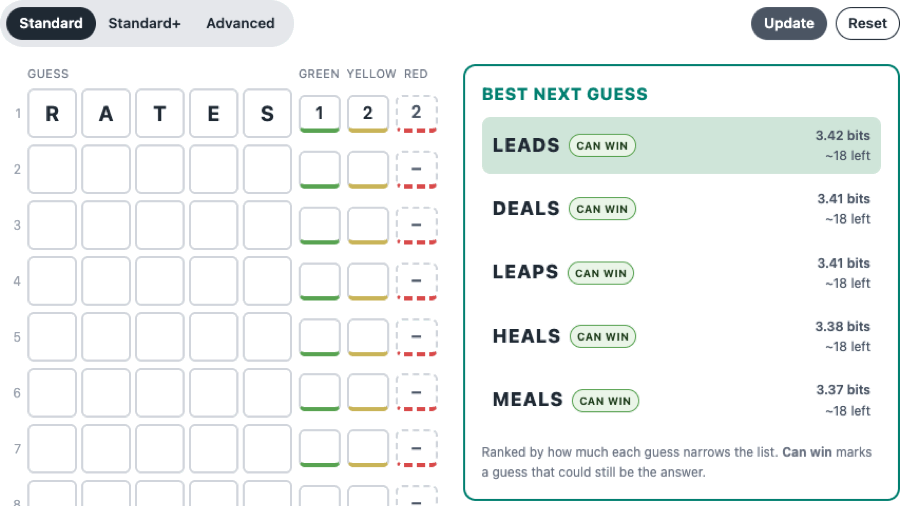
A worked example. Say you open with RATES and the game returns 1 green, 2 yellow, 2 red.
Enter RATES in the first row, then 1 in the green box and 2 in the yellow. Red fills in automatically. The solver now keeps only words where exactly one of R, A, T, E, S sits in the same position it occupies in RATES, and exactly two more appear somewhere else. From over two thousand candidates you are down to about 150.
Add your second guess and its counts to the next row and the list shrinks again, usually by a factor of five or more. By the fourth row you are typically looking at a handful of words.
The letter grid below the rows is there for deductions the counts alone cannot express. If you have worked out that the word definitely contains an L, or definitely does not contain an N, click that letter to mark it. The solver folds those marks into the filter alongside your guesses. It mirrors the marking tool built into the game itself, so anything you have already worked out on the board carries straight across.
Word500 Strategy: Openings and Deduction
Start with a word that splits the field
We ran every word Word500 could use as an answer at Standard difficulty against every other one, and scored each opener by how much information it returns on average. The results:
| Opening word | Information gained | Average words left |
|---|---|---|
| RATES | 3.37 bits | 247 |
| CARES | 3.36 bits | 242 |
| TALES | 3.35 bits | 249 |
| DARES | 3.34 bits | 245 |
| RACES | 3.30 bits | 258 |
The pattern is familiar to anyone who plays Wordle: common letters, one or two vowels, no repeats. The gap between the best opener and the worst is larger than it looks. NYMPH, AUDIO and AWFUL sit at the bottom of the same ranking and leave you with well over five hundred candidates.
The measure used here is Shannon entropy, the standard way of quantifying how much a message narrows down the possibilities. Claude Shannon introduced it in his 1948 paper that founded information theory, and it is the same tool 3Blue1Brown used in his widely watched analysis of optimal Wordle openers.
Understand why eight guesses feel like six
Wordle's coloured tiles can come back in 243 different patterns. Word500's three counts can only come back in 21. That ceiling is the entire story: the best possible Word500 opener returns 3.37 bits of information, while a strong Wordle opener returns around 6. You need roughly 11 bits to isolate one word out of 2,089. In Wordle that is two good guesses' worth. In Word500 it is a bit over three.
Eight guesses is not generosity. It is the number the game needs to stay winnable.
Do not commit early
The most common mistake is treating a high yellow count as a reason to keep reusing the same letters. It is not. A guess that returns 0 green and 3 yellow tells you three of those five letters are in the word, but you have no idea which three, and rearranging the same letters tests only a fraction of the possibilities. Fresh letters usually gain you more, right up until the final guess or two.
In our simulation of every possible answer, a solver opening with RATES and then always taking the highest-information guess finished in 4.49 guesses on average, with a median of 5 and a worst case of 6. It never used more than six of the eight available. That margin exists precisely because it kept gathering information instead of guessing at answers.
Word500 vs Wordle: What Changes When the Colours Go Away
Both games ask for a five-letter word and score each guess on position and presence. The difference is where the score is attached.
Wordle attaches it to individual tiles. You see that the third letter is green, so you know which letter is locked and where. Word500 attaches it to the guess as a whole. You are told two letters are green, but not which two, and the work of figuring that out is the game.
- Repeated letters behave differently. At Word500's Standard difficulty the answer never contains a repeated letter, which removes a whole class of Wordle trap words like MAMMA and FLUFF.
- Guess order matters more. In Wordle, information arrives already sorted by position. In Word500 you have to design guesses that isolate variables, testing one changed letter at a time late in the game rather than reshuffling everything.
- Bookkeeping beats intuition. Experienced Wordle players solve on pattern recognition. That instinct is close to useless here.
If you want the version with the colours back, our Wordle Solver filters by green, yellow and grey letters in specific positions. For four boards at once, there is the Quordle Solver.
What Is Word500?
Word500 is a free daily word game at word500.com. You get eight attempts to find a hidden five-letter word, and after each attempt the game reports three totals: how many of your letters were correct and correctly placed, how many were correct but misplaced, and how many were absent. It runs in daily, practice and archive modes, and in several languages.
The structure is older than it looks. It is the letter version of Bulls and Cows, a pencil-and-paper guessing game that may date back a century, in which players guess a four-digit number with all-different digits and are told only how many digits are "bulls" (right digit, right position) and how many are "cows" (right digit, wrong position). Word500's green and yellow counts are bulls and cows, and its Standard rule that the answer contains no repeated letters is Bulls and Cows' all-different-digits rule carried straight over.
That lineage runs on into the toy aisle. Bulls and Cows was commercialised in 1970 by Mordecai Meirowitz, an Israeli postmaster and telecommunications expert, as the peg-and-board game Mastermind. Mastermind in turn became a favourite test problem for computer scientists. In 1976 Donald Knuth published a short paper in the Journal of Recreational Mathematics, "The Computer as Master Mind", proving that a codebreaker can always crack the standard 1,296-combination game in five guesses or fewer by repeatedly choosing the guess that minimises the worst-case number of surviving possibilities. That paper is the direct ancestor of the ranking method this solver uses.
Full rules and the game's own marking tools are documented on the Word500 help page, including the spacebar shortcut that inserts an underscore placeholder while you are working through a deduction. For the longer version, our guide to what Word500 is and how it works walks through the daily, practice and archive modes, the difficulty settings, and who built the game.
Frequently Asked Questions
Word500 is a free daily word game where you have eight guesses to find a hidden five-letter word. After each guess it tells you how many letters were green (right letter, right position), yellow (right letter, wrong position) and red (not in the word), but never which letters those were. It is played at word500.com in daily, practice and archive modes. Our full Word500 guide covers the modes, the difficulty settings and how the scoring works in more detail.
Wordle colours each tile individually, so you can see exactly which letters are locked and where. Word500 gives you three totals for the whole guess and leaves you to work out which letters they refer to. That is why Word500 allows eight guesses instead of six: each guess returns roughly half as much usable information.
Type each guess you have made into a row, then enter the green and yellow counts the game returned. Red fills in automatically. The solver lists every word still consistent with all your guesses and recommends the next guess that will narrow the list fastest. Add a row for each new guess as you play.
RATES, based on our analysis of every five-letter word Word500 could use as an answer at Standard difficulty. It returns 3.37 bits of information on average and leaves around 247 candidates. CARES, TALES, DARES and RACES are all within 2% of it, so any of them makes a sound opener. The common thread is frequent letters, a vowel or two, and no repeats.
Because each guess tells you far less. Wordle tile colours can form 243 distinct patterns; Word500 three counts can only form 21. Isolating one word from a pool of roughly 2,100 takes about 11 bits of information, which a strong Wordle opener supplies in two guesses and a strong Word500 opener needs a bit over three to match.
Not at Standard difficulty. Word500 has three levels, and its own difficulty menu spells out the rules: Standard allows no repeated letters and never uses J, Q, X or Z; Standard+ still bars repeats but allows those four letters; Advanced permits anything, including repeats. Our solver defaults to Standard and you can switch level with the control above the guess grid, which changes both the word pool and the scoring maths.
That is your call, and it depends what you want from the game. Most people use it when they are stuck on guess six with no idea which letters are which, or afterwards to see which guess they should have made. If you would rather have a nudge than an answer, enter only your first guess and look at what the tool recommends next rather than the candidate list.
Not yet. This version uses an English five-letter word list, so it will not help with the Dutch, German or other language modes. Other languages are on the list for a future update.
Yes. The solver works from the guesses and counts you enter, not from the day answer, so it handles any Word500 board regardless of mode. Daily, practice, archive, timed and speedrun puzzles all work the same way.
Yes. The guess rows, count inputs and letter grid are built for touch, and the count boxes bring up a number keypad rather than a full keyboard. The recommendation panel and candidate list sit near the top on mobile so you do not have to scroll to see the result.
More Game Solvers
Browse every tool on our Game Solvers hub, or jump straight to the Wordle Solver and Quordle Solver.


