🐷 Pig Latin Translator
The Pig Latin Translator turns English into Pig Latin and back again. Pig Latin is a playful word game: you move the first consonants of each word to the end and add "ay," so "pig" becomes "igpay." Type a phrase to translate it, or hit the switch button to decode Pig Latin back into plain English.
How Pig Latin Works
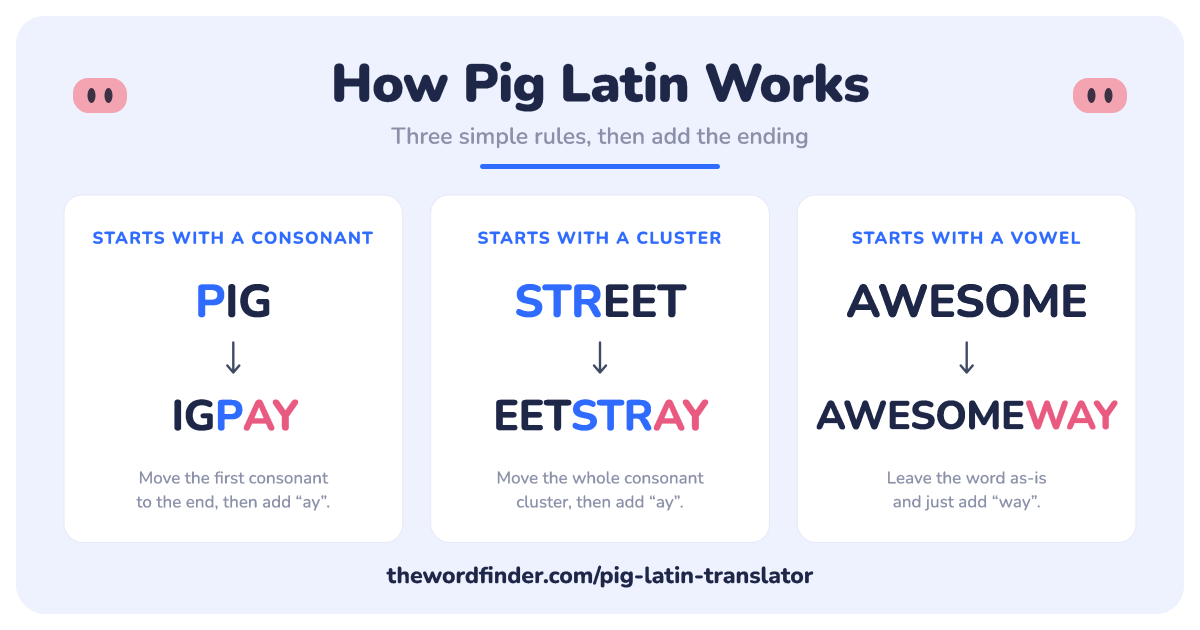
Pig Latin runs on three simple rules, and the translator above applies them automatically.
If a word starts with a consonant, move that consonant to the end and add "ay," so "pig" becomes "igpay" and "latin" becomes "atinlay." If a word starts with a consonant cluster, move the whole cluster, so "street" becomes "eetstray." If a word starts with a vowel, leave it in place and just add "way," so "awesome" becomes "awesomeway." Capital letters and punctuation carry over, which is why "Ouyay areway awesomeway!" still reads as a sentence.
The one place people differ is the vowel ending. Some speakers add "way," others use "yay" or just "ay." All three are correct, and they are mostly a matter of regional habit. Because the whole system is built on swapping sounds around, it has a lot in common with our Anagram Solver, which rearranges letters rather than moving them.
How to Use the Pig Latin Translator
Type or paste English into the left box and the Pig Latin version appears on the right instantly. Press Copy Text to grab the result for a message, a caption, or a game. To go the other way, press the switch button, then anything you type in the left box is read as Pig Latin and translated back into English on the right.
Common Pig Latin Words and Phrases
A few Pig Latin words have escaped the playground and entered everyday slang, like "amscray" (scram) and "ixnay" (stop it, from "nix"). Here are some of the most-looked-up words and phrases.
| English | Pig Latin | Note |
|---|---|---|
| hello | ellohay | |
| yes | esyay | |
| no | onay | a common crossword answer |
| I | Iway | vowel rule |
| you | ouyay | |
| I love you | Iway ovelay ouyay | |
| stop it / nix | ixnay | entered general slang |
| scram | amscray | entered general slang |
| sweets | eetsway | older slang spelling "eetswa" |
| Pig Latin | igpay atinlay |
If you hit "ixnay" or "onay" as a crossword clue rather than a word game, our Crossword Solver is the faster route to the answer.
Where Pig Latin Came From
The exact origin is uncertain, but the game is old. An early relative called "Hog Latin" turns up in 19th-century American writing, and the modern "Pig Latin" name had settled in by the early 1900s. It spread the way schoolyard codes always do, passed from kid to kid, and it later showed up everywhere from Three Stooges shorts to a famous line in The Lion King ("Ix-nay on the upid-stay"). Because the rules are so easy to teach, it has also become a standard beginner exercise in programming classes, which is why "pig latin python" and "java pig latin translator" are real searches.
What Pig Latin is not is a real language. Linguists file it under language games, or "ludlings": systems that transform an existing language by a fixed rule rather than inventing new vocabulary. That is the honest answer to the very common question of whether Pig Latin is a language of its own. It is English, rearranged.
Languages Like Pig Latin Around the World
Almost every language has its own version of this game. French has Verlan, which reverses syllables (the name itself is "l'envers," meaning "the reverse," reversed). Argentine Spanish has Vesre, built on the same syllable-flipping idea. Swedish kids use Rövarspråket, the "robber's language," which doubles consonants around an "o." They all do what Pig Latin does: take a language everyone already knows and scramble it by a rule simple enough for a child to learn.
Explore more wordplay and code tools in our Cipher and Encoding Tools hub, or try a real substitution cipher with the Caesar Cipher Solver.
Frequently Asked Questions
Q: What is Pig Latin? A: Pig Latin is a language game that scrambles English by a fixed rule rather than inventing new words. You move the first consonant sound to the end of each word and add "ay," or add "way" to words that start with a vowel. It has been a playground favourite for well over a century.
Q: Where did Pig Latin come from? A: The exact origin is uncertain. An early relative called "Hog Latin" appears in 19th-century American writing, and the modern name was in use by the early 1900s. It spread the way schoolyard codes do, child to child, and later turned up in films, TV, and even beginner programming exercises.
Q: Who invented Pig Latin? A: No single person invented it. Like most language games, it grew out of folk play rather than a named author, which is why it has regional variations rather than one official rulebook.
Q: Why is it called "Pig Latin"? A: The "Latin" part is a joke: the words sound vaguely Latin-like but mean nothing in Latin. "Pig" simply marks it as mock or nonsense Latin, in the same spirit as calling something "dog Latin." It has no connection to real Latin.
Q: Is Pig Latin a real language? A: No. Linguists classify it as a language game, or "ludling", which transforms an existing language by a rule instead of having its own grammar and vocabulary. Pig Latin is English, rearranged.
Q: What are the rules of Pig Latin? A: Three rules cover it. If a word starts with a consonant, move it to the end and add "ay" (pig becomes igpay). If it starts with a consonant cluster, move the whole cluster (street becomes eetstray). If it starts with a vowel, just add "way" (awesome becomes awesomeway).
Q: How do you say "I love you" in Pig Latin? A: "I love you" becomes "Iway ovelay ouyay." "I" starts with a vowel, so it takes "way," while "love" and "you" move their first consonants to the end and add "ay."
Q: What does "ixnay" mean? A: "Ixnay" is Pig Latin for "nix," meaning stop it or forget it, and it has entered general slang on its own. It is also a frequent crossword answer, so if you met it in a puzzle, our Crossword Solver can help.
Q: What does "amscray" mean? A: "Amscray" is Pig Latin for "scram," meaning go away or get lost. Like "ixnay," it crossed over from the word game into everyday slang and shows up in old films and cartoons.
Q: What is the difference between Pig Latin and real Latin? A: They are unrelated. Real Latin is an ancient language with its own vocabulary and grammar. Pig Latin is an English word game that only sounds Latin-ish because of the "ay" endings. Knowing one tells you nothing about the other.
Q: Are there languages like Pig Latin in other cultures? A: Yes. French has Verlan (syllable reversal), Argentine Spanish has Vesre (also syllable reversal), and Swedish has Rövarspråket (doubling consonants around an "o"). Each takes a familiar language and scrambles it by a simple, learnable rule.
Q: How can I teach my kids Pig Latin? A: Start with single words using the three rules, then move to short phrases. The rules chart and the common-words table above are good practice material, and our Activity Room has more word-game ideas for classrooms and family game nights.
Q: Is Pig Latin used in any famous movies or TV shows? A: Yes. The best-known example is The Lion King, where Timon says "Ix-nay on the upid-stay." It also appears in Three Stooges shorts and other classic comedy, usually so characters can talk past someone who is listening.
Related Tools
- Anagram Solver — rearrange letters to find hidden words.
- Caesar Cipher Solver — Roman-era shift cipher; the simplest classical cipher.
- Atbash Cipher — ancient Hebrew reversal cipher.
- Crossword Solver — solve crossword clues like "ixnay" and "onay."
- Bill Cipher's Decoder — the symbol-substitution alphabet from Gravity Falls.
- Morse Code Translator — translate text to Morse Code and back.
Feedback
If you liked using our translator or want to share some suggestions, click the Feedback button below and fill out a simple form.
