Atbash Cipher Decoder
Use our Atbash Cipher Decoder to decrypt the cipher or encrypt English text!
Solve / Decode Text !
Encrypt / Encode Text !
| Plain | A | B | C | D | E | F | G | H | I | J | K | L | M | N | O | P | Q | R | S | T | U | V | W | X | Y | Z |
|---|---|---|---|---|---|---|---|---|---|---|---|---|---|---|---|---|---|---|---|---|---|---|---|---|---|---|
| Cipher | Z | Y | X | W | V | U | T | S | R | Q | P | O | N | M | L | K | J | I | H | G | F | E | D | C | B | A |
Decode and Encode the Ancient Hebrew Cipher
The Atbash cipher is a monoalphabetic substitution cipher that encodes a message by replacing every letter with its opposite in the alphabet: A becomes Z, B becomes Y, C becomes X, and so on through to M and N. The result is a complete alphabet reversal, applied as a fixed mapping with no key, no shift, and no variation.
It is also known as the mirror cipher, the reverse alphabet cipher, or simply the Hebrew cipher, and all four names refer to the same alphabet-reversal scheme. The original name, "Atbash," is Hebrew, and the cipher is documented in the Hebrew Bible over 2,500 years ago, which makes it potentially the oldest cipher in continuous documented use.
This tool encodes and decodes Atbash ciphers using the standard A to Z mapping. Below the tool you will find the cipher's mechanic explained with worked examples, the biblical origin of the cipher (with the famous "Sheshach" passage in the Book of Jeremiah explained in detail), the etymology of the name "Atbash" (which itself encodes the cipher's rule), and a survey of the cipher's use from the Dead Sea Scrolls through Kabbalistic tradition to modern educational and recreational cryptography.
How the Atbash Cipher Works
The Atbash cipher replaces each letter in the alphabet with its opposite. The first letter (A) is swapped with the last letter (Z), the second letter (B) with the second-to-last (Y), and so on through the middle of the alphabet where M swaps with N.
Here is how the letters correspond:
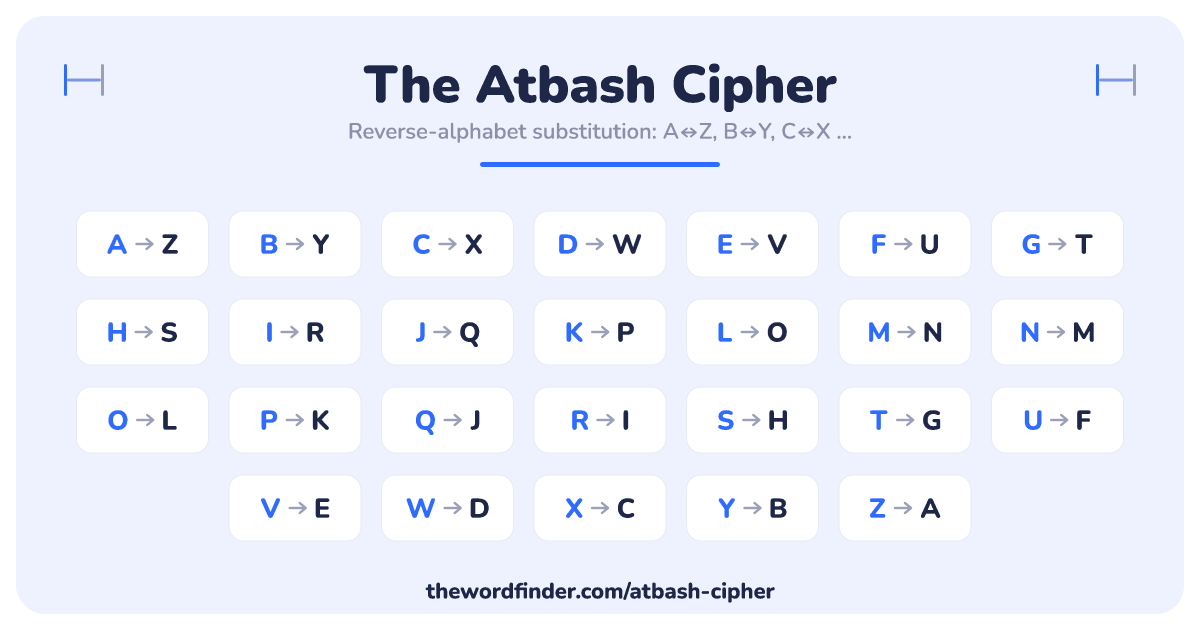
Example of Encoding with the Atbash Cipher
Let's encode the word "GAME" using the Atbash cipher.
- G is the 7th letter from the start of the alphabet, so it is replaced by T, the 7th letter from the end.
- A is the 1st letter, so it is replaced by Z.
- M is the 13th letter, so it is replaced by N.
- E is the 5th letter, so it is replaced by V.
So the word "GAME" becomes "TZNV" when encoded with the Atbash cipher.
Example of Decoding with the Atbash Cipher
To decode "TZNV," you reverse the process:
- T is replaced by G.
- Z is replaced by A.
- N is replaced by M.
- V is replaced by E.
The decoded message is "GAME." Because Atbash is its own inverse (encoding and decoding follow exactly the same rule), the encode and decode steps above are identical: running the encoded text "TZNV" through the encoder again returns "GAME."
The Biblical Origin: Sheshach and the Book of Jeremiah
The Atbash cipher is documented in the Hebrew Bible in the Book of Jeremiah, written in the 6th century BCE, which makes it potentially the oldest cipher in continuously preserved text.
In two passages, Jeremiah 25:26 and Jeremiah 51:41, the prophet refers to a place called "Sheshach" (Hebrew: שֵׁשַׁךְ). For centuries, biblical scholars puzzled over this place name, which appears nowhere else in the historical record. The explanation that emerged is that "Sheshach" is the Atbash encoding of "Babel" (Hebrew: בָּבֶל), that is, Babylon.
Apply the Atbash rule to בָּבֶל letter by letter, using the Hebrew alphabet:
- ב (Bet, the 2nd letter) ↔ שׁ (Shin, the 2nd-to-last letter)
- ב (Bet) ↔ שׁ (Shin)
- ל (Lamed, the 12th letter) ↔ ך (Kaph-final, the 12th-to-last letter)
The result spells שֵׁשַׁךְ, Sheshach. Why did the prophet do this? Almost certainly to obscure a politically dangerous reference to Babylon during a period when Babylonian power was at its height, when a prophetic denunciation written in plain language could have invited retaliation. The Atbash encoding allowed Jeremiah's message to circulate among Hebrew-literate readers who could decipher the substitution while remaining opaque to outsiders.
The Sheshach-for-Babel substitution is the earliest known intentional cryptographic use of a substitution cipher in any preserved text, predating the Caesar Cipher by roughly five centuries. For a fuller scholarly account of the Sheshach passages, My Jewish Learning's coverage of Jeremiah is a strong reference point.
Why It's Called Atbash: the Etymology
The name "Atbash" is itself a Hebrew acronym that encodes the cipher's rule.
The four Hebrew letters in "Atbash" are:
- א (Aleph, the 1st letter of the Hebrew alphabet) ↔ ת (Taw, the last letter)
- ב (Bet, the 2nd letter) ↔ שׁ (Shin, the 2nd-to-last letter)
Put the four together, Aleph-Taw-Bet-Shin, and you get "ATBaSh," which is literally a worked example of the substitution rule embedded in the name itself. The same logic extends through the rest of the alphabet: first letter pairs with last, second pairs with second-to-last, and so on through the centre. It is a piece of self-referential cryptographic naming, and one of the elegant details that makes Atbash worth teaching as the introductory example of how substitution ciphers work.
From the Essenes to Kabbalah: Atbash Through the Centuries
Beyond the Hebrew Bible, Atbash has a long and well-documented history in Jewish textual tradition.
The Dead Sea Scrolls (2nd century BCE to 1st century CE)
The Essene sect, the Jewish community that produced the Dead Sea Scrolls, used Atbash variants in some of their texts. The scrolls, discovered between 1947 and 1956 in caves near Qumran on the western shore of the Dead Sea, are one of the most important archaeological finds of the 20th century. Several scrolls show evidence of Atbash-style letter substitution used for both mystical and concealment purposes, extending the cipher's documented use beyond the biblical period and into the period of Second Temple Judaism.
Kabbalah and Jewish mysticism (medieval period onward)
Atbash became one of several letter-substitution methods used in Kabbalah, the tradition of Jewish mystical interpretation of sacred texts that developed substantially from the 12th century CE onward. Alongside related substitution systems (Albam, where the alphabet is split into halves and the halves are mapped to each other, and Atbah, a variant of Atbash using different pairings), Atbash served both as a tool for hidden interpretation of biblical texts and as a method of encoding mystical or esoteric content. Kabbalistic scholars used these techniques to argue that the Hebrew alphabet itself contained encoded layers of meaning, a tradition that influenced European occult and mystical writers well into the early modern period.
Modern uses: education, puzzles, and pop culture
Today, Atbash is most commonly encountered in educational cryptography, where it is often the first cipher taught after Caesar because the mechanic is even simpler and the historical context is rich, and in recreational cryptography such as escape rooms, geocaching puzzles, alternate-reality games, and treasure hunts.
The animated series Gravity Falls uses Atbash in some of its first-season cryptograms, most famously encoding the phrase "Stan is not what he seems" as "Hgzm rh mlg dszg sv hvvnh" with a standard Atbash substitution. Fans who enjoyed decoding the show's ciphers might also be interested in the Bill Cipher Code Tool, which handles the show's symbol-substitution cipher.
Characteristics: Symmetry and Weakness
- Symmetry. The Atbash cipher is its own inverse, so the process of encoding and decoding is identical. Encoding an already-encoded message returns it to its original form. This is also true of ROT13, the special case of the Caesar cipher with a shift of 13, since both Atbash and ROT13 belong to the small family of self-inverse classical ciphers.
- Simplicity and weakness. Atbash is easy to use and easy to break. Because every letter maps to a single fixed substitute, the cipher is broken trivially by letter-frequency analysis: the most common letter in any English-language Atbash-encoded message will almost always be V (the Atbash substitute for E, English's most common letter), followed by Y (for T) and Z (for A). Once a few common-letter mappings are identified, the rest of the alphabet falls out immediately. For a deeper treatment of cryptanalysis against fixed substitution ciphers, see Practical Cryptography's guide to simple-substitution cryptanalysis.
When to Use the Atbash Cipher
Atbash is not used for serious modern encryption. It is broken trivially by anyone who knows the substitution exists, and frequency analysis recovers messages of any length in seconds. Where Atbash does still earn its keep:
- Educational cryptography. Atbash is the simplest classical substitution cipher and the natural starting point for teaching the substitution-cipher concept. Once students are comfortable with Atbash, the Caesar Cipher (a configurable shift instead of a fixed reversal) is the next step up, followed by the Pigpen Cipher (substitution into geometric symbols rather than letters) and eventually the Vigenère Cipher (multiple substitution alphabets in sequence, polyalphabetic rather than monoalphabetic).
- Puzzle design. Atbash appears regularly in escape rooms, geocaching puzzles, ARGs, and recreational cryptography challenges, often as a single layer within a multi-cipher puzzle. The simplicity of the encoding, with no key to share and no shift to communicate, makes it convenient for puzzle designers who want a cipher that is solvable without instructions.
- Historical and biblical scholarship. Reading Atbash in primary sources requires understanding the cipher mechanic, the Hebrew alphabet, and the historical context, which is part of the value of teaching it.
Frequently Asked Questions
Q: What is the Atbash cipher? A: The Atbash cipher is a monoalphabetic substitution cipher that encodes a message by replacing every letter with its opposite in the alphabet. A becomes Z, B becomes Y, C becomes X, and so on through M and N, a complete alphabet reversal applied as a fixed mapping with no key or shift. Atbash is one of the oldest documented ciphers and is named in Hebrew, where the cipher originated more than 2,500 years ago in the Book of Jeremiah. For an encyclopaedic reference, see the Wikipedia entry on the Atbash cipher.
Q: Why is it called "Atbash"? A: The name itself encodes the cipher's rule. "Atbash" is a Hebrew acronym made of four letters: Aleph (the 1st letter of the Hebrew alphabet), Taw (the last letter), Bet (the 2nd letter), and Shin (the 2nd-to-last letter). The pairings Aleph with Taw and Bet with Shin are themselves worked examples of the substitution rule: first letter swaps with last, second swaps with second-to-last, and so on through the middle of the alphabet. It is a self-referential piece of cryptographic naming, where the cipher's name is a demonstration of the cipher.
Q: Where does the Atbash cipher come from? A: The Atbash cipher is documented in the Hebrew Bible in the Book of Jeremiah (6th century BCE). It appears in Jeremiah 25:26 and Jeremiah 51:41, where the prophet refers to a place called "Sheshach," which is the Atbash encoding of "Babel" (Babylon). The substitution allowed the prophet to encode a politically dangerous reference to the Babylonian empire while remaining decipherable to Hebrew-literate readers. This makes Atbash potentially the oldest cipher in continuously preserved text, predating the Caesar Cipher by roughly five centuries.
Q: How does the Atbash cipher work? A: The Atbash cipher replaces each letter in the alphabet with its opposite. The first letter (A) is swapped with the last letter (Z), the second (B) with the second-to-last (Y), and so on through M and N at the midpoint. Because the substitution is symmetric, the same procedure encodes and decodes: running an already-encoded message through Atbash again returns the original. See the section above for the full A to Z mapping table and the worked example using "GAME" to "TZNV."
Q: Is the Atbash cipher the same as the mirror cipher or reverse alphabet cipher? A: Yes, they are all the same cipher with different names:
- Atbash is the original Hebrew name, an acronym that encodes the substitution rule.
- Mirror Cipher is a descriptive English name based on the alphabet-reversal mechanic.
- Reverse Alphabet Cipher is another descriptive English name with the same meaning.
- Hebrew Cipher is an informal name reflecting the cipher's biblical Hebrew origin.
- Atbash Code is a casual variant of the original name.
All five names refer to the same fixed A to Z substitution. Some sources use "Atbash" specifically for the Hebrew-alphabet version (with 22 letters) and "mirror cipher" or "reverse alphabet cipher" for the English-alphabet adaptation, but these distinctions are not standardised, and most modern usage treats all five terms as interchangeable.
Q: What does "Sheshach" mean in the Bible? A: "Sheshach" (Hebrew: שֵׁשַׁךְ) appears twice in the Book of Jeremiah, in chapters 25:26 and 51:41, as a place name. For centuries, biblical scholars puzzled over the reference, which does not correspond to any known historical city. The accepted explanation is that "Sheshach" is the Atbash encoding of "Babel" (Hebrew: בָּבֶל), that is, Babylon. Apply the Atbash substitution to בָּבֶל: Bet (2nd letter) becomes Shin (2nd-to-last), Bet becomes Shin, and Lamed (12th) becomes Kaph-final (12th-to-last). The result spells Sheshach. The prophet almost certainly used the substitution to obscure a politically dangerous reference to the Babylonian empire while remaining decipherable to Hebrew-literate readers, making this the earliest known intentional cryptographic use of a substitution cipher in any preserved text. For a fuller scholarly treatment, see My Jewish Learning's article on Jeremiah.
Q: Is Atbash really the oldest cipher? A: Atbash is the oldest cipher documented in continuously preserved text. The Book of Jeremiah dates to the 6th century BCE and has been continuously copied, transmitted, and studied for the 2,600 years since. But "the oldest cipher" is a slightly different question. Simple substitution and rearrangement techniques almost certainly existed in earlier Mesopotamian, Egyptian, and other ancient cultures, and fragmentary archaeological evidence, such as encrypted clay tablets from Mesopotamia dated roughly 1500 BCE, shows that the idea of encoded writing is much older than Atbash itself. What sets Atbash apart is that it is the oldest cipher we have documented in a continuously transmitted, intentionally cryptographic context, and the oldest whose use can be precisely dated and explained. For the canonical history of pre-modern cryptography, David Kahn's The Codebreakers (1967) remains the standard reference.
Q: Why is Atbash so easy to break? A: Atbash is broken trivially by letter-frequency analysis. Because the cipher uses a fixed substitution (one letter always maps to the same other letter), the statistical fingerprint of the plaintext language survives unchanged in the ciphertext. The most common letter in any English-language Atbash-encoded message will almost always be V (the Atbash substitute for E, English's most common letter), followed by Y (for T) and Z (for A). Once a few common-letter mappings are identified, the rest of the alphabet falls out immediately. There is also no key to discover, since the substitution is fully determined the moment you suspect Atbash is being used. If you have encountered a substitution cipher that is not Atbash (the pattern looks irregular rather than a clean reversal), try the Cryptogram Solver, which handles arbitrary monoalphabetic substitutions. For a deeper cryptanalytic treatment, Practical Cryptography's substitution-cipher cryptanalysis guide is the standard reference.
Q: What's the difference between Atbash and the Caesar cipher? A: Both Atbash and the Caesar cipher are monoalphabetic substitution ciphers, where each letter in the plaintext is replaced by a fixed substitute. The difference is in the structure of the substitution:
- Atbash uses a fixed full reversal of the alphabet. A to Z, B to Y, C to X, and so on through M and N. There is no key and no variation, so the cipher does one specific thing.
- Caesar uses a configurable shift. Each letter is moved by a fixed number of positions (the "shift") down the alphabet, typically 1 to 25 in English. The shift value is the cipher's key, and different shifts produce different ciphers.
Mathematically, Atbash is not reducible to a Caesar shift, since there is no single shift value that maps A to Z, B to Y, and so on simultaneously. Atbash is its own self-inverse cipher (encoding twice returns the original), while Caesar is self-inverse only at a shift of 13 (a special case known as ROT13). Both ciphers are equally easy to break by frequency analysis, but Atbash is even easier because there is no key to recover.
Q: Was Atbash used in the Dead Sea Scrolls? A: Yes. The Essene sect, the Jewish community that produced the Dead Sea Scrolls between the 2nd century BCE and the 1st century CE, used Atbash variants in some of their texts. The scrolls, discovered between 1947 and 1956 in caves near Qumran on the western shore of the Dead Sea, are one of the most important archaeological finds of the 20th century, and several show evidence of Atbash-style letter substitution used for both mystical and concealment purposes. Beyond the Dead Sea Scrolls, Atbash continued to appear in medieval Kabbalistic texts alongside related substitution systems (Albam, Atbah), and the broader tradition of using letter substitution for hidden interpretation of sacred texts persisted well into the early modern period in European mystical and occult writing.
Related Tools
- Caesar Cipher Solver — Roman-era shift cipher; the simplest classical cipher.
- Vigenère Cipher — polyalphabetic substitution; "le chiffre indéchiffrable" for 300 years.
- Pigpen Cipher — geometric monoalphabetic substitution; the Masonic cipher.
- Bill Cipher's Decoder — the symbol-substitution alphabet from Gravity Falls.
- Morse Code Translator — translate text to Morse Code and back.
- Cryptogram Solver — solve arbitrary monoalphabetic substitution ciphers.
Feedback
If you liked using our decoder or want to share some suggestions, click the Feedback button below and fill out a simple form.