Minecraft Enchanting Table Translator: Decode the Standard Galactic Alphabet
By Naomi | Last updated June 2026
The Minecraft Enchanting Table Translator converts English into the symbols you see on the enchanting table and back again. Those symbols are the Standard Galactic Alphabet, a simple letter-for-letter cipher. Type a word to see it in glyphs, or tap the on-screen keys to decode a message from your game.
Glyph Keyboard — tap a symbol to decode it
How the Minecraft Enchanting Table Translator Works
Type any English word or sentence into the top field and the translator renders it instantly in the enchanting-table symbols below. Every letter from A to Z maps to one symbol, so "DIAMOND" becomes seven glyphs in the same order. Spaces, numbers, and punctuation pass straight through, since the alphabet only covers the 26 letters.
To go the other way and read a message from your game, use the on-screen glyph keyboard. Tap the symbols you see on the enchanting table one by one and the English appears in the plain-text field. This is the same approach our Bill Cipher tool and Wingdings translator use, because these symbol alphabets are not built into your keyboard.
Use the Clear button to start over, or Load Example to drop in a sample phrase and watch the translation happen.
The Standard Galactic Alphabet
The enchanting-table writing is not a real language. It is the Standard Galactic Alphabet, a one-to-one substitution cipher: each English letter is swapped for a fixed symbol, and nothing else changes. The word order, spelling, and spacing stay exactly the same, which is why it translates cleanly in both directions.
That makes it the same kind of cipher as Pigpen and the Bill Cipher code, where one shape stands in for one letter. Because the mapping never changes, anyone with the chart can read it, so it is great for puzzles and classroom codes but offers no real secrecy. If you want to encode a message with a shifting key instead, the Caesar cipher is the classic next step.
Letter Chart
Here is the full A to Z mapping between English and the Standard Galactic Alphabet used by the Minecraft enchanting table.
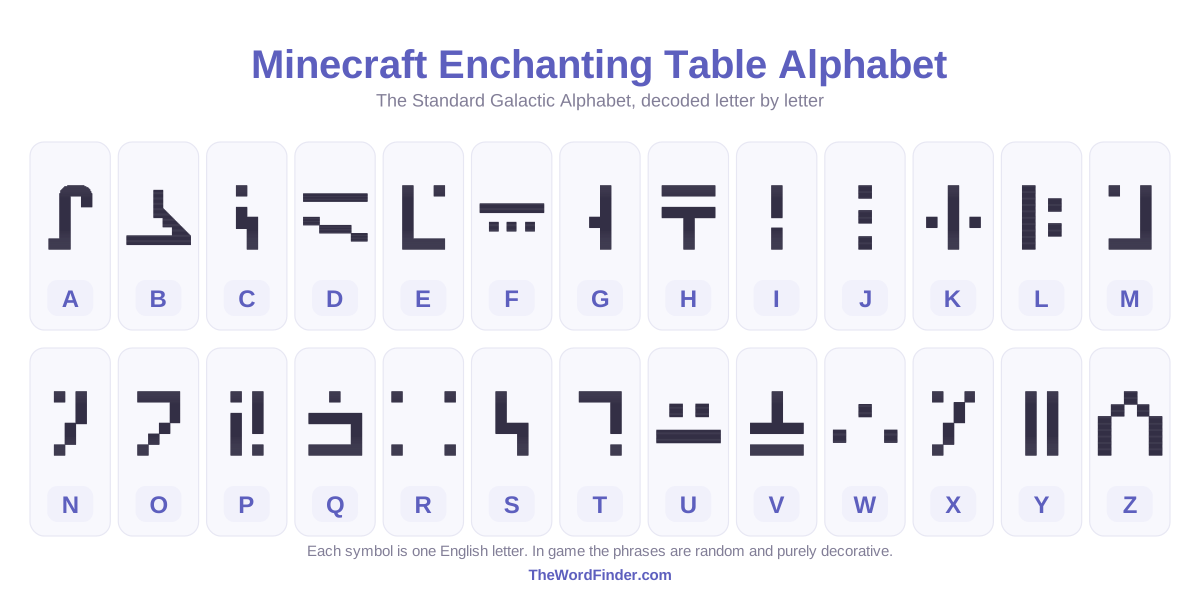
| English | SGA Glyph |
|---|---|
| A | A |
| B | B |
| C | C |
| D | D |
| E | E |
| F | F |
| G | G |
| H | H |
| I | I |
| J | J |
| K | K |
| L | L |
| M | M |
| N | N |
| O | O |
| P | P |
| Q | Q |
| R | R |
| S | S |
| T | T |
| U | U |
| V | V |
| W | W |
| X | X |
| Y | Y |
| Z | Z |
Download the printable enchanting table alphabet chart (PDF): a one-page A-Z reference matching the Standard Galactic Alphabet, free to print for classrooms, escape rooms, and Minecraft nights.
What the Enchanting Table Actually Says
Here is the question almost every player asks: once you decode it, the enchanting table text is gibberish. That is by design. The words shown while you enchant are picked at random from a fixed list and have nothing to do with the enchantment you are about to receive. They are pure decoration.
Some of the phrases are in-jokes. A large share of them are lifted from the opening incantation of H.P. Lovecraft's short story "The Call of Cthulhu" ("Ph'nglui mglw'nafh Cthulhu R'lyeh wgah'nagl fhtagn"), alongside nods to other games. So if you decode your enchanting table and get gibberish, you decoded it correctly. The symbols are real letters; the message just was never meant to mean anything.
History
The Standard Galactic Alphabet was created by id Software designer Tom Hall for the 1990 platformer Commander Keen: Invasion of the Vorticons, where it appeared on in-game signs as hidden messages for players to decode. Hall started by tweaking ordinary "Exit" sign lettering to look alien, then built it out into a full 26-letter alphabet across the series.
Minecraft brought the alphabet to a far larger audience. When enchanting arrived in 2011, Mojang used the Standard Galactic Alphabet as the font for the floating text on the enchanting table, and a new generation met the same symbols Commander Keen fans had been decoding two decades earlier. The cipher has since become a fixture of Minecraft fan culture, classroom code lessons, and puzzle design. For more fictional alphabets to decode, try our Klingon translator, and for the wider family of letter-for-symbol codes, browse the full Cipher & Encoding Tools hub.
Frequently Asked Questions
It is not a language at all. The enchanting-table text is written in the Standard Galactic Alphabet, a symbol-for-letter cipher of plain English. Each glyph stands for one English letter, so it can be read straight off with a chart.
Type English into the translator above to see it in enchanting-table symbols, or tap the on-screen glyph keyboard to enter the symbols you see in your game and read them back in English. The full A-to-Z mapping is in the letter chart.
It is a constructed alphabet created by Tom Hall for the Commander Keen video game series, beginning in 1990. It maps each of the 26 English letters to a unique symbol, and Minecraft later adopted it for the enchanting table.
Yes, once decoded. The phrases are chosen at random from a preset list and are purely cosmetic. Many are drawn from the incantation in H.P. Lovecraft's "The Call of Cthulhu". If your decode comes out as nonsense, you did it right.
No. The words floating above the enchanting table are decorative and randomly selected. They give no hint about which enchantment you will get, so there is nothing to gain from translating them in-game beyond curiosity.
There is no difference. "Enchanting table language" is what Minecraft players call it, and "Standard Galactic Alphabet" is its real name from Commander Keen. They are the same set of symbols and translate identically.
Yes. Because it is a simple substitution alphabet, it works anywhere you want a fun, readable code: classroom activities, escape rooms, party invitations, or puzzle hunts. Our Activity Room teacher tools and sibling Bill Cipher and Pigpen tools pair well with it.
Yes. Download our free printable enchanting table alphabet chart (PDF), a one-page A-to-Z Standard Galactic Alphabet reference. Free to use in classrooms, Minecraft clubs, and at home. Download the PDF.