Cryptogram Solver
Letter Mappings
(0/26)For each encrypted letter, enter the letter you think it represents. Click the lock icon to lock in known mappings (these will be respected by the auto-solver).
Cipher Text
Enter encrypted text above to see letter frequencies.
Standard English
| Letter | % | Distribution |
|---|---|---|
| E | 12.7% | |
| T | 9.06% | |
| A | 8.17% | |
| O | 7.51% | |
| I | 6.97% | |
| N | 6.75% | |
| S | 6.33% | |
| H | 6.09% | |
| R | 5.99% | |
| D | 4.25% | |
| L | 4.03% | |
| C | 2.78% | |
| U | 2.76% | |
| M | 2.41% | |
| W | 2.36% | |
| F | 2.23% | |
| G | 2.02% | |
| Y | 1.97% | |
| P | 1.93% | |
| B | 1.49% | |
| V | 0.98% | |
| K | 0.77% | |
| J | 0.15% | |
| X | 0.15% | |
| Q | 0.1% | |
| Z | 0.07% |
A cryptogram is a short message encoded with a monoalphabetic substitution cipher where every letter in the plaintext is consistently replaced by a different letter throughout the message. To decode a cryptogram, you need to work out which ciphertext letter stands for which plaintext letter. There's no shift, no key, and no shared password, just an arbitrary letter-for-letter mapping that's the same throughout the message.
Cryptograms are also called cryptoquotes, cryptoquips, or substitution cipher puzzles depending on the context.
This tool decodes cryptograms two ways: paste your ciphertext and use the Solve button for an instant best guess, or work the puzzle letter-by-letter using the substitution table with frequency analysis hints. Word boundaries must be preserved (cryptoquips, in the National Puzzlers' League terminology, also called aristocrats).
How the Cryptogram Solver Works
This tool offers two complementary ways to decode a cryptogram. You can use either, or both together.
Auto-solve
Paste your ciphertext into the input field and click Solve. The solver uses statistical letter-frequency analysis combined with English-word dictionary matching to propose the most likely plaintext. It returns up to ten candidate solutions, ranked by confidence. The most likely solution will be shown first, with alternatives below in case the top guess isn't quite right. Auto-solve handles most standard cryptograms accurately, but it isn't perfect. For tricky ciphers or unusual vocabularies, the manual mode below is more reliable.
Manual mode
Below the input field, a 26-letter substitution table lets you map ciphertext letters to plaintext letters one at a time. As you type plaintext letters into the table, the decrypted text updates in real time. Alongside the table, a frequency analysis panel shows you how often each ciphertext letter appears in the message, alongside the standard frequencies of letters in English text, so you can spot likely E's, T's, and A's at a glance.
How to Solve a Cryptogram Manually
Solving cryptograms by hand is a small art — it's the cryptanalytic core of cryptography taught in introductory courses, and a fun puzzle in its own right. Here are the techniques that crack the vast majority of standard cryptograms.
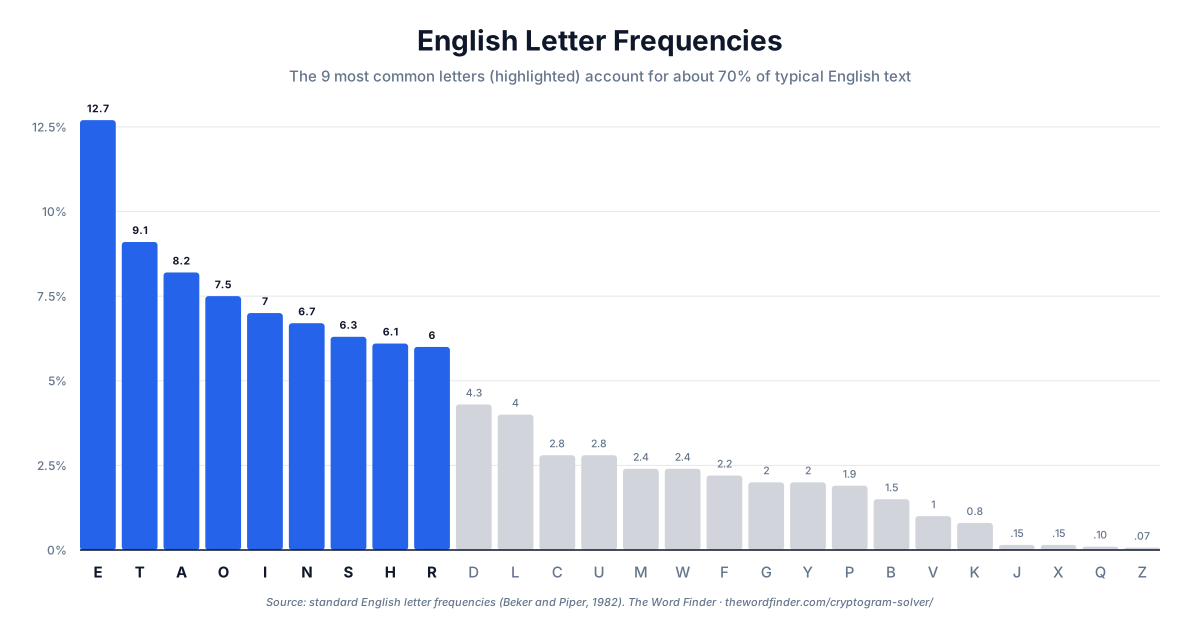
Standard English letter frequencies — E dominates at 12.7%, followed by T, A, O, I, and N. In any sufficiently long substitution cipher, the most common ciphertext letter is overwhelmingly likely to stand for E.
Use letter frequency to find E, T, and A first
English letters appear in roughly predictable frequencies. The most common letters, in order, are E (12.7%), T (9.1%), A (8.2%), O (7.5%), I (7.0%), N (6.7%), S (6.3%), H (6.1%), and R (6.0%). Together these nine letters account for about 70% of typical English text. If a particular ciphertext letter appears far more often than the others in your message, it's almost certainly standing in for E. The next most common is almost always T or A. For a deeper academic treatment of letter frequency, Practical Cryptography's frequency analysis guide is the standard reference.
Look for single-letter words
In English, the only one-letter words are A and I. If your cryptogram contains a single-letter word, it's one of those two. Combine this with the frequency analysis above and you can usually pin down both A and I within seconds.
Watch for double letters
Doubled letters in English are uncommon enough that any doubled ciphertext letter dramatically narrows the possibilities. The most common doubled letters are LL, EE, SS, OO, TT, FF, RR, NN, PP, and CC. If your ciphertext contains, say, "WWRRTT," you're looking at three doubled-letter pairs, which is very rare, but useful for narrowing down which letters they might represent.
Use apostrophe patterns
Apostrophes in English mostly appear in contractions, and the patterns are highly constrained. The most useful patterns:
X'Tis almost always N'T (don't, won't, can't, isn't, …)X'Sis almost always 'S (it's, that's, what's, …)X'LLis almost always 'LL (we'll, they'll, you'll, …)X'VEis almost always 'VE (we've, you've, they've, I've)X'Mis almost always I'M
One contraction in your ciphertext can often unlock four or five letters at once.
Spot common short words
The most common short English words have very distinctive patterns: THE (3 letters, the most common 3-letter word by a wide margin), AND (3 letters), OF (2 letters), TO (2 letters), IN (2 letters), IS (2 letters), IT (2 letters), YOU (3 letters), THAT (4 letters, with the double-T pattern), WAS (3 letters), ARE (3 letters), FOR (3 letters), WITH (4 letters). If you see a 3-letter word that appears many times in the ciphertext, it's almost certainly THE.
Work the substitution table iteratively
As you identify letter mappings, type them into the substitution table above. Each correct mapping reveals partial words in the ciphertext, which usually suggest more mappings ("T_E" is almost certainly "THE"; "T_AT" is almost certainly "THAT"; "_OU" is almost certainly "YOU"). With practice, you can solve most cryptograms in a few minutes by hand without ever using the auto-solver.

Cryptogram puzzles make great party activities — kids can work together to crack the code using frequency analysis, pattern matching, and a bit of teamwork.
What Is a Cryptogram?
A cryptogram is a short text encoded with a substitution cipher and presented as a puzzle for the reader to decode. Each letter in the original message has been consistently replaced by a different letter (the same substitution applied throughout) and the puzzle is to work out which letter stands for which. Punctuation is usually preserved, and word boundaries are preserved in the standard cryptogram form (called a cryptoquip or aristocrat, depending on the source).
Cryptograms emerged as a popular puzzle form in the 1890s, when American "penny press" newspapers and magazines began running them as daily features. Their popularity owes a meaningful debt to Edgar Allan Poe, whose 1843 short story The Gold-Bug turned on the solving of a substitution cipher and almost single-handedly popularised cipher cryptanalysis as a recreational pursuit. Poe also wrote a non-fiction essay, A Few Words on Secret Writing (1841), that walked through the techniques.
Today, cryptograms appear daily in newspapers (the syndicated Cryptoquote by Tribune Content Agency, the Cryptoquip by King Features Syndicate), in puzzle books, in escape rooms, and in alternate-reality games. The National Puzzlers' League, the foremost cryptogram community organisation, founded in 1883, maintains formal categorisations of the various cryptogram forms (aristocrats, patristocrats, xenocrypts, and so on) and runs an active community of cryptogram constructors and solvers.
Cryptograms in Famous Puzzles and History
Substitution-cipher puzzles have a long and well-documented history beyond the daily newspaper page.
Edgar Allan Poe's 1839 cryptography challenge
In Alexander's Weekly Messenger, Poe famously challenged his readers to send him substitution ciphers, promising to solve any they could devise. He solved them all, a feat that made him one of the most famous figures in 19th-century popular cryptography. His essay A Few Words on Secret Writing and his short story The Gold-Bug together established the genre.
The Beale Ciphers (1885)
Three encrypted documents purportedly leading to a buried Virginia treasure worth tens of millions in modern terms. One of the three ciphers was decoded using a key based on the U.S. Declaration of Independence, but the other two have resisted cryptanalysis for over 130 years. Whether they're genuine, a hoax, or a flawed cipher that simply can't be solved is still debated.
The Voynich Manuscript
A 15th-century illustrated codex written in an unknown script that no one has ever decoded. Various theories have proposed it as a substitution cipher, a polyalphabetic cipher, an artificial language, or an elaborate hoax, but after more than 600 years no one has produced a verified translation.
The Zodiac Killer's Z408 and Z340
In 1969, the American serial killer known as the Zodiac Killer sent four encrypted messages to Bay Area newspapers. The first cipher, Z408, was solved within a week by amateur cryptographers Donald and Bettye Harden. The second major cipher, Z340, resisted cryptanalysis for 51 years until a team led by David Oranchak cracked it in December 2020. The FBI maintains an archive of the original ciphers.
Frequently Asked Questions
A cryptogram is a short text encoded with a monoalphabetic substitution cipher. Each letter of the original message has been consistently replaced by a different letter throughout. The puzzle is to work out which ciphertext letter stands for which plaintext letter. Cryptograms are also called cryptoquotes, cryptoquips, or substitution cipher puzzles depending on the context.
The tool offers two modes. Auto-solve uses statistical letter-frequency analysis combined with English-word dictionary matching to propose the most likely plaintext, returning up to ten candidate solutions ranked by confidence. Manual mode gives you a 26-letter substitution table where you map ciphertext letters to plaintext letters one at a time, with a frequency analysis panel showing you how often each ciphertext letter appears in the message.
The main techniques: identify the most common ciphertext letter (almost certainly E), look for single-letter words (A or I), watch for doubled letters (LL, EE, SS, OO, TT are most common), exploit apostrophe patterns (X'T is almost always N'T, X'S is almost always 'S), and spot common short words (THE is by far the most common 3-letter word). See the How to Solve a Cryptogram Manually section above for the full step-by-step approach, including the standard English letter-frequency table.
An aristocrat is the National Puzzlers' League name for a substitution-cipher puzzle in which word boundaries are preserved. This is exactly the type of puzzle this tool solves. The aristocrat designation has been used by the NPL since the late 19th century, and the same puzzle is sometimes called a cryptoquip (King Features) or a cryptoquote (Tribune) in syndicated newspaper contexts. The opposite is a patristocrat, in which word boundaries are removed (all letters run together). Patristocrats are harder to solve because word-pattern techniques don't apply, and they're not currently supported by this tool.
Frequency analysis is the cryptanalytic technique of using letter-frequency statistics to identify the substitution mapping. English text has predictable letter frequencies. E appears in about 12.7% of typical text, followed by T (9.1%), A (8.2%), O (7.5%), I (7.0%), and N (6.7%). In any sufficiently long substitution-cipher ciphertext, the most common letter is overwhelmingly likely to map to E. The tool's frequency analysis panel shows you the per-letter frequencies in your ciphertext alongside these reference values, so you can identify the likely mappings at a glance. For a deeper academic treatment, Practical Cryptography's frequency analysis guide covers the underlying statistics in detail.
Not currently. This tool supports cryptograms with word boundaries preserved (cryptoquips, aristocrats), but not patristocrats, where all the letters run together with no spaces. Patristocrats are harder to solve because word-pattern techniques (single-letter words, common short words like THE, double letters at known positions) don't apply. You have to rely on frequency analysis and bigram/trigram statistics alone.
The substitution this tool solves is monoalphabetic. Each letter is consistently mapped to one other letter, with no shift or key. The Caesar Cipher is a special case of this, in which the substitution is a fixed shift of the alphabet (a shift of 3 turns A→D, B→E, …). Pasting Caesar ciphertext into this tool will work because the solver will discover the shift. But for any Caesar-specific work, the dedicated Caesar Cipher Solver is faster and includes a shift slider and an auto-decode mode that tries all 25 shifts at once. For other classical substitution ciphers in the same family, see the Atbash Cipher (a fixed alphabet reversal), the Pigpen Cipher (substitution into geometric symbols rather than letters), and the Vigenère Cipher. Though Vigenère is polyalphabetic (different shifts for different positions) and won't be solved by this tool, which only handles monoalphabetic substitutions.
If you're looking for daily cryptogram puzzles rather than a solver, several sources are worth a look. The National Puzzlers' League has run cryptogram puzzles continuously since 1883 and is the canonical community organisation. Online puzzle sites including Razzle Puzzles and Cryptograms.org offer daily puzzles with difficulty levels and saved progress. This tool is intentionally a solver rather than a puzzle platform.
Printable cryptogram puzzles are widely available. The National Puzzlers' League publishes downloadable puzzle books, and most of the syndicated daily-puzzle sites offer printable versions. This tool focuses on solving rather than generating puzzles, but if you'd like to create your own cryptograms, our Cryptogram Maker will let you encode any plaintext message into a custom cryptogram suitable for printing.
Substitution-cipher puzzles as a recreational form trace back to at least the 19th century, with Edgar Allan Poe's 1839 Alexander's Weekly Messenger cryptography challenges and his 1843 short story The Gold-Bug establishing the genre in the English-speaking world. The underlying substitution-cipher technique is far older, for example the Atbash Cipher, documented in the Hebrew Bible over 2,500 years ago, and the Caesar Cipher, used by Julius Caesar in the 1st century BCE. For a comprehensive history of pre-modern cryptography, David Kahn's The Codebreakers (1967) remains the standard reference.