Morse Code Alphabet — Chart & Audio
Morse code is a method of encoding text as short and long signals known as dots ("dits") and dashes ("dahs"). The complete reference is below: every letter from A to Z, the numerals 0 through 9, all standard punctuation, the operator prosigns (including SOS), and the ITU-recognised accented letters.
Letters (A–Z)
Numbers (0–9)
Cut Numbers
Punctuation
Prosigns
Accent Letters
What is Morse code?
Morse code is a character-encoding system that represents letters, numbers, and punctuation as sequences of short and long signals. The short signals are called dots (or "dits") and the long signals are dashes (or "dahs"). The standard length ratio is 1:3 — a dash is three times the length of a dot — and the gap between elements within a letter is one dit, between letters is three dits, between words is seven dits. It was invented in the 1830s by Samuel Morse and Alfred Vail.
The version used worldwide today is International Morse code, standardised by the International Telecommunication Union (ITU) in 1865 and refined into the current ITU-R M.1677-1 standard. It replaced the older American (or "Railroad") Morse code that Samuel Morse and Alfred Vail developed in the 1830s for telegraph wires. Every chart on this page uses the International standard.
How Morse code timing works
Timing in Morse code is measured in time units, and every element has a fixed length relative to that unit:
- A dot (·) is 1 time unit
- A dash (−) is 3 time units
- The gap between elements inside a letter is 1 time unit
- The gap between letters is 3 time units
- The gap between words is 7 time units
Speed is measured in words per minute (WPM) using the standard reference word PARIS, which is 50 time units long. At 5 WPM, a dot lasts 240 milliseconds. At 20 WPM, a dot is 60 milliseconds. At 40 WPM, a dot is 30 milliseconds.
The Farnsworth method speeds up the elements (the dots and dashes) to a target speed but keeps wider spacing between characters and words — so beginners can recognise full-speed letters with more time to react in between. It is commonly used alongside the Koch method in Morse-code trainers.
SOS — the most famous Morse code signal
SOS — · · · − − − · · · — is the most famous Morse code sequence in the world. Three dits, three dahs, three dits, transmitted as one continuous signal with no pauses between the S–O–S letters. The lack of letter spacing makes the nine-element distress signal instantly distinguishable from any other sequence.
SOS was adopted as the international distress signal at the 1906 International Radiotelegraph Convention and came into formal use on 1 July 1908. It replaced an earlier Marconi-company distress call, CQD. The choice of SOS was practical, not semantic. The letters were picked for their distinctive Morse pattern, not because they stand for "Save Our Souls" or "Save Our Ship" (those are later folk etymologies).
The signal earned global recognition in 1912 when the RMS Titanic, after striking an iceberg, transmitted both CQD and SOS, making it one of the first major sea disasters to use the newer code. Today SOS remains internationally recognised as the universal distress signal, though formal use in maritime communication has largely been replaced by the digital Global Maritime Distress and Safety System (GMDSS).
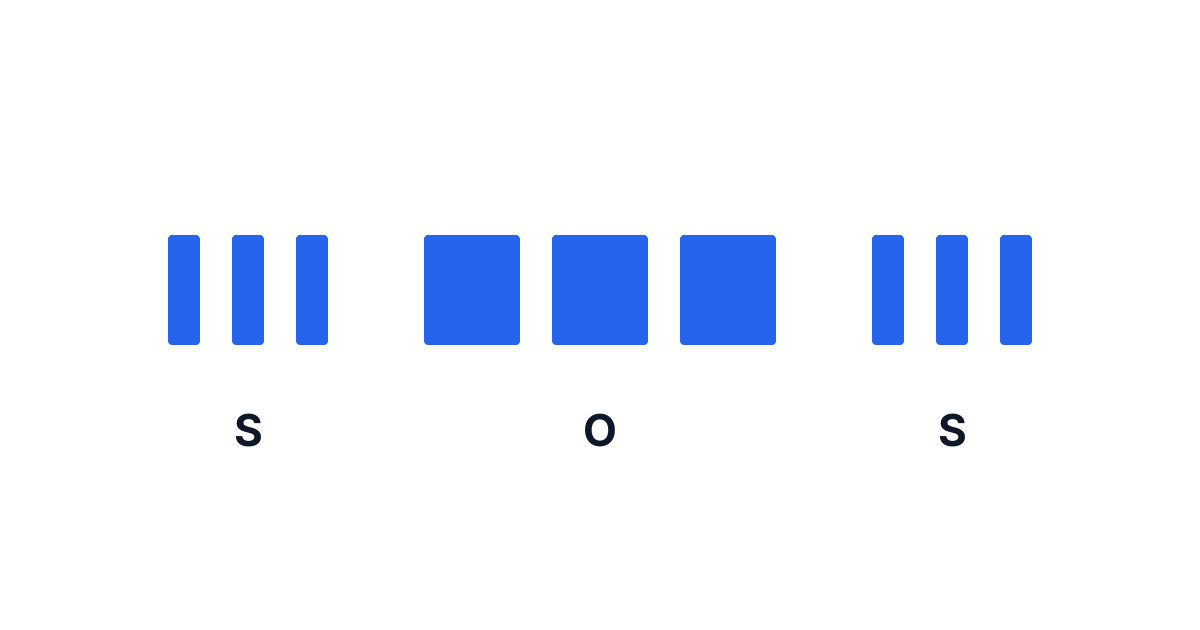
SOS in Morse code — three dits (S), three dahs (O), three dits (S) — transmitted as one continuous signal with no letter spacing, making it instantly recognisable as a distress call.
How to learn Morse code: the Koch and Farnsworth methods
The fastest path to Morse fluency is to learn by sound, not by sight. Reading dits and dahs from a chart is fine for recognising the alphabet, but it builds a translation step in your head. You hear "···" and consciously think "S as in Sister", and that puts a hard ceiling on your speed. Serious Morse learners skip the translation step from day one using one of two standard methods.
Koch method. Developed by the German psychologist Ludwig Koch in 1936, the Koch method introduces just two characters at full target speed (typically 18–20 WPM) and only adds a new character when the learner reaches 90% recognition accuracy. Because every character is heard at full speed from the start, the learner never builds the habit of "counting dits" — pattern recognition trains directly. It's the standard approach for ham radio operators and military signallers. For free Koch-method practice, LCWO (Learn CW Online) is the most widely used online trainer; G4FON's Koch Method Morse Trainer is the desktop standard.
Farnsworth method. Named after the American ham radio operator Russ Farnsworth, the Farnsworth method plays characters at full target speed but widens the spacing between characters and words. A common configuration is 18 WPM character speed at 5 WPM effective overall — you hear "fast letters with extra breathing room in between" rather than "slow letters." Beginners get used to the sound of fast individual characters before having to keep up with fast text. The ARRL's guide to learning Morse code covers Farnsworth setups in detail.
The two methods are often combined: most modern Morse trainers (including LCWO above) use Koch character selection with Farnsworth timing.
How long does it take? With 15–30 minutes of daily practice, most learners reach basic reading proficiency at 5 WPM in 4–8 weeks. Fluent ham-radio-level reception at 20+ WPM typically takes 6–12 months of consistent practice. Plateaus at 7–10 WPM are common; the standard advice is to keep practising at target speed rather than dropping back to slower characters.
Where Morse code is still used today
Morse code is no longer required for civilian aviation or maritime communication (the requirement was dropped from US merchant marine certification in 1999 and from the FCC's amateur radio licence in 2007). But it remains in active use in several specific niches:
- Amateur radio (ham radio). Continuous wave (CW) transmission using Morse code cuts through atmospheric interference better than voice, especially over long distances and with low-power equipment.
- Military and intelligence. Several militaries retain Morse-trained operators as a fallback when digital communications fail or can be intercepted.
- Aviation navigation. Many navigation beacons (VOR, NDB) still identify themselves in Morse code as a backup verification.
- Assistive technology. Users with limited motor function use Morse code as an input method, mapping a single switch or eye-blink input to dits and dahs.
- Distress signals. SOS remains a globally recognised emergency code, taught in scouting, emergency preparedness, and survival training.
Convert text to Morse code
Want to translate a message rather than reference the alphabet? Use our Morse Code Translator. Type any text and get the encoded Morse output with audio playback, or paste Morse code and get the decoded text. The translator uses the same International Morse standard as the charts on this page.
Frequently Asked Questions
Morse code is a method of encoding text characters as sequences of short signals (dots, or "dits") and long signals (dashes, or "dahs"). It was developed by Samuel Morse and Alfred Vail in the 1830s for use on telegraph lines. The International Morse code used today, standardised by the ITU, assigns a unique dot-dash pattern to every letter, number, and punctuation mark.
SOS in Morse code is "··· −−− ···" — three short dots, three long dashes, three short dots. It is transmitted as a single continuous nine-element sequence with no pauses between the S, O, and S letters, making it instantly distinguishable from ordinary text. SOS was adopted as the international distress signal in 1906 and came into formal use on 1 July 1908.
For basic letter recognition at 5 words per minute, most learners reach reading proficiency in 4–8 weeks of consistent daily practice (15–30 minutes per day). Ham radio operators aiming for fluent transmission and reception at 20+ WPM typically take 6–12 months. The Koch method, which teaches characters at full target speed from day one, is widely regarded as the most efficient learning approach.
Yes, in several niches. Amateur radio (ham radio) operators still use Morse code in continuous wave (CW) transmission, which cuts through interference better than voice. Some military and aviation systems retain Morse capability as a fallback. Aviation navigation beacons identify themselves in Morse. Assistive technology uses Morse code as an input method for users with limited motor function. And the SOS signal remains internationally recognised.
American (or "Railroad") Morse code was developed by Samuel Morse and Alfred Vail in the 1830s for telegraph lines. International Morse code, standardised in 1865 and refined into the current ITU-R M.1677-1 standard, replaced it for global radio and telegraphy use. International Morse uses simpler, more regular dot-dash patterns. Every chart on this page (and virtually every Morse resource online) uses the International standard.
A dot (·) represents a short signal — typically one time unit. A dash (−) represents a long signal of three time units. The gap between elements inside a single letter is one unit; the gap between letters is three units; the gap between words is seven units. Time unit length depends on transmission speed: at 20 words per minute, a dot is roughly 60 milliseconds.
The mnemonics method assigns each letter a memorable English word whose syllabic pattern mirrors its Morse code. The letter A (·−) becomes "Allow" — one short syllable, one long. The letter B (−···) becomes "Boisterous" — long-short-short-short. There are various different mnemonic methods. Other proven learning methods include the Koch method and the Farnsworth method.