
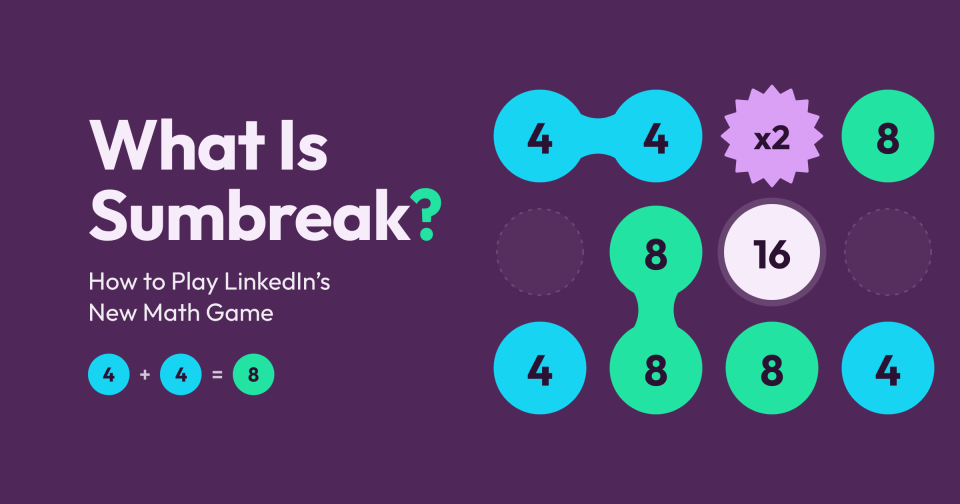
Sumbreak is the new LinkedIn game that launched on 18 November 2026 as a free daily math and logic puzzle. You merge identical numbers until only one tile remains. The Sumbreak game asks you to combine matching neighbours on a fixed board each day until a single number is left.
We played puzzle #1 on launch morning. This guide covers the full rules, a move-by-move walk-through of that puzzle, the trap that can leave matching numbers stranded on a diagonal, and practical tips drawn from solving the board ourselves.
Sumbreak is LinkedIn’s daily math and logic game
LinkedIn describes Sumbreak as a free daily math and logic puzzle in which you merge identical numbers until only one tile remains. The game went live at midnight Pacific time on 18 November 2026, a day late. The day before, LinkedIn’s Sumbreak page posted “Our timing didn’t quite add up”, explaining that the game was taking a little longer than planned. Early the next morning the same page replied “It took sumtime” and confirmed the game was out.
You can play the Sumbreak LinkedIn game at linkedin.com/games/sumbreak in a browser or inside the LinkedIn app. The Sumbreak game is free. In a browser you do not need to sign in; the results screen offers a sign-in only if you want to start a streak and save recent activity to your account. New puzzles drop daily, and the reset moment matches the rest of LinkedIn Games: midnight Pacific, which is 8am in the UK.
Sumbreak is the ninth title in LinkedIn Games and the first new LinkedIn game since Wend arrived in June 2026. It is also the first LinkedIn numbers game in the suite.
How to play Sumbreak, step by step
Here’s how to play Sumbreak: you merge matching numbers that sit next to each other until one number remains. LinkedIn’s own How to play panel puts it in two sentences: “Drag to combine matching neighbor cells. Repeat until one cell remains.”
- The board on puzzle #1 is a 3 by 3 grid of nine numbered circles. Circles grow larger as their numbers increase.
- Drag a circle onto another circle that shows the same number and sits directly above, below, left or right of it. The two merge into their sum on the circle you drop onto.
- The spot you dragged from becomes an empty dot. Nothing slides in to fill the gap.
- Diagonal neighbours do not count. Dropping one circle onto a matching number that touches only at a corner does nothing.
- If the numbers do not match, the game displays “Numbers must be identical” with a ≠ sign between the circles and the merge fails.
- Keep merging until a single number is left on the board.
A timer runs at the top of the screen. Undo reverses your last merge. Hint outlines one pair of matching neighbours. When no merges remain, the game tells you no more merges are possible, marks the empty spots with crosses, and replaces Undo and Hint with two buttons: “Last good move”, which restores the board to the state just before the move that stranded you, and “Reset game”. The results screen records your time under “Solved in” and offers a Copy score button.
Puzzle #1 takes eight merges to solve
Spoiler: the section below walks through puzzle #1 move by move. Skip ahead to the tips if you still want to solve today’s board yourself.
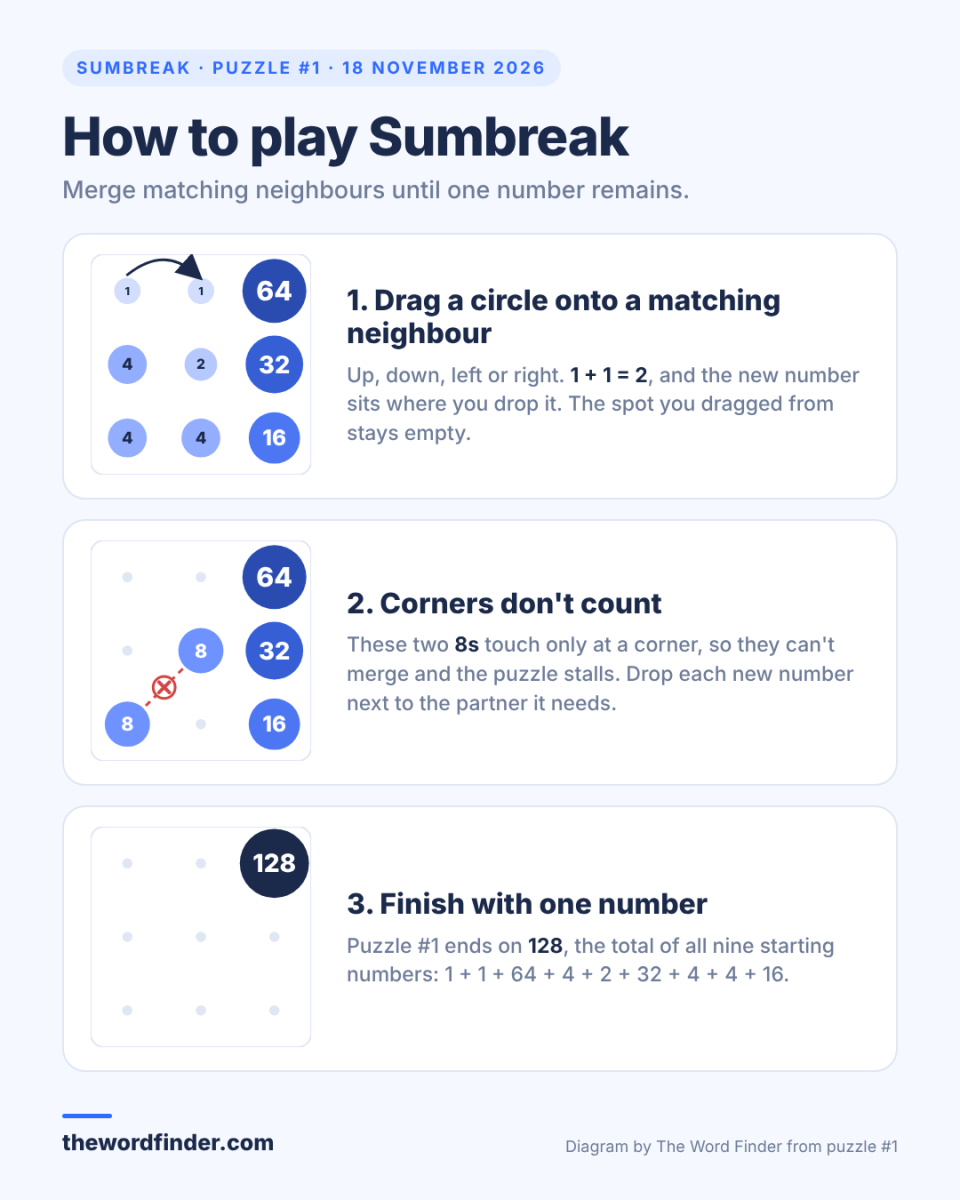
We played puzzle #1 on launch day. The starting board, reading left to right and top to bottom, was:
Row 1: 1, 1, 64
Row 2: 4, 2, 32
Row 3: 4, 4, 16
A clean solution needs exactly eight merges. Each step drags the first circle onto the second; the sum lands on the second circle:
- The 1 in row 1, column 1 onto the 1 beside it → 2.
- That 2 down onto the 2 in the middle of the board → 4.
- The 4 in row 2, column 1 onto the middle 4 → 8.
- The 4 in row 3, column 1 onto the 4 beside it in column 2 → 8.
- The middle 8 down onto that new 8 → 16, now in row 3, column 2.
- That 16 onto the 16 in the bottom-right corner → 32.
- That 32 up onto the 32 above it → 64.
- That 64 up onto the 64 in the top-right corner → 128.
The board finishes with a single number: 128. That figure is the exact total of every starting number (1 + 1 + 64 + 4 + 2 + 32 + 4 + 4 + 16). Because every merge simply adds two numbers, the final tile on a board of plain numbers always equals the starting sum.
We also hit the trap. At the equivalent of move 4 we dragged the bottom-middle 4 left onto the bottom-left 4 instead. The new 8 landed in row 3, column 1 and touched the other 8 only at a corner. No legal merges remained. The game displayed its “No more merges” message. “Last good move” returned the board to the position just before that merge, so we could continue without a full reset.
We solved puzzle #1 in 1:05 on our first attempt. A second run that deliberately included a hint, a wrong drop and the dead-end position took 1:28. Puzzle #1 is gentle. It has nine circles and needs eight merges, and the only real decision is where the 4s and 8s land.
Tips for solving Sumbreak faster
Five habits from our play of puzzle #1 make the board clearer and reduce the chance of stranding matching numbers.
- Add up the board before you start. On a board of plain numbers the final tile equals the starting total, so you already know the number you are building.
- Find the ladder. On puzzle #1 the right-hand column already held 64, 32 and 16; the practical job was to create a second 16 next to the existing 16 and climb the column.
- Drop towards the next partner. The merged number stays where you drop it, so place it beside the number it still needs to meet.
- Check the diagonals. Two matching numbers that touch only at a corner cannot merge; that is exactly how the board can become stuck.
- Use Hint before you are stuck and Last good move once you are. Neither option restarts the puzzle.
How Sumbreak compares with 2048 and Mini Sudoku
Sumbreak shares the basic merge-and-add idea with 2048, the sliding-tile puzzle Gabriele Cirulli released in March 2014. In both games matching numbers combine into their sum. The differences are sharper. In Sumbreak you move only one circle at a time, nothing slides, no new numbers appear after a move, every player receives the same fixed board each day, and the goal is simply to finish with a single number.
Mini Sudoku, by contrast, uses digits without any arithmetic. You fill a small grid so that each row, column and shaded region contains every required digit exactly once. That is the distinction Thomas Snyder, LinkedIn’s Principal Puzzlemaster, drew in early November: Sudoku uses numbers but no arithmetic.
| Game | Board | What you do | Arithmetic | Where to play |
|---|---|---|---|---|
| Sumbreak | 3 by 3 grid on puzzle #1 | Drag matching neighbours together until one number is left | Yes, every merge adds two numbers | LinkedIn, daily |
| 2048 | 4 by 4 grid | Slide all the tiles so matching numbers merge, while new tiles appear | Yes | Free online and in apps |
| Mini Sudoku | A small Sudoku grid | Place digits so none repeats in a row, column or region | No | LinkedIn, daily |
Why Sumbreak is a LinkedIn numbers game
Thomas Snyder told Beebom in early November that LinkedIn’s next game would probably be another logic title and that it would get players thinking about how numbers combine. GamesBeat reported in March that LinkedIn had deliberately shifted towards logic puzzles that players can solve without knowing English, because word games are hard to adapt across 20, 30 or 40 languages and most players live outside the United States. Numbers need no translation, so a LinkedIn numbers game works for players whatever language they speak, and Sumbreak fills the arithmetic gap Snyder described.
Sumbreak is the only LinkedIn math game in a lineup that now runs to nine: three word games, five logic puzzles and one numbers game.
| Game | Type | LinkedIn’s tagline | Puzzle number on 18 November 2026 |
|---|---|---|---|
| Pinpoint | Word | Guess the category | #932 |
| Crossclimb | Word | Unlock a trivia ladder | #932 |
| Wend | Word | Weave through words | #163 |
| Queens | Logic | Crown each region | #932 |
| Tango | Logic | Harmonize the grid | #772 |
| Zip | Logic | Complete the path | #611 |
| Mini Sudoku | Logic | The classic game, made mini | #464 |
| Patches | Logic | Piece it together | #246 |
| Sumbreak | Numbers | Merge identical numbers | #1 |
Our guide to how LinkedIn’s other games work covers the rest of the lineup, and our piece on Wend, the word game LinkedIn added in June, covers the launch before this one.
Where to find a Sumbreak hint when you’re stuck
If a board leaves you with no obvious merge, our Sumbreak hints page supplies a gentle prompt that gives away as little as possible. The LinkedIn Games hub gathers the other eight titles in one place.
Frequently Asked Questions
What is Sumbreak on LinkedIn?
Sumbreak is LinkedIn’s free daily math and logic puzzle that launched on 18 November 2026. It is the ninth LinkedIn game. The objective is to merge matching numbers until only one number remains.
How do you play Sumbreak?
Here’s how to play Sumbreak: drag a numbered circle onto a matching circle directly above, below, left or right of it, and the two merge into their sum. Circles that touch only at a corner can’t merge, and numbers that don’t match won’t combine. The puzzle is solved when one number remains.
Where can I play Sumbreak?
You can play Sumbreak on the web at linkedin.com/games/sumbreak or in the LinkedIn app. It’s free, and in a browser you can play without signing in. Signing in lets you keep a streak and saves your most recent result to your LinkedIn account.
Is Sumbreak a new LinkedIn game?
Yes. Sumbreak launched at midnight Pacific time on 18 November 2026 with puzzle #1, a day later than LinkedIn had planned. It is the first new LinkedIn game since Wend arrived in June 2026.
What time does a new Sumbreak puzzle come out?
LinkedIn says new Sumbreak puzzles drop daily. The game launched at midnight Pacific time, which is 8am in the UK, the same moment LinkedIn’s other games reset each day.
Is Sumbreak free to play?
Yes, the Sumbreak game is free. You can play in a browser without a LinkedIn account, and signing in adds a daily streak.
Can you get stuck in Sumbreak?
Yes. If no matching neighbours are left, the game tells you no more merges are possible and marks the empty spots. Last good move rewinds the board to just before the merge that stalled it, and Reset game starts the puzzle again.

