Survey Reveals: The Accents People Want Their AI Assistant to Speak With
By Praveen L | Last edited March 23rd, 2026
The technology powering AI is improving all the time. Chatbots can undertake numerous tasks, but there is one aspect of them that still feels oddly incomplete: the voice.
Right now, chatbots such as ChatGPT only offer around 9 or 10 voice options, typically with slightly different tones. But if people could pick any accent at all, which one in particular would they want to hear coming back at them?
To explore this, we surveyed just over 3,000 AI users across the country.
Our goal was not only to establish which accents people prefer, but also to establish which ones are considered the most trustworthy, intelligent, or reassuring when a machine is doing the talking.
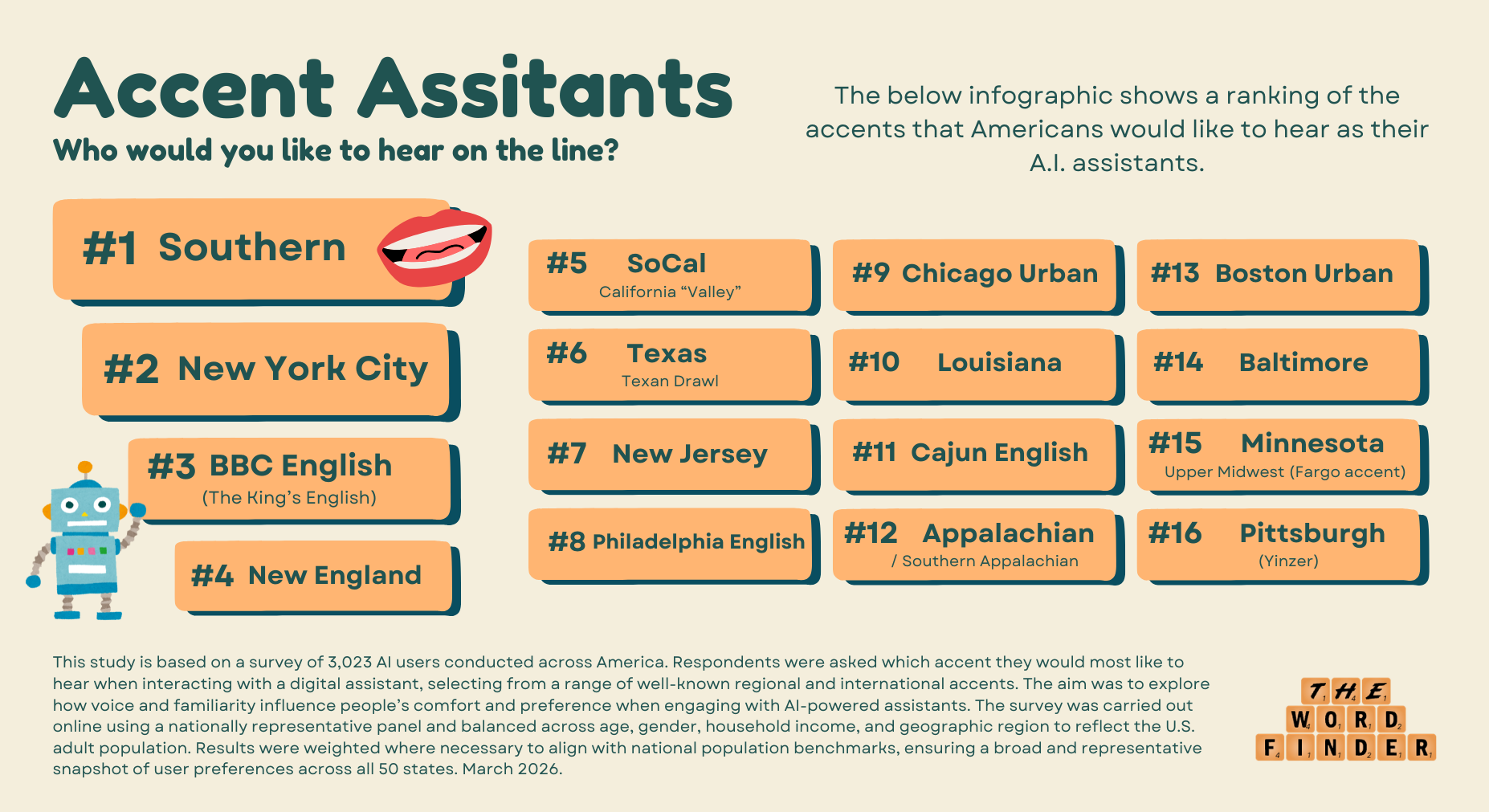
The accents Americans would most like to hear from their AI assistants
Key Findings
Warm voices tend to inspire the most trust
One of the most interesting patterns in the data was how strongly people associate trust with certain accents. Southern voices stood out from the rest as the ones they would trust the most.
The explanation is quite straightforward: the Southern accent is known for its sense of warmth and friendliness, and that tone can make instructions or advice feel more approachable.
New York City accents were the next most trusted. That may seem surprising at first, but the New York style of speech has its own kind of authority. It's fast, direct, and confident - which can translate well when you're asking a system for answers.
BBC English also performed strongly. Most Americans have enjoyed decades of documentaries and news broadcasts, which have built a strong credibility. If someone such as David Attenborough is speaking back at you, you tend to assume it knows what they're talking about.
British accents still dominate when intelligence is the question
When respondents were asked which accent would make an AI assistant sound the smartest, one voice clearly stood above the rest: BBC English.
More than one in five respondents (22%) chose it. No other accent came close.
A few American accents did follow behind, though at a distance. Minnesota's Fargo voices came next, with 11% saying they sounded the most intelligent. The Baltimore accent followed at 9%.
When money is involved, people prefer neutral voices
The answers shifted a little when respondents were asked about more serious tasks, like financial advice.
Here, the clear favorite was the Midwestern accent – indeed, around 20% of respondents said that's the voice they would feel most comfortable hearing when discussing something important.
New York City and BBC English were tied behind it at 12% each.
That pattern suggests people are looking for something steady and predictable when the stakes are higher. It is notable that the NYC accent, hailing from the world's top financial center, emerged in the top 3.
Most people don't want their AI constantly changing accents
Given how customizable technology has become, you might expect people to want their AI assistants to switch voices depending on the situation. However, an overwhelming 73% said they would prefer one consistent accent.
Americans enjoy a surprisingly wide range of accents
The survey also revealed just how many different accents people would enjoy hearing from AI assistants.
Some were obvious choices. Others were much more regional. The full list included voices like:
- Southern
- New York City
- BBC English (The King's English)
- New England
- SoCal / California Valley
- Texas drawl
- New Jersey
- Philadelphia English
- Chicago Urban
- Louisiana
- Cajun English
- Appalachian
- Boston Urban
- Baltimore
- Minnesota / Upper Midwest
- Pittsburgh ("Yinzer")
It's a reminder that accents do more than shape how words sound. They carry personality. They hint at identity. And they subtly influence how we interpret what someone is saying.
Even when that "someone" happens to be an algorithm.
Final Thoughts
The rise of AI is usually framed as a story about algorithms, data, and computing power. But this survey highlights something much more human.
The voice matters.
People don't just evaluate the information they receive – they also react to the way it's delivered. Certain accents sound friendly. Others sound authoritative. Some simply feel entertaining.
As AI assistants become more common in everyday life, developers may discover that voice customization isn't just a cosmetic feature. It's part of how users build trust with the technology.
In the end, the future of AI may not just be about how smart these systems become.
It may also depend on how they sound when they talk to us.
Methodology
This study is based on a survey of 3,023 AI users conducted across America. Respondents were asked which accent they would most like to hear when interacting with a digital assistant, selecting from a range of well-known regional and international accents. The aim was to explore how voice and familiarity influence people’s comfort and preference when engaging with AI-powered assistants. The survey was carried out online using a nationally representative panel and balanced across age, gender, household income, and geographic region to reflect the U.S. adult population. Results were weighted where necessary to align with national population benchmarks, ensuring a broad and representative snapshot of user preferences across all 50 states. March 2026.
Anagram Challenge
OGOGOKEL
Hint: A popular virtual assistant
Find the answer with our anagram solver
From Accent Marks to AI Voices
The word accent is a neat little linguistic double act. In one sense, it refers to the marks we place on letters—those small but meaningful symbols that can change how a word is read or understood. In another, it describes the way people speak—the rhythm, tone, and pronunciation shaped by place and identity. Same word, two distinct meanings: a classic example of a homonym.
Explore the world of diacritics and accent marks with our accent letter copy tool!